
 +8657486688117
 400-616-0305

ALT: B2B engineer reviewing food waste disposer samples during OEM trial order validation checkpoint process
Why Sample Validation Checkpoints Determine OEM Success or Costly Rework
A procurement manager receives the first production samples from a new food waste disposer supplier. The units look right on the surface — correct branding, correct color, correct packaging insert. But two weeks into internal testing, a grinding assembly fails under sustained load, and the electrical labeling does not align with the destination market's certification standard. By that point, the brand has already committed to a larger trial order.
This scenario is not a rare exception. In our work with clients across different global markets, it is one of the most consistent patterns we see: problems that surface after a trial order is placed almost always have their roots in validation gaps that occurred during the sample review phase. The five critical checkpoints covered in this article exist precisely to close those gaps — systematically and early, before sunk costs accumulate.
Sample validation and trial orders represent the hinge point between promising supplier discussions and a scalable manufacturing relationship. Get the checkpoints right, and you compress the time to market while protecting your brand. Miss them, and the rework cycle that follows can cost far more than any initial savings in unit price or tooling fees.
The Current Landscape of OEM Food Waste Disposer Procurement and Why Validation Pressure Is Rising
OEM food waste disposer procurement is a process by which a brand or distributor contracts a specialized manufacturer to produce disposer units built to the buyer's specifications, labeling, and standards — with the buyer owning the finished product's commercial identity. The global food waste disposer market has expanded significantly as urban kitchen renovation trends, food waste regulation, and consumer environmental awareness converge across North America, Europe, Australia, and rapidly growing Southeast Asian markets.
This growth brings a corresponding rise in procurement complexity. Buyers today are sourcing not just standard batch-feed or continuous-feed models but increasingly differentiated products: brushed motor units for cost-sensitive retail channels, brushless motor disposers for premium positioning, and smart variable-frequency models that integrate with IoT-connected kitchen systems. Each technology profile carries its own validation requirements, and a checkpoint process designed for one motor type may be wholly inadequate for another.
Per guidance from the International Electrotechnical Commission (IEC), electrical household appliances must meet specific performance and safety standards before reaching end consumers — standards that vary in their local implementation from market to market. Regulatory alignment is therefore not a single event but an ongoing verification discipline. For OEM buyers, this means that trial orders must be treated as structured validation exercises, not merely as the first shipment of product.
At EACHER — a professional food waste disposer manufacturer operating under Ningbo Yiju Environmental Technology Co., Ltd. with an annual production capacity of 300,000 units — engineering teams routinely guide international clients through structured pre-production and sample review protocols. The patterns that lead to smooth launches versus delayed ones are well understood internally, and they consistently trace back to whether these five checkpoints were executed with rigor. For a broader view of how the full manufacturing relationship unfolds, the complete OEM partnership process from requirements to mass production provides essential structural context.
The Five Checkpoints: Root Causes, Mechanisms, and What Each Is Really Testing
Checkpoint One: Specification Conformance Verification
Specification conformance verification is the process of comparing received samples against the formally agreed product specification document — not against verbal descriptions, marketing summaries, or catalog photographs. This distinction matters because the gap between a buyer's internal understanding of a specification and what the supplier's engineering team actually built is consistently the largest source of first-sample failures.
When reviewing a food waste disposer sample against its specification, verification should cover motor type and rated performance envelope, grinding chamber geometry, material grades for internal components, connection fittings and installation interface dimensions, and surface finishing standards. Each element should be cross-referenced against a specification sheet that both parties signed before tooling began. Where a discrepancy exists — even a minor one in finish texture or connection fitting tolerance — it must be formally logged and resolved before the trial order is placed. A deviation accepted informally at the sample stage becomes an engineering standard for mass production unless corrected in writing.
Checkpoint Two: Functional and Durability Performance Testing
Functional performance testing during sample validation is designed to answer one question: does this unit perform reliably across its intended use envelope, not just in a single demonstration run? Food waste disposers, particularly those incorporating brushless motor technology or smart variable-frequency drive systems, operate across a range of load conditions. A single-pass demonstration with soft food waste tells a buyer almost nothing about how the unit will behave under real household conditions.
Structured functional testing at the sample stage should include sustained operation under representative load cycles, motor temperature behavior over time, jam recovery performance, noise output under load, and vibration characteristics at the installation interface. For variable-frequency models, the control response across different operating modes deserves particular attention. Understanding how disposers are validated in a pre-production testing environment gives buyers a clearer picture of what a rigorous protocol actually covers. Buyers who skip or abbreviate this checkpoint often discover durability issues only after consumer returns begin — a far more expensive correction point.
Checkpoint Three: Regulatory and Certification Alignment
Regulatory and certification alignment means confirming, at the sample stage, that the physical product as built will support the certifications required for the target market — not simply that the manufacturer holds relevant certificates for a generic model. This is a checkpoint that buyers frequently underestimate, especially when sourcing from a manufacturer who is already certified for one market and is now producing for another.
Certification requirements for food waste disposers vary meaningfully across destination markets. The CE marking framework governs European market entry and encompasses low-voltage directive compliance and electromagnetic compatibility. Markets including Australia and New Zealand operate under their own electrical safety and performance standards. North American markets reference UL and CSA standards. According to IEC standards bodies, the applicable standard for household electrical appliances can differ in both test method and pass criteria depending on the regional implementing authority.
At the sample validation stage, buyers should confirm that the sample unit's electrical system — including motor windings, insulation grade, switching components, and labeling — is aligned with the target market's implementing standard. Voltage and frequency compatibility is a particularly consequential variable; a disposer engineered for a 120V/60Hz market will not simply operate on a 230V/50Hz grid. For export-focused buyers, the voltage and electrical compliance considerations for European and Australian markets represent a dedicated area of review at this checkpoint.
Checkpoint Four: Packaging, Labeling, and Branding Integrity Review
Packaging and labeling integrity review is frequently treated as a cosmetic checkpoint — the last item on the list, reviewed briefly before sign-off. This undervaluation is a consistent source of downstream problems. Packaging serves multiple simultaneous functions: it protects the unit during transit, communicates regulatory compliance through required labeling elements, establishes the consumer-facing brand impression, and satisfies import documentation requirements in the destination country.
At the sample stage, the complete retail packaging unit — not just the box graphics — should be evaluated. This includes the insertion and orientation of the unit within the box, cushioning performance for the unit's actual weight and fragility profile, the accuracy and completeness of regulatory labeling (voltage ratings, certification marks, country of origin, disposal symbols), the language and content accuracy of the installation manual, and QR code or barcode functionality if applicable. Branding elements including logo reproduction, color matching, and print registration should be verified against brand standards documentation rather than recalled from memory.
Checkpoint Five: Trial Order Process and Manufacturing Consistency Audit
Manufacturing consistency audit during the trial order phase answers the question that the sample stage cannot: does the manufacturer produce units consistently at volume, or do samples represent a curated best-case result? Trial orders — typically the first limited-quantity production run — are the only pre-mass-production opportunity to observe the manufacturer's actual production process, quality control systems, and inter-unit consistency.
Buyers should treat the trial order as a structured audit, not simply as an early inventory acquisition. This means requesting and reviewing quality control documentation for the trial batch, inspecting a statistically meaningful proportion of units rather than a handful, and comparing trial units against the validated sample for dimensional, functional, and cosmetic consistency. Any systematic variation observed across the trial batch — however small individually — signals a process control issue that will amplify at full production volumes.
Evidence and Multi-Angle Comparison: Approaches to Sample Validation Rigor
Sample validation approaches in OEM food waste disposer procurement span a wide range of rigor levels. The choice of approach carries real consequences for time to market, cost of correction, and manufacturing relationship quality. The following comparison reflects patterns consistently observed across different buyer profiles.
| Perspective / Approach | Strengths | Trade-offs | Best Fit |
|---|---|---|---|
| Abbreviated review (visual check only) | Fastest time to trial order placement; lower upfront resource investment | High exposure to functional and compliance failures discovered post-launch | Buyers with very deep familiarity with the specific manufacturer and product type |
| Structured internal testing protocol | Catches functional and durability issues before trial order; establishes performance baseline | Requires internal testing capability and clear specification documentation | Brands with established product engineering teams and existing test infrastructure |
| Third-party laboratory verification | Independent certification-aligned testing; strongest documentation for regulatory submission | Adds lead time and cost; requires coordination between buyer, manufacturer, and laboratory | Products entering highly regulated markets (EU, North America, Australia) or premium-tier retail |
| Manufacturer-guided validation with buyer oversight | Leverages manufacturer expertise; reduces buyer resource burden; maintains collaborative relationship | Quality of outcome depends on manufacturer's own validation rigor | Buyers working with experienced, transparent OEM partners with documented QC systems |
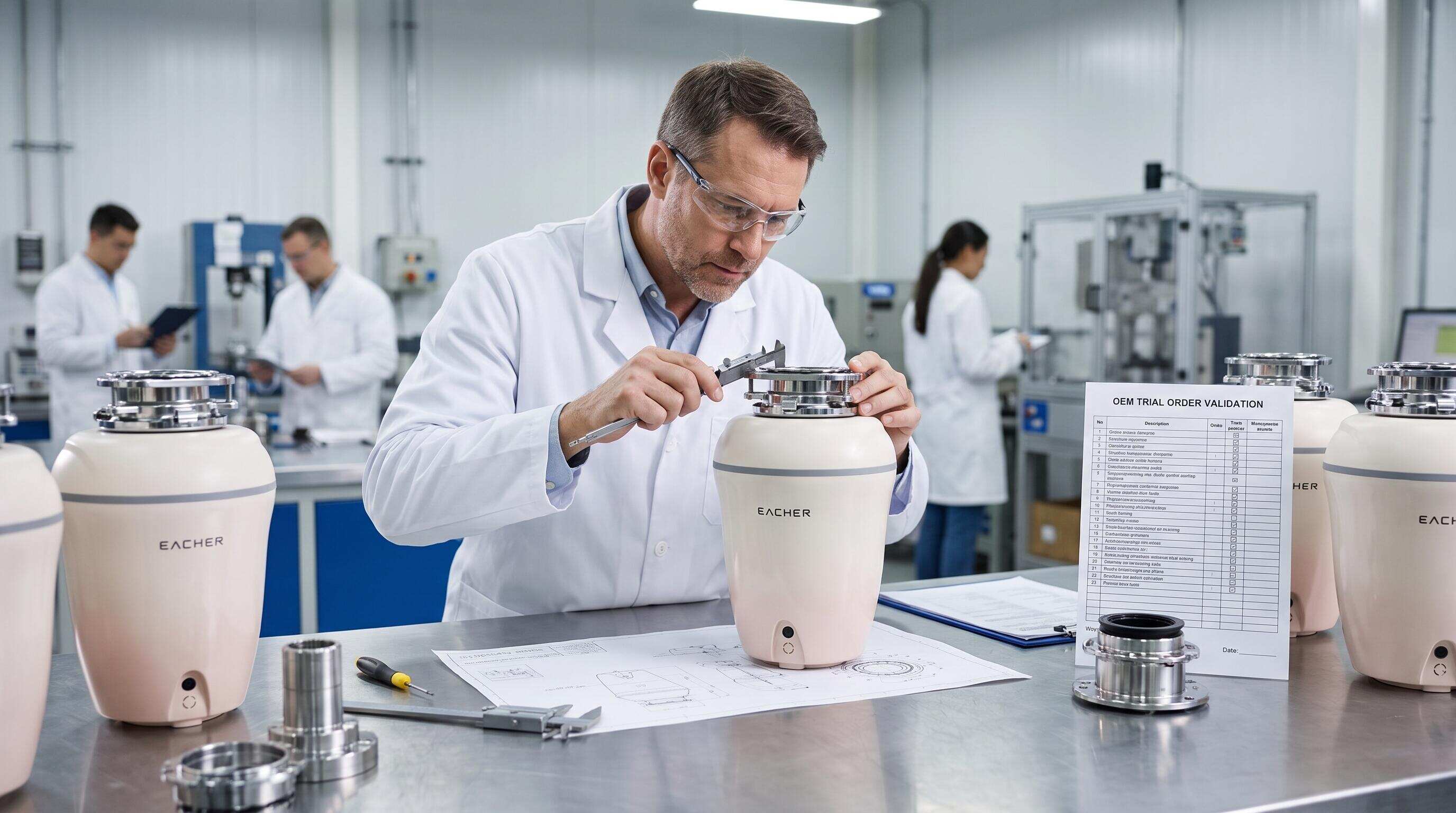
ALT: Quality engineer conducting sample validation checkpoint review of food waste disposer trial unit on OEM production floor
For technology-specific validation, motor type introduces meaningful variation in what each checkpoint emphasizes. Brushed motor models require particular attention to commutator wear indicators during durability testing. Brushless motor designs — which are gaining share in global markets due to their longer service life and efficiency profile — require verification of electronic control unit behavior across load and temperature ranges. Smart variable-frequency models add software behavior and connectivity protocol verification as explicit checkpoint elements. The growing adoption of brushless variable-frequency motors in disposer markets reflects how buyer requirements are evolving — and why validation protocols must evolve in parallel.
Per IEC and relevant regional standards bodies, the responsibilities for ensuring product compliance sit with the party placing the product on the market — in most OEM arrangements, that is the buyer's brand entity. This makes thorough sample validation not merely a quality preference but a regulatory risk management obligation.
Outlook and What These Checkpoints Mean for Your Sourcing Strategy
The direction of OEM food waste disposer procurement is toward greater product differentiation, stricter regulatory scrutiny, and more complex technology profiles. Each of these trends increases the cost of validation failures and raises the value of rigorous checkpoint execution.
Buyers who treat sample validation as a formality will face increasing pressure as markets tighten compliance enforcement and consumers raise return rate sensitivity. Buyers who invest in structured checkpoint protocols — even when it adds two to three weeks to the pre-production timeline — will experience fewer correction cycles, stronger supplier relationships, and more predictable launch schedules.
For procurement managers and product engineers working with an OEM partner for the first time, the practical implication is straightforward: build the five checkpoints into your project timeline as non-negotiable milestones, not as optional reviews that get compressed when schedules slip. Establish written sign-off requirements at each checkpoint before the process advances to the next stage.
For buyers already engaged with an OEM partner, the checkpoints serve a secondary function: they create a shared language and documented baseline that strengthens the working relationship over successive product generations. A manufacturer that supports rigorous sample validation — rather than resisting it — is signaling the kind of operational transparency that makes long-term partnership viable.
The step-by-step guide to starting an OEM food waste disposer project provides a practical framework for integrating these checkpoints into the broader project timeline from initial inquiry through mass production authorization.
Questions & Answers
Q1: How should a buyer formally document sample validation findings to protect their OEM agreement?
Effective documentation of sample validation findings begins with a pre-agreed specification sheet signed by both parties before samples are produced. Each checkpoint review should generate a written report — covering what was tested, the method used, the observed result, and whether the result meets specification — with photographs attached. Discrepancies should be logged in a formal deviation register that specifies required corrective action and the deadline for re-submission. This documentation protects both buyer and manufacturer by creating a clear record of what was agreed, observed, and resolved.
Q2: Are third-party laboratory tests required for OEM food waste disposers entering European markets?
Third-party laboratory testing is not universally mandated for all product categories under EU directives, but it is strongly advisable for food waste disposers entering European markets. The CE marking process requires a conformity assessment, and for products within scope of the Low Voltage Directive and EMC Directive, the technical documentation must demonstrate compliance with applicable harmonized standards. According to IEC, electrical household appliances must meet specific safety and performance criteria. Engaging an accredited testing laboratory at the sample validation stage significantly strengthens the technical file supporting CE marking and reduces regulatory risk.
Q3: How long does a typical sample validation and trial order cycle take for a custom food waste disposer?
The timeline for sample validation and trial order cycles varies based on product complexity, the number of revision cycles required, and destination market certification requirements. In our experience working across different product configurations — from standard brushed motor units to smart variable-frequency models — a single revision cycle from sample submission to approved sign-off typically requires several weeks when all five checkpoints are executed thoroughly. Buyers should plan for at least one revision cycle and build contingency into project timelines accordingly. Compressing the validation phase rarely saves calendar time overall; it typically extends the total timeline by triggering corrections at later, more expensive stages.
Final Thoughts
Sample validation and trial orders are the most consequential phase in any OEM food waste disposer sourcing engagement — not because they are the most complex, but because they are where the gap between expectation and reality is either closed or locked in.
Key Takeaways:
- Specification conformance must be verified against signed documentation, not verbal descriptions or catalog references.
- Functional and durability testing at the sample stage is the only reliable way to detect performance issues before they reach consumers.
- Regulatory and certification alignment is a market-access prerequisite, not a post-production administrative task.
- Packaging and labeling review protects both import compliance and brand integrity simultaneously.
- The trial order is a manufacturing process audit, not just an early inventory purchase — treat it accordingly.
The buyers who consistently achieve smooth product launches are those who protect their sample validation timeline even when commercial pressures push toward acceleration. If you are planning an OEM food waste disposer project and want a manufacturing partner that supports rigorous validation at every stage, the right conversation to have is with a team that has the engineering depth and production scale to match your requirements.
Visit the EACHER website to explore the full range of OEM/ODM food waste disposer capabilities — from brushed and brushless to smart variable-frequency models — request a product catalog, or connect with the engineering team for a personalized consultation on your next project.
Sources & Citations
- International Electrotechnical Commission (IEC). "IEC Standards for Safety of Household and Similar Electrical Appliances."
https://www.iec.ch - International Organization for Standardization (ISO). "ISO Standards for Quality Management and Product Testing."
https://www.iso.org - Underwriters Laboratories (UL). "UL Standards for Safety — Electrical Appliances."
https://www.ul.com
Note: Standards may be updated; please check the latest official documents or consult professional advisors.