
 +8657486688117
 400-616-0305
ALT: Patent development driving food waste disposer product differentiation for OEM manufacturers in global markets
Patent Strategy vs. Copycat Competition: How Continuous IP Development Shapes Disposer Product Differentiation This Year
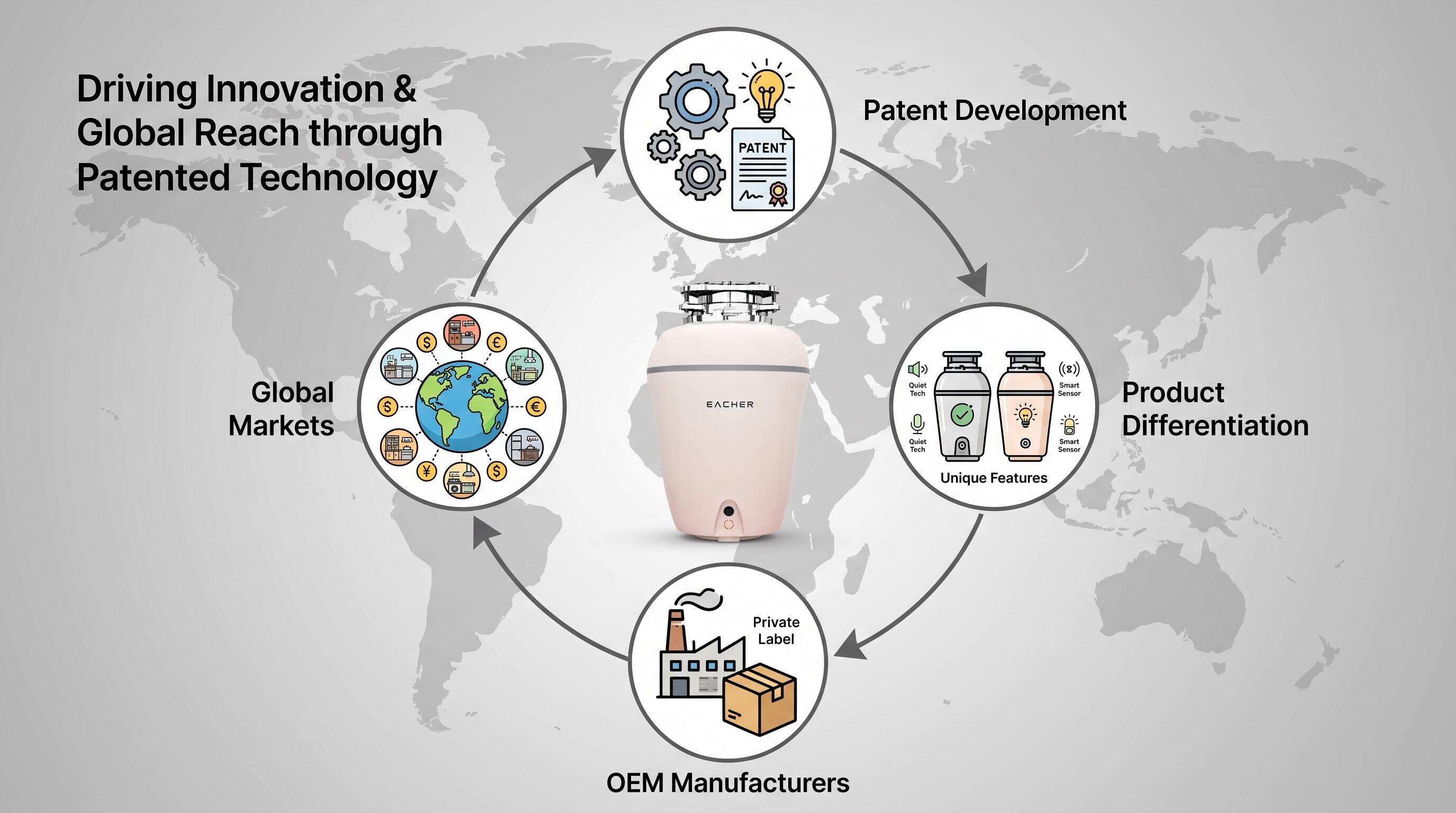
Continuous patent development is one of the most reliable mechanisms a food waste disposer manufacturer can use to create durable product differentiation — and in a market where imitation moves fast, it is increasingly the difference between owning a product category and chasing it. This article compares two strategic postures available to manufacturers and their brand partners: active, ongoing intellectual property (IP) development versus a reactive, spec-matching approach to product design. The criteria used to evaluate these postures include long-term market exclusivity, OEM/ODM customization depth, buyer confidence, compliance readiness, and supply chain resilience.
Why Patent Portfolio Depth Is the Right Lens for Evaluating Disposer Differentiation
The correct framework for assessing disposer product differentiation in today's market is patent portfolio depth, not simply feature lists or price points. A patent — defined here as a government-granted exclusive right that prevents competitors from making, using, or selling a protected invention — gives a manufacturer and its brand partners the legal and commercial space to build unique product identities that cannot be easily replicated. According to analysis published by IPWatchdog, companies that continue building patent portfolios maintain stronger competitive positioning even in crowded commodity markets, because each new patent extends the window of exclusivity and raises the barrier for imitators.
The criteria below define the five dimensions most relevant to B2B buyers — procurement managers, product development leads, and sourcing directors — who are evaluating OEM/ODM partners for food waste disposers.
Long-term market exclusivity: Patents directly protect revenue by preventing competitors from copying a differentiated feature. For distributors and brand owners, this translates into defensible shelf space and margin protection over time.
OEM/ODM customization depth: A manufacturer with active R&D and patent activity can offer genuinely differentiated builds — not just color or label changes — allowing brand partners to bring unique products to market rather than commoditized alternatives.
Buyer confidence and brand trust: Patent-backed products signal engineering investment and quality intent to retail buyers, category managers, and end consumers, strengthening the brand partner's position with downstream customers.
Regulatory and compliance readiness: IP development programs frequently run in parallel with certification work (such as compliance with standards maintained by the International Electrotechnical Commission), ensuring that novel features meet electrical safety, noise, and performance requirements across target markets.
Supply chain resilience: Manufacturers that invest in R&D and IP are generally more vertically capable, giving brand partners access to proprietary components and reducing exposure to single-source commodity supply chains.
The Two Strategic Postures Compared
Active, Continuous Patent Development
Active, continuous patent development is a strategy in which a manufacturer systematically files new patents — and builds on existing ones through continuation and divisional applications — to protect an expanding range of product innovations. A continuation patent is a subsequent application that claims the benefit of an earlier filing while introducing new claims, allowing the original invention's protection to be extended and refined over time. As documented in IP legal practice, continuation and divisional patent strategies are widely used in global jurisdictions to maintain coverage as products evolve, making them a critical tool for manufacturers competing on innovation.
For food waste disposer manufacturers, this approach means that motor efficiency improvements, noise-reduction housing geometries, smart control algorithms, grinding chamber designs, and variable-frequency drive implementations can each generate separate, layered patent protection. The cumulative result is a patent portfolio — a collection of related intellectual property assets — that competitors must design around, rather than simply copy.
EACHER, the OEM/ODM manufacturing brand of Ningbo Yiju Environmental Technology Co., Ltd., operates with this posture as a core part of its product development discipline. In our work with global brand clients, a pattern we consistently see is that partners who engage with our R&D pipeline early — co-developing features that feed into new IP filings — are better positioned to launch products with meaningful differentiation at retail, rather than relying solely on price to compete.
Reactive Spec-Matching Without IP Investment
Reactive spec-matching is the alternative posture, in which a manufacturer (or a brand working with one) simply replicates the feature set of existing market leaders without investing in original R&D or IP. The products that result are functionally similar to what is already available, undifferentiated at the engineering level, and fully exposed to imitation by the next lower-cost entrant.
This approach can appear attractive in the short term because it reduces upfront development cost and accelerates time to market. However, it creates a structural disadvantage: without proprietary features, brand partners cannot defend premium pricing, distributors struggle to justify exclusivity agreements, and retail buyers have little reason to prefer one product over another beyond packaging. In markets where food waste disposers are becoming more widely adopted, the brands that rely on spec-matching find themselves in a price spiral that erodes margin and weakens long-term position.
Head-to-Head Comparison: Patent-Driven Differentiation vs. Spec-Matching
| Criterion | Active Patent Development | Reactive Spec-Matching |
|---|---|---|
| Long-term market exclusivity | High — protected features create durable barriers | Low — features are replicable by any competitor |
| OEM/ODM customization depth | Deep — proprietary motors, controls, housing designs available | Shallow — limited to cosmetic or packaging changes |
| Buyer confidence and brand trust | Strong — patents signal R&D credibility | Weak — no engineering differentiation to communicate |
| Regulatory and compliance readiness | Integrated — new features developed alongside certification work | Variable — compliance added reactively, often at higher cost |
| Supply chain resilience | High — proprietary components reduce commodity dependency | Low — fully exposed to commodity supply volatility |
| Time to initial market entry | Moderate — R&D and filing timelines require planning | Fast — no development cycle required |
| Long-term margin protection | Strong — exclusivity supports premium pricing | Weak — price competition erodes margins over time |
The table above reveals a consistent pattern: active patent development delivers advantages across every commercially significant dimension except initial speed to market. For brand owners and distributors with a multi-year product roadmap, the time-to-market trade-off is almost always worth accepting in exchange for the structural protection that proprietary IP provides.
The most important contrast in the table is the relationship between customization depth and buyer confidence. A manufacturer with an active patent program can offer brand partners features that are genuinely unavailable from competitors — for example, a variable-frequency motor control system designed to reduce power draw during low-load operation, or a noise-dampening housing geometry that measurably outperforms generic alternatives. These are features a brand can communicate in product listings, packaging, and sales materials with confidence, because they are legally protected. Spec-matched products, by contrast, offer no such narrative.
The supply chain dimension deserves particular attention for international buyers. Manufacturers that invest in proprietary component development — including custom motor windings, control boards, and grinding assemblies — are less exposed to the disruptions that affect commodity supply chains. In our experience working with clients across North America and Europe, this resilience is increasingly weighted as a sourcing criterion alongside price and lead time.
Which Approach Should You Choose? Scenario Recommendations
If you are building a brand that will be sold through retail channels in North America or Europe, active patent development with your manufacturing partner is the correct posture. Retail buyers at major chains increasingly require suppliers to demonstrate product uniqueness and compliance credentials. A patent-backed product provides both, and a structured OEM partnership process that integrates R&D, IP filing, and certification from the outset will save significant cost and time compared to retrofitting compliance onto a spec-matched product later.
If you are a distributor entering a new regional market with a private-label product, the depth of your manufacturing partner's patent portfolio is a direct proxy for the quality and uniqueness of what you can offer. A partner with active IP development can provide a product that your regional competitors cannot quickly replicate, giving you time to build brand recognition and distribution relationships before imitation occurs.
If you are a procurement manager sourcing for a retail chain that wants category exclusivity, spec-matching will not serve your objectives. Category exclusivity requires that the product you carry cannot be sourced identically from a competing retailer, and only proprietary engineering — protected by IP — can deliver that guarantee at the manufacturing level.
If you are evaluating partners for a brushless or smart variable-frequency disposer program, the technology complexity of these product types makes patent protection particularly valuable. Brushless variable-frequency motors involve control software, power electronics, and motor geometry that can each generate independent patent claims, creating layered protection that is difficult for competitors to design around completely.
Pros of active patent development for brand partners: durable market exclusivity, deeper customization options, stronger buyer confidence, integrated compliance readiness, and better long-term margin protection.
Cons of active patent development: requires earlier engagement with the manufacturing partner, involves R&D investment and timeline, and demands that brand partners participate meaningfully in the product definition process.
Pros of spec-matching: faster initial time to market, lower upfront development cost.
Cons of spec-matching: no defensible differentiation, margin erosion over time, no protection against imitation, and limited ability to build brand equity on product grounds.
ALT: EACHER OEM/ODM food waste disposer patent development process supporting product differentiation for global brand partners
People Also Ask
Q1: How does continuous patent development specifically support food waste disposer differentiation?
Continuous patent development supports food waste disposer differentiation by protecting unique engineering advances — such as brushless motor designs, variable-frequency control algorithms, and noise-reduction housing geometries — that competitors cannot legally copy. Each new patent or continuation filing extends the period of exclusivity and adds a new layer of protection to the product. According to IPWatchdog, companies that sustain active patent portfolios maintain stronger competitive positioning even in markets where product categories mature, because the cumulative IP creates durable barriers that spec-matching competitors must navigate around.
Q2: Are continuation patents a practical tool for disposer manufacturers seeking ongoing protection?
Continuation patents are a well-established and practical tool for manufacturers who want to maintain protection as their products evolve. A continuation application allows a manufacturer to introduce new claims based on an earlier filing — for example, refining the claims around a motor control feature as the technology matures. As documented in IP legal practice across global jurisdictions, continuation and divisional strategies are standard components of a patent portfolio management program. For food waste disposer manufacturers, this means a single foundational innovation can generate multiple layers of protection across different product generations and market applications.
Q3: How long does it typically take to move from a new patent filing to a differentiated product in production?
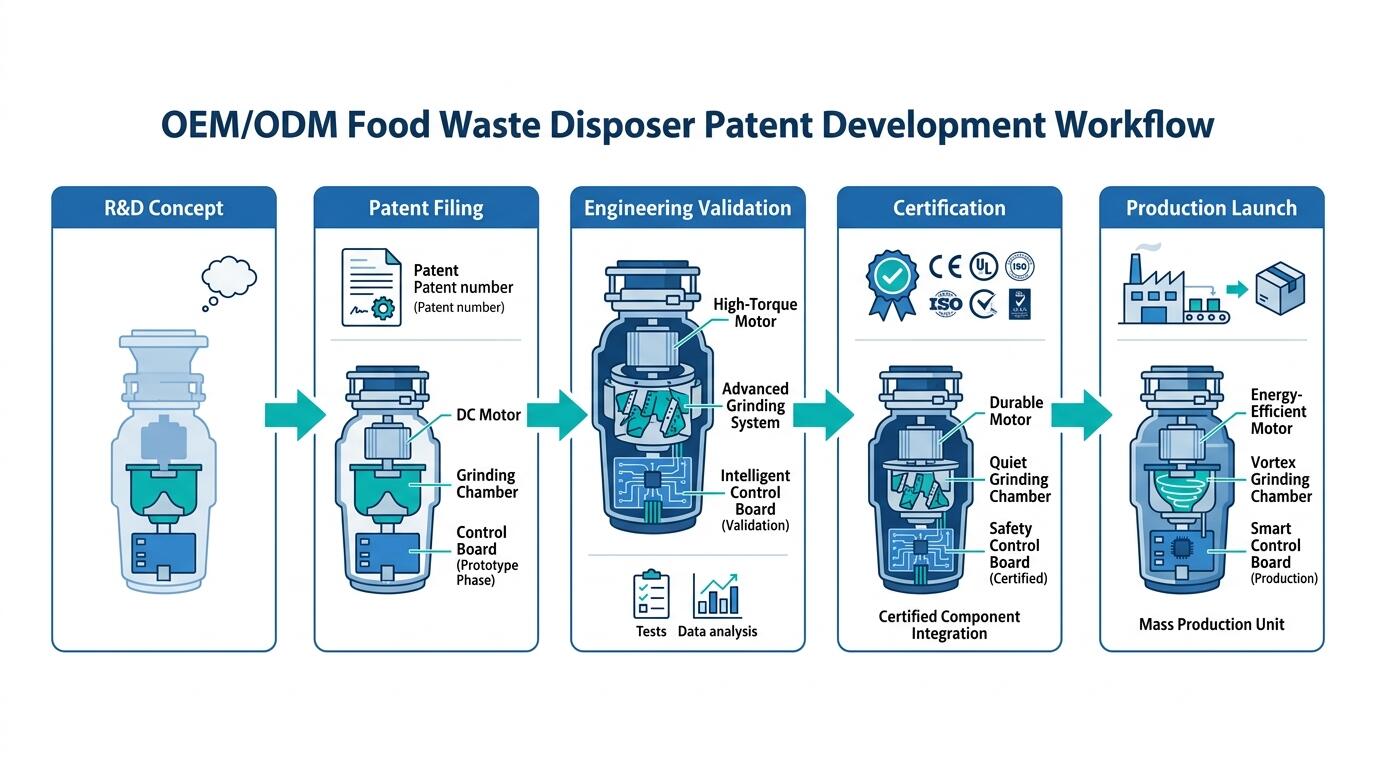
The timeline from initial patent filing to a differentiated product reaching production varies depending on jurisdiction, technology complexity, and the manufacturing partner's R&D infrastructure. In our work with OEM clients, the development cycle for a genuinely differentiated disposer — one with novel motor, control, or grinding system features — typically spans multiple months from concept through engineering validation, patent application, and pre-production testing. Engaging a manufacturing partner early in the process, and aligning IP strategy with the production roadmap from the outset, is the most effective way to manage this timeline and bring the product to market without delays.
The Bottom Line
Continuous patent development is not a legal formality — it is an active competitive strategy that directly determines how much product differentiation a food waste disposer brand can achieve and sustain in the market. Three points define the core value:
First, patents create the only form of product differentiation that competitors cannot legally replicate, giving brand partners a defensible market position that spec-matching simply cannot deliver.
Second, a manufacturing partner with an active R&D and IP program offers OEM/ODM customization at a fundamentally deeper level — covering motor technology, control systems, and housing engineering — rather than limiting brand partners to superficial changes.
Third, the compliance and performance validation work that accompanies patent development integrates naturally with certification requirements for markets in North America, Europe, and beyond, reducing the risk and cost of regulatory approval for international programs. For buyers evaluating suppliers for a new OEM food waste disposer project, the depth of a manufacturer's patent portfolio is one of the most reliable signals of engineering capability and long-term partnership value.
The next step for procurement managers and product development leads is to engage directly with a manufacturing partner who can demonstrate both active IP development and the production scale to support a commercial program — and to begin that conversation early enough to integrate patent strategy into the product development roadmap rather than treating it as an afterthought.
Ready to bring your food waste disposer product to life with a trusted manufacturing partner? EACHER specializes in fully customized OEM/ODM solutions — from brushed and brushless to smart variable-frequency models — backed by an annual production capacity of 300,000 units. Visit the EACHER website today to explore partnership opportunities, request a product catalog, or get a tailored quote for your next project.
Sources & Further Reading
- IPWatchdog. "Why Companies Should Still Build a Patent Portfolio".
https://ipwatchdog.com/2025/03/24/companies-still-build-patent-portfolio/ - VK Law. "Extending Your Patent: Continuation and Divisional Patent Practices & Strategies in Worldwide Jurisdictions".
https://www.vklaw.com/ImagineThatIPLawBlog/extending-your-patent-continuation-and-divisional-patent-practices-strategies-in-worldwide-jurisdictions - World Intellectual Property Organization (WIPO). International Patent Classification and IP Resources.
https://www.wipo.int - International Electrotechnical Commission (IEC). Electrical Safety and Performance Standards for Household Appliances.
https://www.iec.ch - United States Patent and Trademark Office (USPTO). Patent Application and Portfolio Guidance.
https://www.uspto.gov
Note: Standards and patent regulations may be updated; please check the latest official documents or consult professional advisors.