
 +8657486688117
 400-616-0305
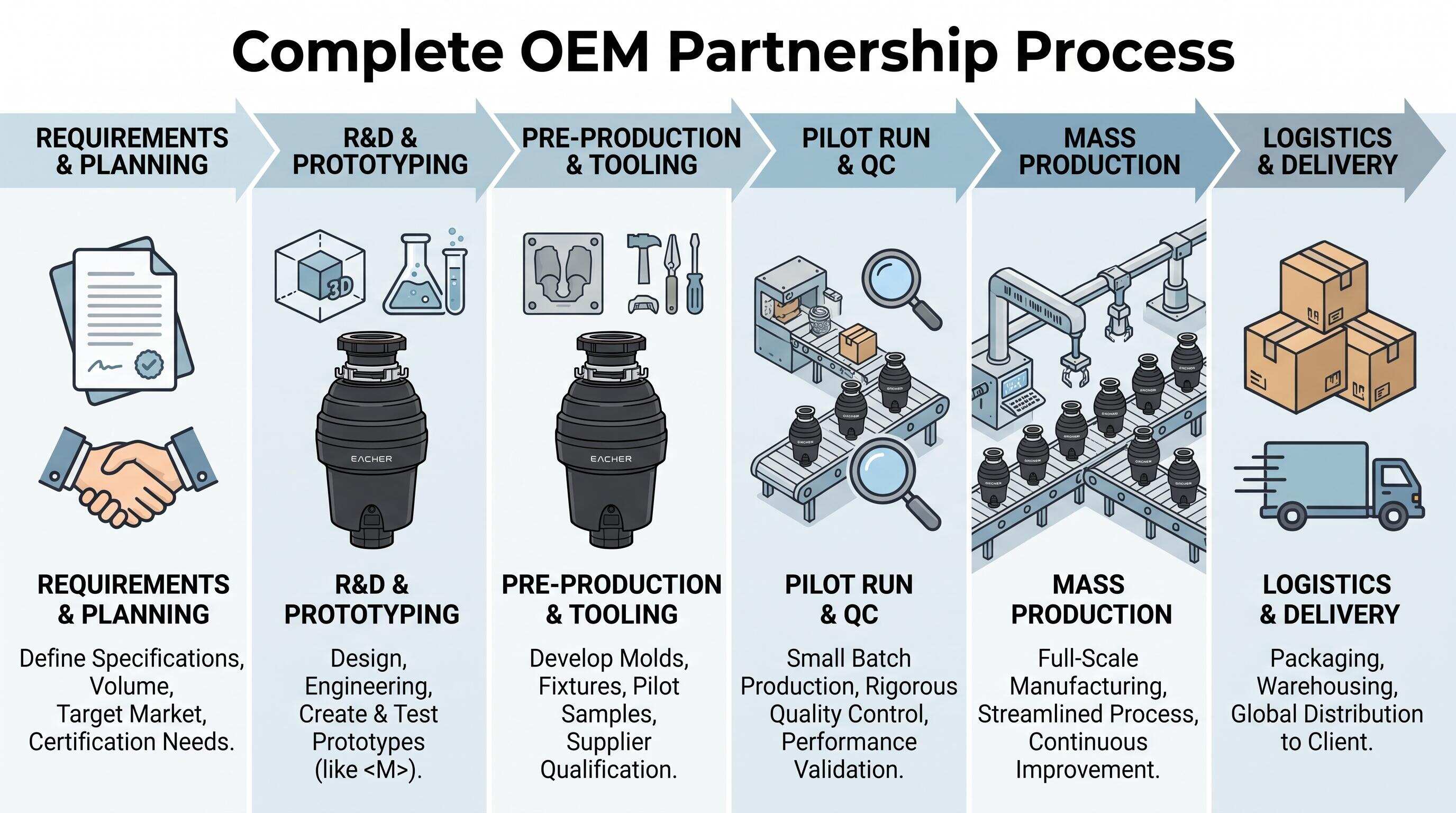
ALT: Complete OEM partnership process for food waste disposers from requirements to mass production
What Does the OEM Partnership Process for Food Waste Disposers Actually Look Like — and Where Do Most Buyers Go Wrong?
The single question most global buyers ask before committing to an OEM food waste disposer project is this: what exactly happens between the moment we share our requirements and the day pallets leave the factory floor? The honest answer is that the process is more structured — and more consequential at each stage — than most first-time buyers expect.
In our work with clients at EACHER, a specialized OEM/ODM manufacturer of food waste disposers under Ningbo Yiju Environmental Technology Co., Ltd., a pattern we consistently see is that buyers who treat the partnership process as a simple transaction routinely face delays, specification mismatches, and cost overruns. Buyers who treat it as a collaborative engineering and compliance exercise — moving stage by stage with clear sign-offs — consistently achieve faster time-to-market and stronger unit economics. This article maps every stage of that process, defines the evaluation criteria that separate strong OEM partners from weak ones, and provides concrete guidance for matching your project profile to the right approach.
Evaluation Criteria: How to Judge an OEM Food Waste Disposer Partner
Selecting the right OEM manufacturer for food waste disposers requires scoring candidates across six dimensions that directly affect product quality, cost-effectiveness, and commercial risk.
Technical range and motor platform depth. A credible manufacturer must offer at minimum three motor technology paths: brushed motor disposers for cost-sensitive, entry-level SKUs; brushless motor disposers for longer-service-life and quieter operation; and smart variable-frequency disposers for premium, connected-home applications. Breadth here is not marketing language — it determines whether a single partner can serve your entire product line as it evolves.
OEM and ODM capability distinction. OEM manufacturing — producing to a buyer's existing design — is fundamentally different from ODM manufacturing, where the factory contributes design and engineering resources. Partners who genuinely do both give buyers more flexibility and lower development cost on new categories.
Production capacity and scalability. Annual rated capacity is a proxy for factory maturity and supply-chain depth. A partner operating at 300,000 units per year has, by necessity, established multi-tier component sourcing, SPC-driven quality control, and logistics infrastructure that a smaller workshop simply cannot replicate.
Regulatory and certification competence. Food waste disposers sold into North America, Europe, or Australia must meet market-specific electrical safety, EMC, and noise standards. The factory's in-house compliance team — not just a broker relationship with a third-party lab — determines how quickly your product navigates certification.
Tooling and customization investment terms. Tooling cost, amortization policy, and minimum order quantity thresholds directly shape your project's break-even point and ROI. Transparent, negotiated tooling terms are a reliable signal of a mature OEM partner.
Communication and project management process. In a cross-border OEM engagement, ambiguity is expensive. Partners who assign a dedicated project engineer, maintain milestone-based documentation, and provide structured sample-approval workflows eliminate the rework cycles that inflate project costs.
The Contenders: Three Approaches to OEM Food Waste Disposer Manufacturing
Turnkey OEM from a Specialized Manufacturer
A turnkey OEM arrangement with a specialist like EACHER means the buyer supplies brand identity, performance specifications, and target market requirements — and the manufacturer owns the entire execution chain. This includes component sourcing, motor assembly (brushed, brushless, or variable-frequency), grinding chamber fabrication, electrical harness integration, noise attenuation treatment, and final QC. The buyer receives finished, branded units ready for retail packaging or distribution. This model delivers the lowest total project-management burden on the buyer and, at scale, the most competitive landed cost per unit.
ODM Design-and-Manufacture Engagement
An ODM engagement begins upstream of manufacturing. Here, the buyer briefs the manufacturer on functional goals, target price point, aesthetic direction, and target certification markets — and the manufacturer's engineering team generates the product design. For buyers launching a first-generation food waste disposer SKU, or repositioning an existing category with a differentiated form factor, ODM is structurally the more capital-efficient path because it avoids the buyer having to maintain an in-house hardware engineering team. EACHER's ODM capability spans all three motor platforms, meaning a buyer can brief for a mid-market brushless unit today and extend the same design language to a smart variable-frequency premium SKU without switching partners.
Hybrid Private-Label with Incremental Customization
A pattern we consistently see among regional kitchen appliance importers is the hybrid approach: start with a manufacturer's existing validated platform, apply brand-specific cosmetic and packaging customization, and introduce functional differentiation in subsequent product generations once sales volume justifies deeper tooling investment. This phased approach minimizes upfront tooling expenditure and allows the buyer to validate market demand before committing to full custom engineering. It is particularly relevant for distributors entering new geographic markets where consumer preferences are still being mapped.
Head-to-Head Comparison: OEM Models for Food Waste Disposer Manufacturing
| Criterion | Turnkey OEM (Buyer Spec) | ODM (Manufacturer Design) | Hybrid Private-Label |
|---|---|---|---|
| Buyer design input required | High | Low to medium | Low |
| Upfront engineering investment | Moderate to high | Low | Minimal |
| Time-to-first-sample | Longer (design-dependent) | Moderate | Shortest |
| Differentiation potential | Highest | High | Moderate |
| Tooling cost exposure | Higher | Shared or factory-borne | Lowest |
| Minimum order flexibility | Consult provider | Consult provider | Consult provider |
| Suitable for first-time OEM buyers | With strong internal spec team | Yes | Yes |
| Motor platform options | Brushed, brushless, variable-frequency | Brushed, brushless, variable-frequency | Existing validated platforms |
| Certification path ownership | Buyer-led, factory-supported | Factory-led | Factory-led |
| ROI timeline | Longer (deeper customization) | Medium | Shortest |
The table reveals a clear trade-off structure. Turnkey OEM delivers maximum product differentiation and IP ownership, but it demands more buyer-side engineering resource and a longer development runway before first shipment. ODM compresses that runway significantly by substituting the manufacturer's existing design capability — a particularly attractive value proposition for buyers whose competitive advantage is commercial distribution rather than hardware engineering.
Hybrid private-label occupies the low-risk entry position. It is the appropriate model when speed-to-market and capital preservation take priority over product uniqueness. A buyer choosing this path is, in effect, paying a premium in competitive differentiation in exchange for a discount in time and tooling cost.
One critical observation from working across all three models: the certification path is where hidden costs accumulate for buyers who do not plan ahead. Per IEC 60335 (the international standard for household and similar electrical appliances, published by the International Electrotechnical Commission), food waste disposers must demonstrate electrical safety compliance before market entry in most regulated jurisdictions. A manufacturer with in-house pre-compliance testing capability — the ability to identify failure modes before formal third-party submission — reduces the number of certification iterations and therefore the direct cost and time lost per cycle.
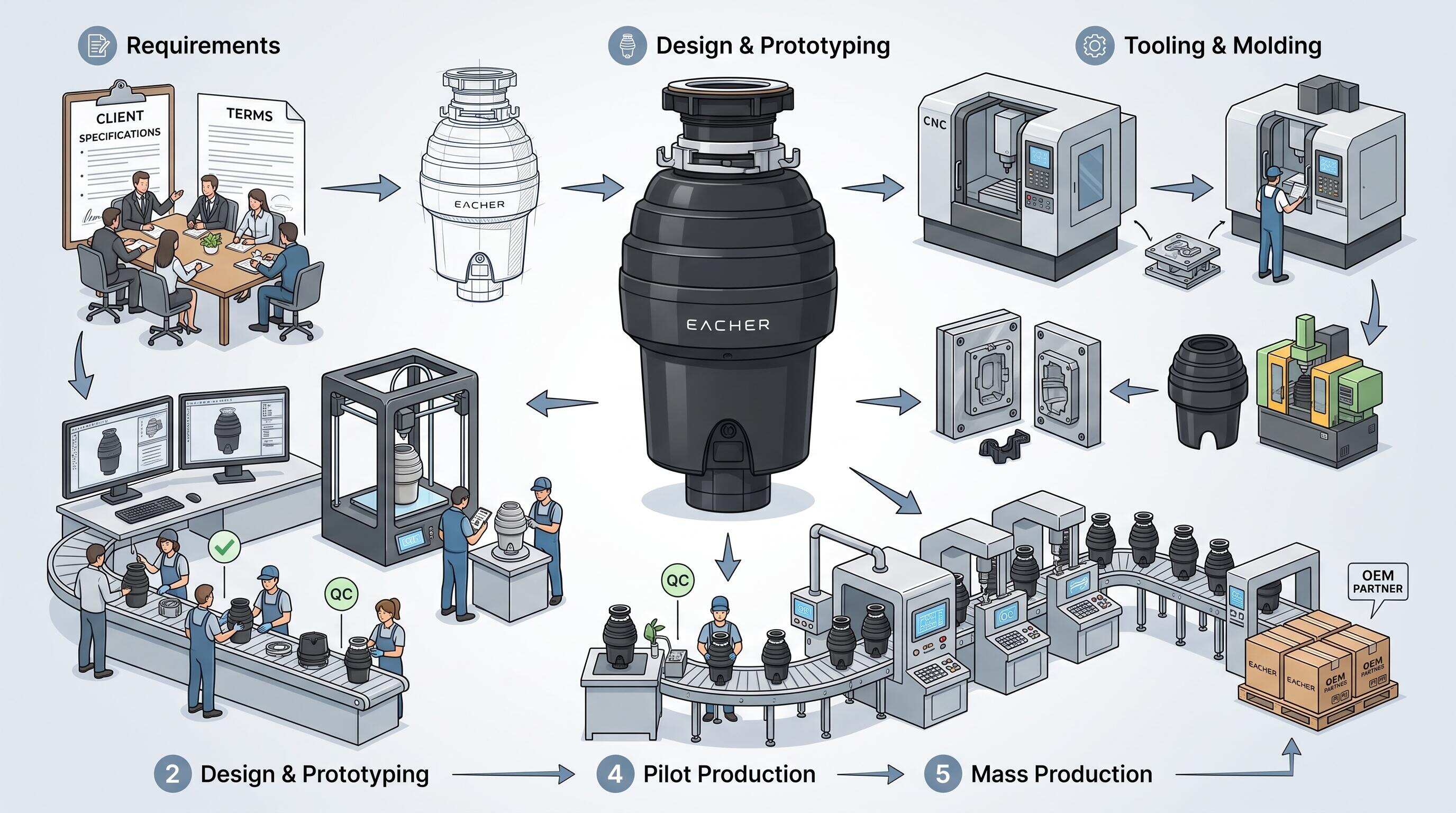
ALT: OEM food waste disposer manufacturing stages including motor selection, tooling, sampling, certification, and mass production line
Which Approach Should You Choose? Scenario-Based Recommendations
If you are a kitchen appliance importer launching a food waste disposer line for the first time, the ODM path is almost always the correct starting point. You minimize upfront capital exposure, leverage the manufacturer's regulatory knowledge for your target market, and retain the option to differentiate in subsequent generations once you have real sales data. The cost-effectiveness argument here is straightforward: you are not paying to develop what already exists.
If you are an established private-label brand owner with existing design assets and a defined specification, turnkey OEM is the natural fit. Bring your engineering brief, your certification target, and your annual volume forecast to the manufacturer. A partner with 300,000 units per year of rated capacity has the supply-chain depth to absorb volume spikes without compromising lead times — which directly protects your working capital cycle.
If you are a regional distributor testing demand in a new market, the hybrid model gives you a validated, manufacturable product with your brand applied, at the lowest possible tooling and development cost. The ROI calculus favors this approach when volume certainty is low: you are not amortizing deep tooling investment across uncertain unit volumes.
If you need multiple SKUs across price tiers, look for a partner who operates across all three motor platforms. A manufacturer who can supply a brushed motor entry unit, a brushless mid-market unit, and a smart variable-frequency premium unit under a single OEM relationship eliminates the vendor fragmentation that increases total quality management cost and complicates consolidated shipping logistics.
The core decision framework comes down to two variables: how much design IP you want to own, and how much time-to-market flexibility you have. These two levers, traded against each other, determine which of the three models delivers the best return on your OEM investment.
As documented in lessons from building long-term OEM partnerships in food waste disposer manufacturing, the buyers who extract the most value from a manufacturing relationship are those who invest in the early-stage alignment process rather than those who compress it in pursuit of speed. This finding aligns with well-established procurement practice: ambiguity resolved at the specification stage costs a fraction of what it costs to resolve in tooling rework or failed certification submissions.
Questions & Answers
Q1: How long does the complete OEM process typically take from initial brief to first mass production shipment?
The duration of an OEM food waste disposer project depends on the model chosen and the complexity of customization. A hybrid private-label engagement — using an existing validated platform — can reach first shipment most quickly. A full turnkey OEM project with custom tooling, new motor configuration, and market-specific certification will require a longer runway. Per standard manufacturing practice, certification submission and approval from third-party bodies is typically the longest single phase and should be planned for early in the project schedule.
Q2: Are brushless motor food waste disposers significantly more complex to manufacture than brushed models?
Brushless motor food waste disposers involve a more sophisticated electronic control system than their brushed counterparts, which directly affects component sourcing and assembly validation requirements. However, a manufacturer with dedicated brushless production experience — and the in-house capability to tune motor control firmware for different grinding load profiles — manages this complexity within the standard OEM process. The additional engineering investment is reflected in the product's service life, noise performance, and energy efficiency rather than in a proportionally higher unit cost at scale.
Q3: What is the typical tooling cost structure for a custom food waste disposer OEM project?
Tooling costs in food waste disposer OEM manufacturing vary based on the number of custom injection-molded or die-cast components required by the buyer's design. A manufacturer's existing modular platform architecture — where core motor and grinding chamber components are shared across SKUs — significantly reduces the tooling investment needed to achieve a differentiated exterior design. Buyers should negotiate tooling cost amortization into the per-unit price at a defined volume threshold, which converts a fixed capital outlay into a predictable cost-of-goods-sold line item.
Wrapping Up
The OEM partnership process for food waste disposers is a disciplined, stage-gated journey — not a one-time transaction. Choosing the right model (turnkey OEM, ODM, or hybrid), selecting a partner with proven multi-platform manufacturing capability, and investing in the specification and compliance phases are the three decisions that most directly determine whether a project delivers its target ROI.
Key Takeaways:
- The right OEM model — turnkey, ODM, or hybrid private-label — depends on your design IP ambitions, time-to-market window, and volume certainty.
- Motor platform breadth (brushed, brushless, smart variable-frequency) at a single partner eliminates vendor fragmentation and reduces total quality management cost.
- Annual production capacity is a reliable proxy for supply-chain maturity and the ability to absorb commercial volume without lead-time risk.
- Certification planning, particularly for IEC 60335 and market-specific electrical safety standards, should begin at the specification stage — not after tooling is complete.
- Tooling cost structure and amortization terms are negotiating levers that directly affect break-even unit economics and project ROI.
The next step is to translate your product concept, target market, and volume forecast into a structured OEM brief — and bring it to a manufacturer with the capability to challenge and refine it before a single tool is cut.
Ready to bring your food waste disposer product to market with a trusted manufacturing partner? EACHER combines deep R&D expertise with an annual production capacity of 300,000 units to deliver tailored OEM/ODM solutions — from brushed and brushless to smart variable-frequency models. Visit the EACHER website today to explore customization options and request a quote for your next project.
Sources & Citations
- EACHER (Ningbo Yiju Environmental Technology Co., Ltd.). "Lessons from Building Long-Term OEM Partnerships in Food Waste Disposer Manufacturing."
https://www.cneacher.com/news/long-term-oem-partnerships-food-waste-disposer-manufacturing/ - International Electrotechnical Commission (IEC). IEC 60335 — Household and Similar Electrical Appliances: Safety Standard Series.
https://www.iec.ch - International Organization for Standardization (ISO). ISO 9001 — Quality Management Systems Requirements.
https://www.iso.org - U.S. Environmental Protection Agency (EPA). Food Recovery and Waste Management Resources.
https://www.epa.gov - European Commission. Ecodesign Directive and Regulation Framework for Energy-Related Products.
https://ec.europa.eu
Note: Standards may be updated; please check the latest official documents or consult professional advisors.