
 +8657486688117
 400-616-0305
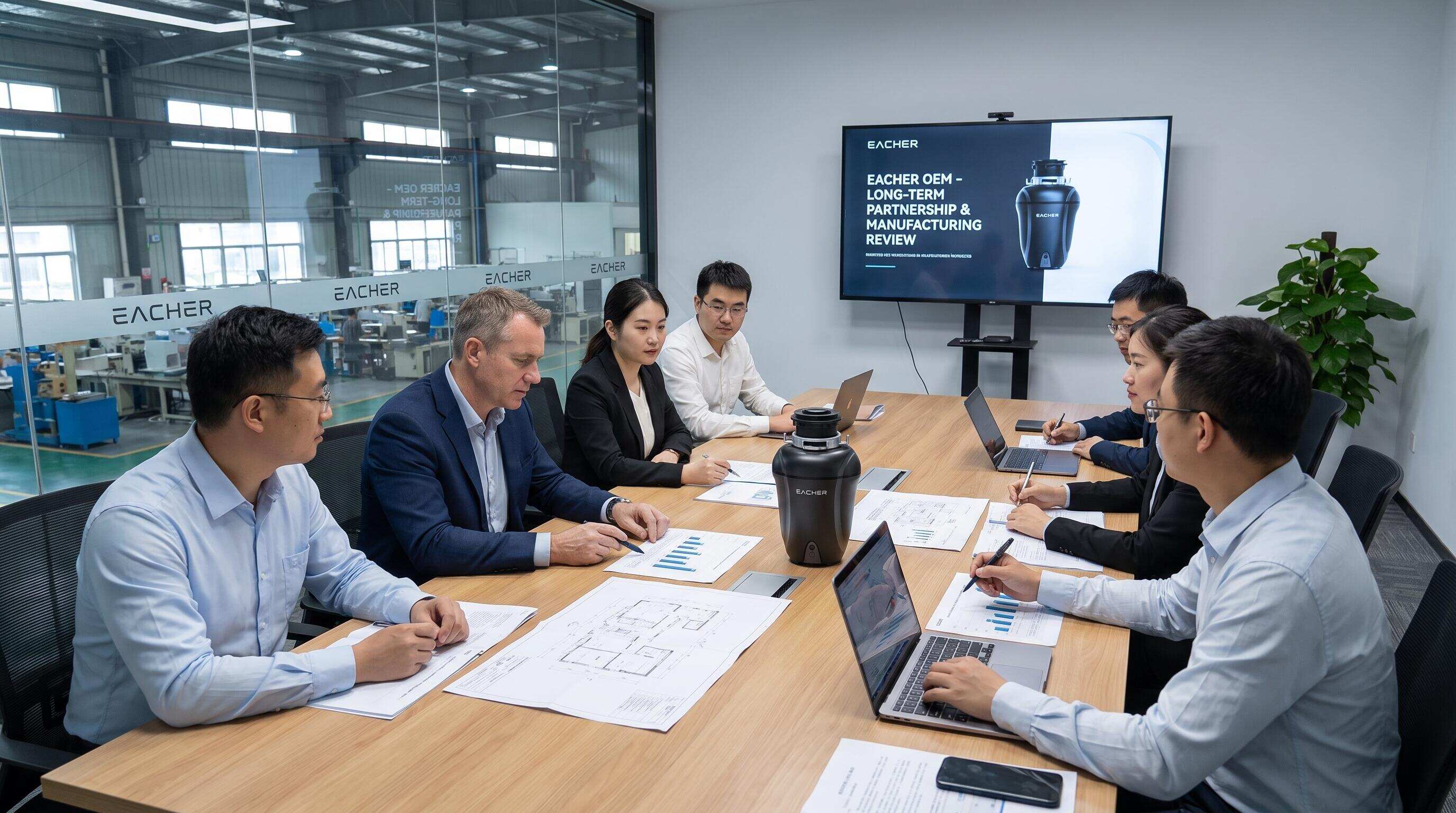
ALT: EACHER OEM food waste disposer factory team reviewing long-term client partnership manufacturing collaboration
What Sustains a Long-Term OEM Partnership in Food Waste Disposer Manufacturing
Picture a brand owner who has switched manufacturing partners three times in five years. Each transition cost months of tooling re-development, certification re-testing, and market delays — not because the products were defective, but because the relationship never matured into genuine collaboration. In our work with clients across different regions and product tiers, a pattern we consistently see is that the brands achieving the strongest market positions are those who invest in partnerships rather than transactions. The lesson is clear: long-term OEM partnerships in food waste disposer manufacturing are not an accident of good luck — they are the product of deliberate alignment, structured communication, and a shared understanding of product development goals.
This article looks back at what those mature collaborations actually look like in practice, the pitfalls that derail promising partnerships early, and the principles EACHER has applied across years of OEM/ODM client engagements to build relationships that compound in value over time.
Who This Article Is For — and When It Applies
Applicable Scenarios:
Brand owners and importers who are evaluating whether to deepen an existing OEM relationship or transition to a new manufacturing partner
Product development teams planning to launch a new line of food waste disposers and wanting to structure their OEM engagement correctly from the outset
Distributors and private-label operators who need a manufacturing partner capable of scaling with their growth, not just fulfilling a single purchase order
Not Applicable/Cautions:
Buyers seeking a one-time spot purchase with no interest in product development collaboration — the dynamics discussed here apply specifically to iterative, multi-phase engagements
Teams who have not yet defined their target market, product category, or basic technical requirements, as partnership maturity depends on a minimum level of specification clarity on the client side
Why the OEM Partnership Model Is Under Greater Scrutiny Today
OEM partnership quality has become one of the most consequential variables in the kitchen appliance category precisely because product complexity has risen faster than most buyers anticipated. A food waste disposer is no longer a simple induction-motor appliance with a grinding plate. The market now segments clearly across brushed motor models, brushless motor models, and smart variable-frequency models — each carrying distinct R&D requirements, component sourcing strategies, and certification pathways.
According to the International Electrotechnical Commission (IEC), electrical appliance standards governing motor-driven household equipment are regularly updated to reflect new efficiency and safety benchmarks. Brands that rely on manufacturing partners who are not proactively tracking these changes find themselves facing compliance gaps at precisely the wrong moment — typically during a product launch or a key retail listing review.
The broader market reality, as tracked by industry bodies such as the Association of Home Appliance Manufacturers (AHAM), is that demand for food waste management solutions continues to expand, particularly in markets where municipal organic waste diversion programs are gaining policy support. This creates urgency for brands: the window to establish a strong product line and reliable supply chain is finite, and it is compressed further if the OEM relationship is fragile.
At EACHER, operating under Ningbo Yiju Environmental Technology Co., Ltd. with an annual production capacity of 300,000 units, we have seen how this market pressure plays out in client relationships. Brands that treated their early OEM engagements as purely transactional found themselves unable to move quickly when the market shifted. Those who had built genuine working relationships with our engineering and production teams could iterate, pivot, and launch new SKUs in a fraction of the time.
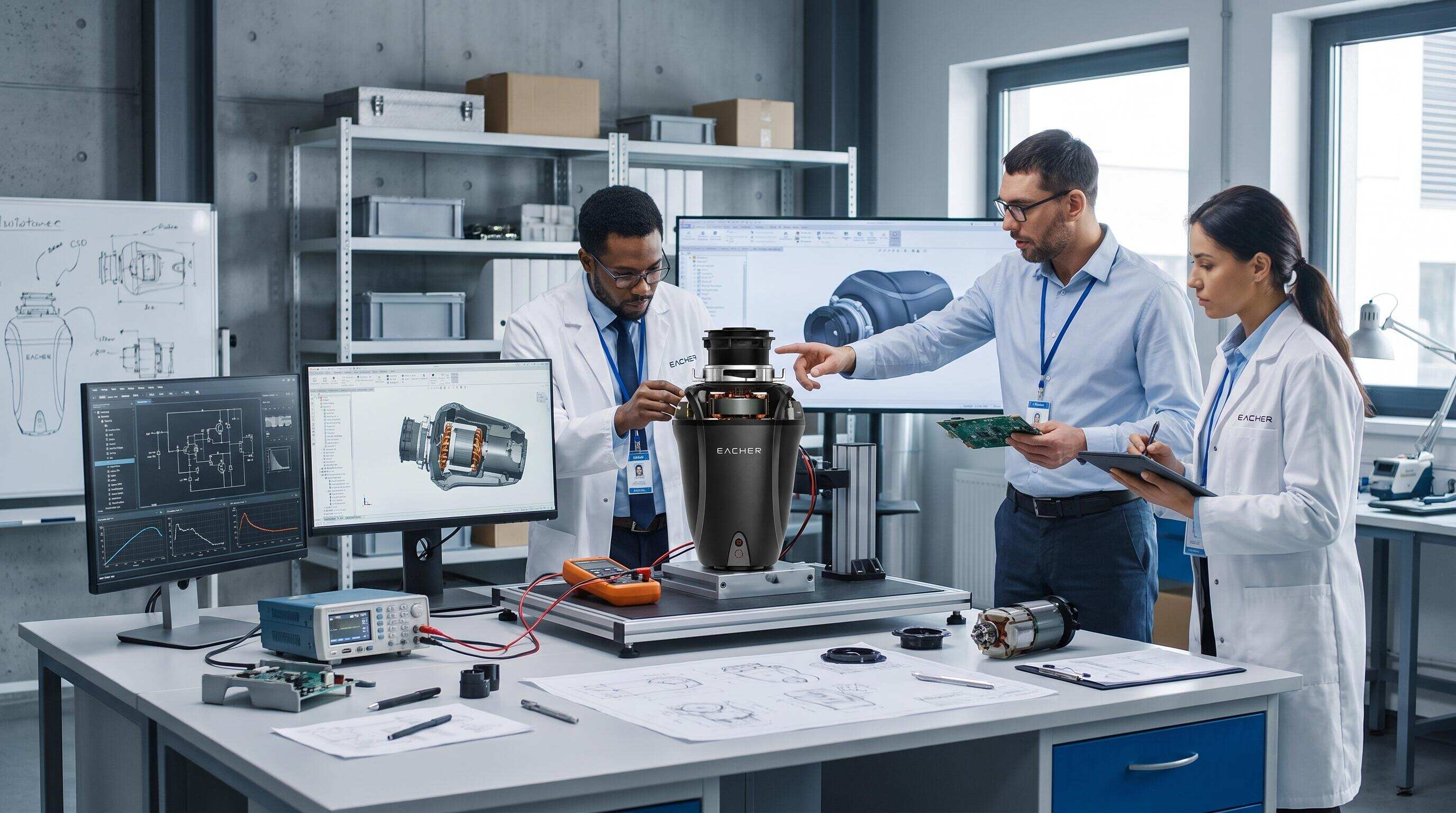
ALT: EACHER engineering team collaborating on brushless motor food waste disposer OEM product development for global B2B clients
The Architecture of a Lasting OEM Collaboration
Building the Foundation: Three Stages That Determine Long-Term Outcomes
Step 1: Alignment on Technical Scope Before Commercial Terms
The single most common mistake we observe in early-stage OEM negotiations is that commercial terms — pricing, minimum order quantities, lead times — are locked before technical scope is properly defined. This sequence creates compounding problems. A client who commits to a price before specifying whether their product requires a brushed or brushless motor, what grinding capacity tier they need, or which certification markets they are targeting will inevitably face re-negotiation or cost escalation later. The alignment step should require two to four working sessions covering product category selection, motor technology, noise and performance expectations, target certifications, and packaging and labeling requirements. Investing this time upfront is not slow — it is the fastest path to an accurate and stable commercial agreement.
Step 2: Structuring the Prototype and Validation Phase as a Shared Process
A prototype is not a supplier deliverable handed to the client for approval. In the partnerships that work best, the prototype phase is a shared process with clearly defined review gates, documented feedback loops, and mutual accountability for decisions. When a client requests a change to grinding chamber geometry or motor torque calibration after a prototype review, that change needs to be captured in a change log that both parties sign off on — not communicated informally. Our internal performance testing and validation process is specifically structured to support this kind of documented, iterative collaboration, because ambiguity during prototyping is one of the primary reasons OEM projects stall or produce misaligned final products.
Step 3: Establishing a Communication Cadence That Survives Organizational Change
The most underrated risk in long-term OEM partnerships is personnel turnover. A relationship that exists only between two individual contacts — a sales manager on one side and a procurement officer on the other — is one resignation away from starting over. Sustainable partnerships are institutionalized: they involve shared project documentation, named escalation contacts at multiple levels, and regular review calls that are logged and carry forward context regardless of who is in the room. We recommend that clients designate at least two internal contacts for any active OEM engagement, and we mirror that structure on our side.
Comparing Engagement Models: What Long-Term Clients Actually Choose
Different clients approach OEM relationships with different structural preferences. Understanding these models helps brands select the one most consistent with their internal capabilities and growth trajectory.
| Engagement Dimension | Standard OEM | Full ODM | Hybrid OEM/ODM |
|---|---|---|---|
| Product Ownership | Client holds design | Manufacturer holds design base | Shared IP, client-specific customization |
| Client Engineering Input | High — client provides specifications | Low — client selects from existing platforms | Medium — client customizes over a validated platform |
| Development Speed | Slower — full custom build | Fastest — platform-based | Moderate — faster than full custom |
| Suitable Motor Types | Brushed, brushless, or variable-frequency | Typically brushed or brushless platforms | All three, depending on platform selection |
| Certification Responsibility | Shared or client-led | Typically manufacturer-led | Shared, with manufacturer support |
| Annual Volume Suitability | Higher volumes justify investment | Flexible — suits emerging brands | Flexible — suits growth-stage brands |
| Long-Term Partnership Value | Highest — deepest product alignment | Moderate — limited differentiation over time | High — balances speed with differentiation |
In practice, a pattern we consistently see is that early-stage brands begin with a hybrid ODM model — leveraging EACHER's existing platform architecture for brushed or brushless motor disposers, then adding brand-specific customization in grinding performance, industrial design, and packaging. As their volume grows and their product knowledge deepens, the most successful clients migrate toward fuller OEM engagements where they are contributing more proprietary specification input. This migration is healthy and planned for from the beginning of the relationship.
The Pitfalls That Break Promising Partnerships — and How to Avoid Them
Pitfall 1: Treating Certification as an Afterthought
Per IEC standards governing household motor appliances, certification requirements vary significantly by destination market — what qualifies a product for one region may be insufficient for another. We regularly encounter situations where a client has completed a full production run before engaging seriously with certification requirements for their target market. The cost of this sequencing error is not merely financial; it can mean months of product sitting in a warehouse while re-testing is arranged. The correct approach is to surface certification targets in the first alignment session, so that the product design and component selection are built to meet those requirements from the start.
Pitfall 2: Optimizing for Unit Price at the Expense of Component Quality
Price pressure is a legitimate commercial concern, and EACHER takes cost competitiveness seriously given our scale. However, a pattern we consistently see in failed partnerships is that aggressive price negotiation during the RFQ stage leads to undisclosed component substitutions during mass production. This is a trust-breaking event that is difficult to recover from. The mitigation is straightforward but requires discipline: a bill of materials (BOM) lock, agreed in writing, that specifies approved component grades for motors, grinding chambers, and control electronics. Any deviation from the approved BOM requires written sign-off from the client. This process protects both parties.
Pitfall 3: Underestimating the Complexity of Smart Variable-Frequency Models
Smart variable-frequency food waste disposers represent the leading edge of the product category, incorporating variable-speed motor control, often paired with app connectivity or integration with smart home ecosystems. Brands entering this segment for the first time frequently underestimate the software development, EMC compliance, and user experience testing that these products require, in addition to the mechanical and motor engineering. A long-term manufacturing partner can absorb a significant share of this complexity, but only if the client has been transparent about their technical ambitions from the beginning of the relationship. Mismatched expectations about what the manufacturer's scope includes — versus what the client team needs to deliver — are the leading source of schedule failures in smart disposer projects.
Pitfall 4: Neglecting Supply Chain Transparency
In the current global component environment, supply chain visibility is not optional. Clients who do not regularly discuss component lead times, alternative sourcing strategies, and inventory buffer policies with their manufacturing partner are exposed to the full impact of any upstream disruption. Effective long-term OEM partnerships build a shared view of the supply chain, including agreed buffer stock levels for critical components and a pre-negotiated process for communicating lead time changes. For those planning a new OEM food waste disposer engagement from the ground up, our step-by-step guide to launching an OEM project covers supply chain planning as an integrated part of the project framework, not a separate afterthought.
What Mature Partnerships Look Like in Practice
When a long-term OEM relationship reaches maturity, its most visible characteristic is speed. Mature clients can move a new SKU from brief to prototype in a compressed timeframe because the engineering team already understands their performance targets, their brand standards, and their certification requirements. The alignment sessions that once took weeks are replaced by a shared vocabulary and a pre-existing decision framework.
A second characteristic is proactive intelligence sharing. In mature relationships, EACHER's engineering team brings market intelligence to the client — emerging component technologies, evolving regulatory signals, or competitive product trends observed across our broader production network — rather than simply waiting for client-initiated requests. This is only possible when there is sufficient trust and history for both parties to speak candidly about what they are seeing.
The third characteristic is resilience. Long-term partnerships that have been through at least one significant disruption — whether a component shortage, a certification delay, or a product performance issue discovered in the field — and navigated it transparently, emerge significantly stronger. The shared experience of problem-solving under pressure creates institutional trust that no new-partner RFQ process can replicate.
According to ISO principles governing quality management and supplier relationships (ISO 9001), mutually beneficial supplier relationships are explicitly recognized as a driver of sustained organizational value. This principle, applied to OEM manufacturing relationships in the kitchen appliance category, aligns precisely with what we observe in practice.
Advanced Considerations: When Standard Partnership Models Are Insufficient
Handling Multi-Region Certification Complexity
Some clients operate across multiple destination markets simultaneously, each with distinct certification requirements. In these cases, a standard OEM engagement structure — where certification is treated as a single-market exercise — is insufficient. The partnership needs to accommodate a certification matrix from the outset, with the manufacturing partner taking a coordinating role across testing laboratories and regulatory documentation. This requires a higher level of manufacturing partner engagement than many brands initially budget for, but it is far less costly than managing certification failures market by market after production has begun.
Common Misconception: Larger Order Volumes Automatically Improve Partnership Quality
A persistent misconception among brands new to OEM manufacturing is that committing to larger order volumes will naturally produce better communication, better quality control, and better partner responsiveness. Volume matters for unit economics, but it does not substitute for the relationship architecture described above. We have seen large-volume relationships fail due to poor communication structures just as readily as small-volume ones. Volume is a commercial lever; partnership quality is a process and culture lever. They operate independently.
Relationship with Certification Bodies and Third-Party Testing
Long-term OEM partnerships that include a clear shared understanding of which certification bodies the manufacturer has existing relationships with — and which testing laboratories have pre-existing familiarity with the product platform — move significantly faster through compliance processes. This is not about circumventing rigorous testing; it is about reducing the friction of scheduling, documentation formatting, and iterative sample submission that can add weeks to a certification timeline when a manufacturer and a testing lab are working together for the first time.
Questions & Answers
Q1: How should a brand structure the first six months of an OEM partnership to maximize long-term success?
The first six months of an OEM partnership should be treated as an investment in shared infrastructure, not just a product development sprint. This means completing a thorough technical alignment before finalizing commercial terms, establishing a documented prototype review process, agreeing on a bill of materials that is locked against undisclosed substitution, and building a communication structure that does not depend on any single contact at either organization. Brands that complete these steps in the first engagement are measurably better positioned for their second and third product cycles with the same partner.
Q2: Is it realistic to expect an OEM manufacturer to contribute proactively to product development, or is that the client's responsibility?
Proactive product development contribution from an OEM manufacturer is realistic, but it is a characteristic of mature relationships, not first engagements. Early in an OEM partnership, the manufacturer's role is primarily responsive — translating client specifications into manufacturable products. As the relationship deepens and the manufacturer gains a thorough understanding of the client's market positioning and performance requirements, proactive input on component upgrades, design improvements, and emerging compliance requirements becomes both possible and valuable. Setting this as an explicit expectation and building toward it deliberately is the correct approach.
Q3: How long does it typically take to move from initial OEM inquiry to first mass production run?
Timeline varies based on product complexity, certification requirements, and the maturity of the client's initial specifications. Simpler brushed motor models on an existing platform can move faster than fully custom brushless or smart variable-frequency models that require ground-up engineering. Certification timelines add further variability depending on the destination market. The most reliable guidance is that brands who arrive at an OEM engagement with clear, well-documented specifications — motor type, target markets, performance tiers, and certification requirements — consistently achieve shorter timelines than those who develop these specifications iteratively during the manufacturer engagement.
Key Takeaways
Key Takeaways
Long-term OEM partnerships in food waste disposer manufacturing create compounding value — in development speed, supply chain resilience, and product quality — that no series of transactional relationships can replicate.
Technical alignment must precede commercial negotiation; locking pricing before defining motor type, target certifications, and performance requirements is the most common source of cost escalation and partnership friction.
A locked bill of materials, documented change control, and a multi-contact communication structure are the three process mechanisms most predictive of partnership durability.
Smart variable-frequency disposer projects carry significantly higher complexity than brushed or brushless models and require manufacturing partners with proven capability across software integration, EMC compliance, and iterative user experience validation.
The brands that achieve the fastest time-to-market on their second and third product cycles are those who invested in partnership infrastructure — not just product delivery — during their first engagement.
The next step for any brand serious about building a sustainable position in the food waste disposer category is to evaluate their current or prospective manufacturing partner not only on price and capacity, but on the depth of their engineering capability, the maturity of their quality and communication processes, and their track record of supporting clients through full product development cycles.
If you are looking for a trusted OEM/ODM partner to develop high-performance food waste disposers — whether brushed, brushless, or smart variable-frequency models — EACHER has the engineering expertise and production capacity to bring your product vision to life. With an annual output of 300,000 units and end-to-end customization capabilities, EACHER is equipped to serve brands of all scales worldwide. Visit the EACHER website today to explore custom solutions and request a consultation with our engineering team.
References
International Electrotechnical Commission (IEC). "Standards for Household and Similar Electrical Appliances — Safety and Performance."
https://www.iec.chInternational Organization for Standardization (ISO). "ISO 9001: Quality Management Systems — Requirements and Supplier Relationship Principles."
https://www.iso.orgAssociation of Home Appliance Manufacturers (AHAM). "Industry Data and Market Research on Home Appliance Categories."
https://www.aham.org
Note: Standards may be updated; please check the latest official documents or consult professional advisors.