
 +8657486688117
 400-616-0305
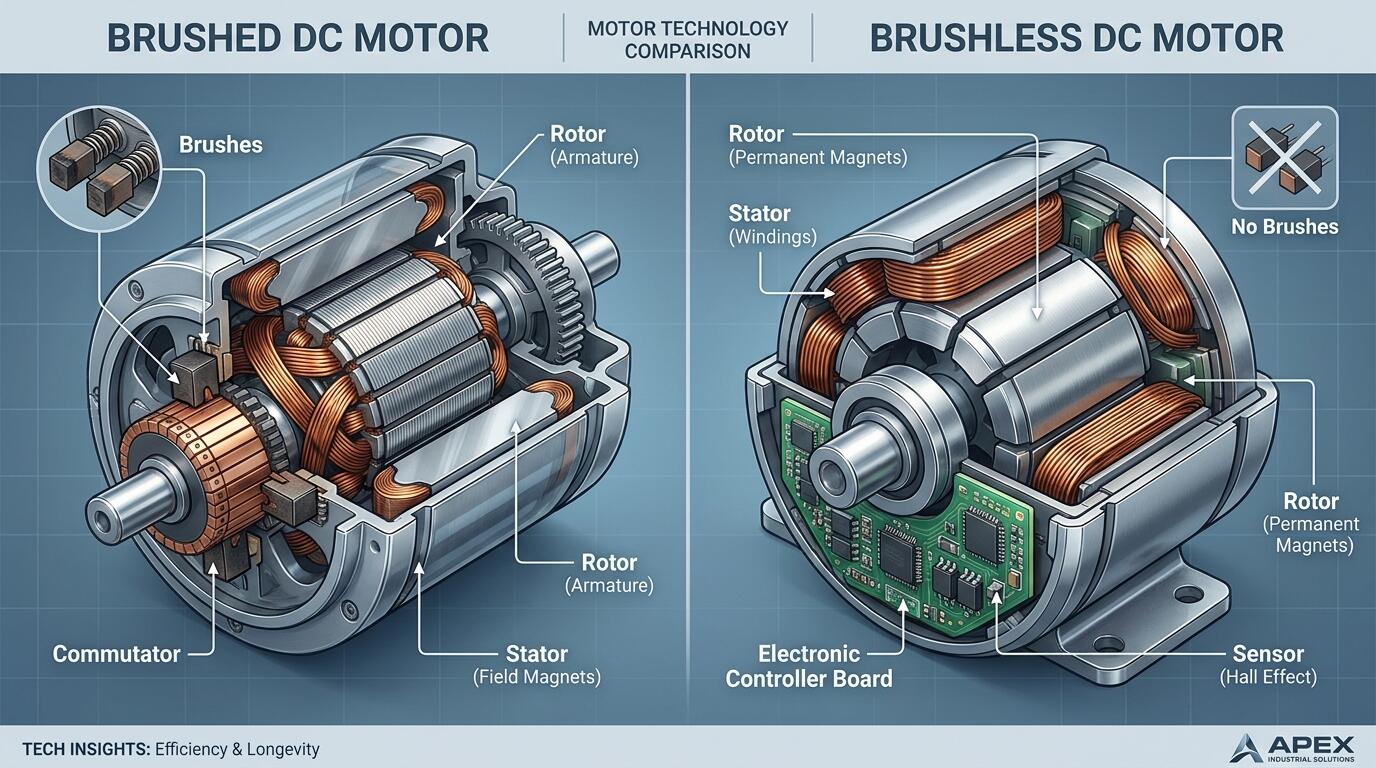
ALT: Brushed vs. brushless food waste disposer motors compared for 2026 OEM product line decisions
Brushed vs. Brushless Motor Food Waste Disposers: A Technical Comparison for Your 2026 Product Line
Key Conclusion: For B2B buyers planning 2026 kitchen appliance lineups, the choice between brushed and brushless food waste disposer motors is not purely technical — it is a strategic product positioning decision. Brushed motors offer proven cost-efficiency for entry-level and mid-range SKUs, while brushless motors deliver the quieter operation, longer service life, and smart-integration capability that premium and sustainability-focused segments demand. Understanding the trade-offs across durability, cost, noise, and application fit is essential to building a competitive, differentiated product line.
Sourcing decisions for food waste disposers increasingly hinge on a single architectural question: which motor technology — brushed or brushless — best serves the product tier, market segment, and brand promise you are building toward? This article compares both motor types across the criteria that matter most to procurement managers and product development engineers, drawing on the hands-on manufacturing experience of EACHER, a professional food waste disposer manufacturer under Ningbo Yiju Environmental Technology Co., Ltd., to map each technology to real-world sourcing and commercialization scenarios.
Evaluation Criteria: How to Judge Motor Technology for Food Waste Disposers
Selecting the right motor architecture for a food waste disposer requires evaluating six distinct dimensions. Each criterion directly affects product performance in the field, total cost of ownership for end users, and commercial viability for the brands selling these units.
Durability and Mechanical Lifespan: A food waste disposer is a high-cycle kitchen appliance — it runs daily, processes abrasive materials, and is expected to last for years without service. The mechanical architecture of the motor is the primary determinant of how long the unit performs reliably. Brush wear is the defining failure mode for traditional motors and must be factored into warranty and returns planning.
Noise and Vibration Profile: In residential kitchens, noise is a primary purchase driver. According to testing methodologies referenced by consumer evaluation organizations such as Consumer Reports, disposal noise levels vary significantly across motor types and grinding chamber designs. A quieter unit commands a premium retail price and reduces warranty claims related to perceived defects.
Energy Efficiency and Power Consumption: Regulatory frameworks in key export markets — including EU energy labeling requirements and North American ENERGY STAR guidelines — are tightening standards for household appliances. Motor efficiency directly affects compliance positioning and can be a differentiating factor in eco-conscious retail channels.
Cost Structure and BOM Complexity: The bill-of-materials cost difference between motor types has direct implications for target retail price, margin at each distribution level, and the feasibility of hitting price-competitive market tiers. Brushless motors carry higher component costs; the question is whether the application justifies that investment.
Smart Integration Readiness: The 2026 product landscape increasingly expects appliances to connect with home automation ecosystems. Variable-frequency control, torque sensing, and app-based monitoring are features that only brushless and smart variable-frequency motor platforms can support at a manufacturing level.
Manufacturing Scalability and OEM Flexibility: For importers, distributors, and brand owners placing volume orders, the ability of an OEM partner to scale production, accommodate custom specifications, and maintain consistent quality across large runs is as important as the technology itself.
The Contenders: Brushed, Brushless, and Smart Variable-Frequency Food Waste Disposers
Brushed Motor Food Waste Disposers
A brushed motor food waste disposer is a disposal unit powered by a DC or universal AC motor in which carbon brushes make physical contact with a rotating commutator to transfer electrical current to the rotor windings. This contact-based current transfer mechanism is a mature, well-understood technology that has been the backbone of the food waste disposer category for decades.
Brushed motors are characterized by straightforward electrical control requirements, lower raw material cost, and a well-established supply chain for components. From an OEM manufacturing standpoint, they are easier to assemble, test, and troubleshoot at scale. The trade-off is mechanical: the brushes wear over time, generating carbon dust and eventually requiring replacement — a maintenance event that, in sealed disposer units, typically translates to end-of-life for the appliance. In our manufacturing work with clients sourcing entry-level and mid-range disposer programs, brushed motor units consistently deliver the most competitive landed cost, making them the preferred architecture for price-sensitive retail channels and private-label programs where margin compression is a primary constraint.
Brushless Motor Food Waste Disposers
A brushless motor food waste disposer uses a motor design in which the commutation function is handled electronically rather than through physical brush contact. The rotor contains permanent magnets, and the stator windings are energized in a controlled sequence by an electronic controller, eliminating the brush-commutator interface entirely.
The absence of mechanical contact has cascading engineering benefits: no brush wear, significantly reduced heat generation at comparable load levels, quieter acoustic profile, and a fundamentally longer operational lifespan under normal use conditions. Brushless motors are also inherently more amenable to variable-speed control and real-time torque management — capabilities that are essential for the smart appliance tier. The component and manufacturing cost premium over brushed technology is real and meaningful, but for product lines targeting the mid-premium and premium retail segments, the performance differentiation justifies the investment. A pattern we consistently see in client engagements is that brands entering the European or North American premium kitchen segment find the brushless platform indispensable for meeting both consumer expectations and emerging regulatory efficiency standards.
Smart Variable-Frequency Food Waste Disposers
A smart variable-frequency food waste disposer is a category built on brushless motor technology augmented with variable-frequency drive (VFD) control electronics, enabling real-time adjustment of motor speed and torque in response to grinding load conditions. EACHER's product development capabilities extend explicitly to this platform, which represents the leading edge of the current food waste disposer product landscape.
Smart variable-frequency models can detect load changes — such as the difference between soft food scraps and fibrous or hard materials — and dynamically adjust power delivery to optimize grinding efficiency while minimizing energy consumption. These units are the natural platform for IoT connectivity features, app-based monitoring, and integration with smart home ecosystems. From a product line architecture perspective, the smart variable-frequency tier functions as the anchor for flagship SKUs, enabling brand differentiation in crowded retail environments. Clients developing connected kitchen appliance portfolios for 2026 will find this platform increasingly difficult to ignore as smart home adoption rates continue to climb in key markets.
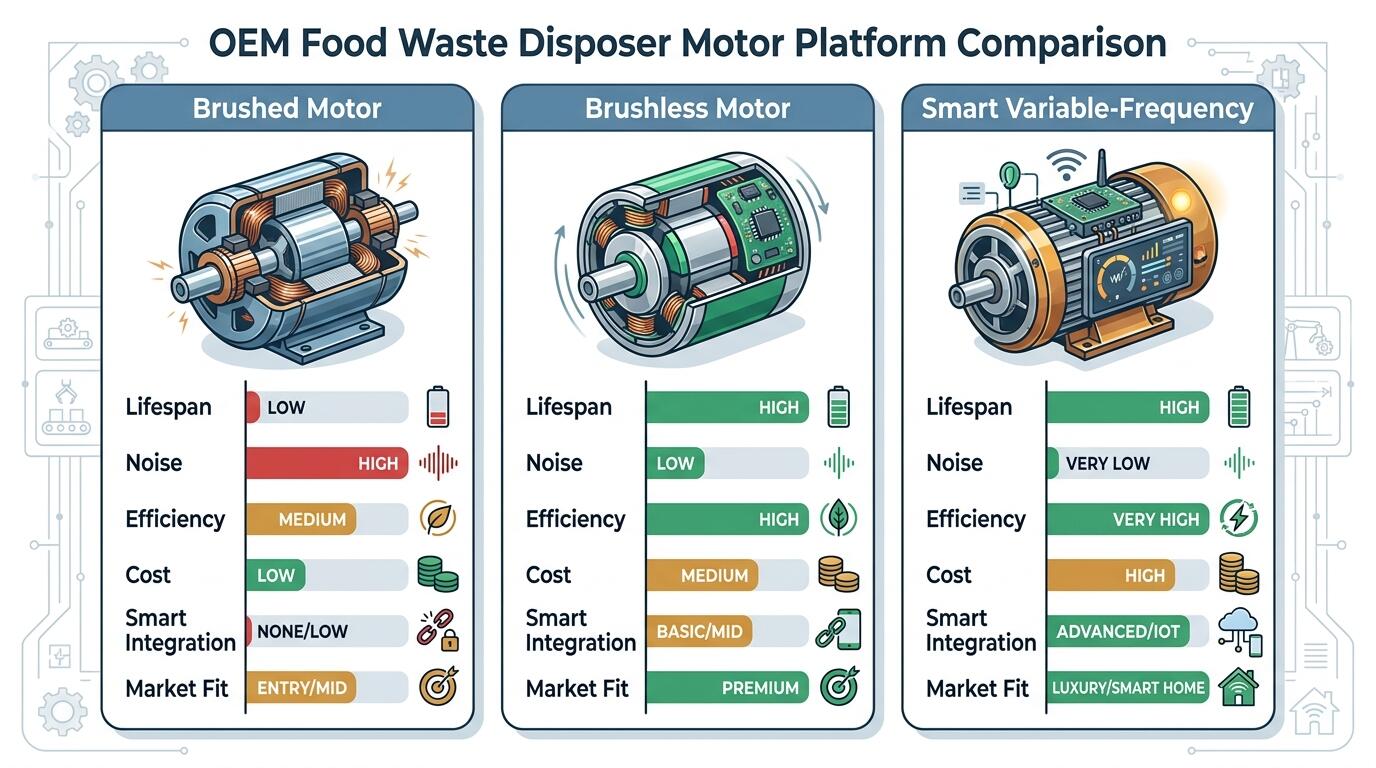
ALT: Side-by-side comparison of brushed, brushless, and smart variable-frequency food waste disposer motor platforms for OEM product line planning
Head-to-Head Comparison: Brushed vs. Brushless vs. Smart Variable-Frequency
| Criterion | Brushed Motor | Brushless Motor | Smart Variable-Frequency |
|---|---|---|---|
| Mechanical Lifespan | Moderate — brush wear limits service life | High — no brush contact, fewer wear points | High — brushless foundation plus optimized load management |
| Noise & Vibration | Higher baseline noise, more vibration at load | Noticeably quieter, smoother operation | Quietest tier — adaptive speed control reduces noise under load |
| Energy Efficiency | Good for the price tier; no active optimization | More efficient than brushed at equivalent output | Highest efficiency — real-time power adaptation |
| Unit BOM Cost | Lowest | Moderate premium over brushed | Highest — VFD controller and sensors add cost |
| Smart Home / IoT Ready | Not natively supported | Supportable with additional electronics | Natively designed for connectivity and app integration |
| OEM Customization Scope | Motor specs, chamber design, form factor | Motor specs, controller tuning, speed profiles, noise treatment | Full-stack: hardware, firmware, connectivity, UI |
| Best Market Fit | Entry to mid-range, price-competitive retail | Mid-premium to premium residential and commercial | Premium, flagship, and connected appliance product lines |
| Regulatory Positioning | Meets baseline standards in most markets | Strong positioning for efficiency-conscious markets | Best positioned for evolving EU and North American efficiency requirements |
The comparison table surfaces several conclusions that procurement teams should internalize before finalizing 2026 sourcing plans.
First, the lifespan and noise gap between brushed and brushless is not marginal — it is structural. Brushed motors operate through a mechanism that inherently degrades with use. For brands building product lines where warranty duration is a competitive differentiator or where return rates are closely managed, the service life advantage of brushless technology has a direct commercial value that partially offsets the higher unit cost. Per IEEE standards on electric motor classification, electronically commutated motors (the category that includes brushless designs) are recognized for their efficiency and reduced maintenance requirements compared to brush-commutated motors.
Second, the smart variable-frequency tier is not simply a "better brushless" — it is a categorically different product architecture. The addition of variable-frequency control enables capabilities — real-time load sensing, adaptive power delivery, diagnostic data output — that are impossible to retrofit onto a fixed-speed motor, brushed or brushless. Brands that plan to support smart home integration features must start with this platform from the design stage; it cannot be added as an afterthought.
Third, cost should be evaluated across the full product lifecycle, not just the bill of materials. A brushed unit may carry a lower initial manufacturing cost, but higher warranty claim rates, shorter SKU refresh cycles due to perceived obsolescence, and limited platform extensibility all affect total program economics. The right cost comparison is a full landed-cost-plus-warranty-exposure analysis, not a line-item BOM comparison.
Which Should You Choose? Scenario Recommendations for 2026 Sourcing
Matching motor technology to the right application is where sourcing strategy becomes product strategy. The following scenarios, drawn from the types of client conversations we have regularly in our OEM/ODM work, provide a practical framework.
If you are developing a private-label entry-level program for a value-oriented retail chain, choose brushed motor technology. The cost structure is optimized for the target retail price point, the technology is reliable within its service-life expectations, and the manufacturing scalability is well-suited to high-volume, margin-sensitive programs. EACHER's brushed motor food waste disposer platform delivers the quality consistency and volume flexibility these programs require.
If you are building a branded mid-range line targeting North American or European kitchen renovation consumers, the brushless motor platform is the correct choice. The acoustic performance, extended service life, and efficiency credentials address the purchase criteria that drive conversion in this segment. The unit cost premium is recoverable at retail through positioning and can be offset against reduced warranty exposure over the product life cycle.
If you are developing a flagship or hero SKU for a premium kitchen appliance brand, the smart variable-frequency platform is the only architecture that delivers the full feature set required — quiet operation, intelligent load management, and IoT connectivity. For brands competing in the premium tier, the smart variable-frequency food waste disposer is the product that justifies the brand story and commands the retail price point that protects margin at every distribution level.
If you are sourcing for a commercial food service equipment program — such as a hotel chain, restaurant equipment distributor, or institutional kitchen operator — the brushless or smart variable-frequency platform is preferred. Commercial duty cycles are significantly more demanding than residential use, and the extended service life and adaptive performance of brushless technology translate directly into lower total cost of ownership for the end operator.
If you are an importer or distributor evaluating a range strategy that spans multiple price tiers, EACHER's OEM/ODM model — with an annual production capacity of 300,000 units and engineering support across all three motor platforms — is structured to support multi-tier sourcing from a single manufacturing partner. Consolidating production with one technically capable partner reduces vendor management complexity and enables coordinated quality assurance across the full range. Explore EACHER's full OEM/ODM capabilities at the EACHER product platform for detailed motor platform options and customization parameters.
A common pitfall to avoid: brands that standardize on a single motor type across their entire product range to simplify sourcing often find themselves unable to compete effectively at either end of the market. The entry-level tier requires cost-optimized brushed technology; the premium tier cannot be served without brushless. Attempting to use brushless technology in an entry-level program creates an uncompetitive price point, while using brushed technology in a premium program creates a product that underdelivers on the quality expectations the brand price implies.
People Also Ask
Q1: How does a brushless motor improve food waste disposer performance compared to a brushed motor?
A brushless motor improves food waste disposer performance by eliminating the mechanical brush-commutator contact that causes wear, heat buildup, and noise in traditional motors. Because commutation is handled electronically, brushless motors operate more quietly, generate less heat under load, and maintain consistent torque output over a longer service life. For OEM product lines, this translates to lower warranty exposure and stronger positioning in premium retail segments where acoustic performance and durability are key purchase criteria.
Q2: Are smart variable-frequency food waste disposers compatible with standard plumbing and electrical installations?
Smart variable-frequency food waste disposers are designed to connect to standard residential sink drain plumbing configurations, and their electrical requirements are generally compatible with standard household circuits. However, the variable-frequency drive electronics require proper grounding and, in some markets, may require compliance review against local electrical safety standards such as those governed by IEC or UL frameworks. OEM buyers should confirm market-specific certification requirements with their manufacturing partner early in the product development process to avoid costly redesigns.
Q3: How long does OEM development typically take for a custom brushless food waste disposer?
OEM development timelines for a custom brushless food waste disposer vary depending on the degree of customization — motor specification, grinding chamber design, housing, and software features all affect the timeline. In our experience working with brand clients across different complexity levels, straightforward customization programs (cosmetic differentiation on an established platform) move faster than ground-up hardware development. Engaging an OEM partner early with a clear product brief, target specifications, and market certification requirements is the most effective way to compress the development-to-production timeline.
Key Takeaways
Three core conclusions should guide 2026 sourcing decisions for food waste disposer motor technology.
First, motor type is a product positioning decision, not just a technical specification. Brushed motors are the right tool for cost-competitive entry and mid-range programs; brushless motors are the correct foundation for premium and durability-positioned products; and smart variable-frequency platforms are the only architecture for connected, intelligent appliance programs. Matching motor type to market tier is as important as any other product specification.
Second, total program economics — including warranty exposure, SKU lifecycle, and platform extensibility — must be factored into the motor technology decision alongside unit BOM cost. The product line that appears cheapest to build is not always the cheapest to run as a commercial program.
Third, OEM partner capability is a determinant of motor technology access. Not all manufacturers can support all three motor platforms at the quality and scale required for global commercial programs. EACHER's engineering capability across brushed, brushless, and smart variable-frequency platforms — backed by an annual production capacity of 300,000 units — positions it as a single-source manufacturing partner capable of supporting a full product range strategy.
The next step for procurement teams and product development engineers is to move from platform assessment to specification development. Define your target market tier, regulatory compliance requirements, and retail price architecture — and bring that brief to a manufacturing partner with demonstrated capability across all three motor platforms.
Ready to bring your custom food waste disposer to market with a trusted manufacturing partner? EACHER offers end-to-end OEM/ODM solutions — from brushed and brushless to smart variable-frequency models — tailored to your brand's exact specifications. Visit EACHER's official website to explore manufacturing capabilities, request a product catalog, or connect with the engineering team for a personalized consultation.
Sources & Further Reading
- Consumer Reports. "Best Garbage Disposals of 2026".
https://www.consumerreports.org/appliances/garbage-disposals/best-garbage-disposals-from-consumer-reports-tests-a6080080424/ - InSinkErator. "Garbage Disposal (2026)".
https://www.insinkerator.com/en-us/insinkerator-products/garbage-disposals - YouTube. "Best Garbage Disposal 2026".
https://www.youtube.com/watch?v=t9m2Tq9ljyk - International Electrotechnical Commission (IEC). Standards for household and similar electrical appliances and motor efficiency classifications.
https://www.iec.ch - Institute of Electrical and Electronics Engineers (IEEE). Standards and technical references for electric motor design and classification.
https://www.ieee.org
Note: Standards may be updated; please check the latest official documents or consult professional advisors.