
 +8657486688117
 400-616-0305
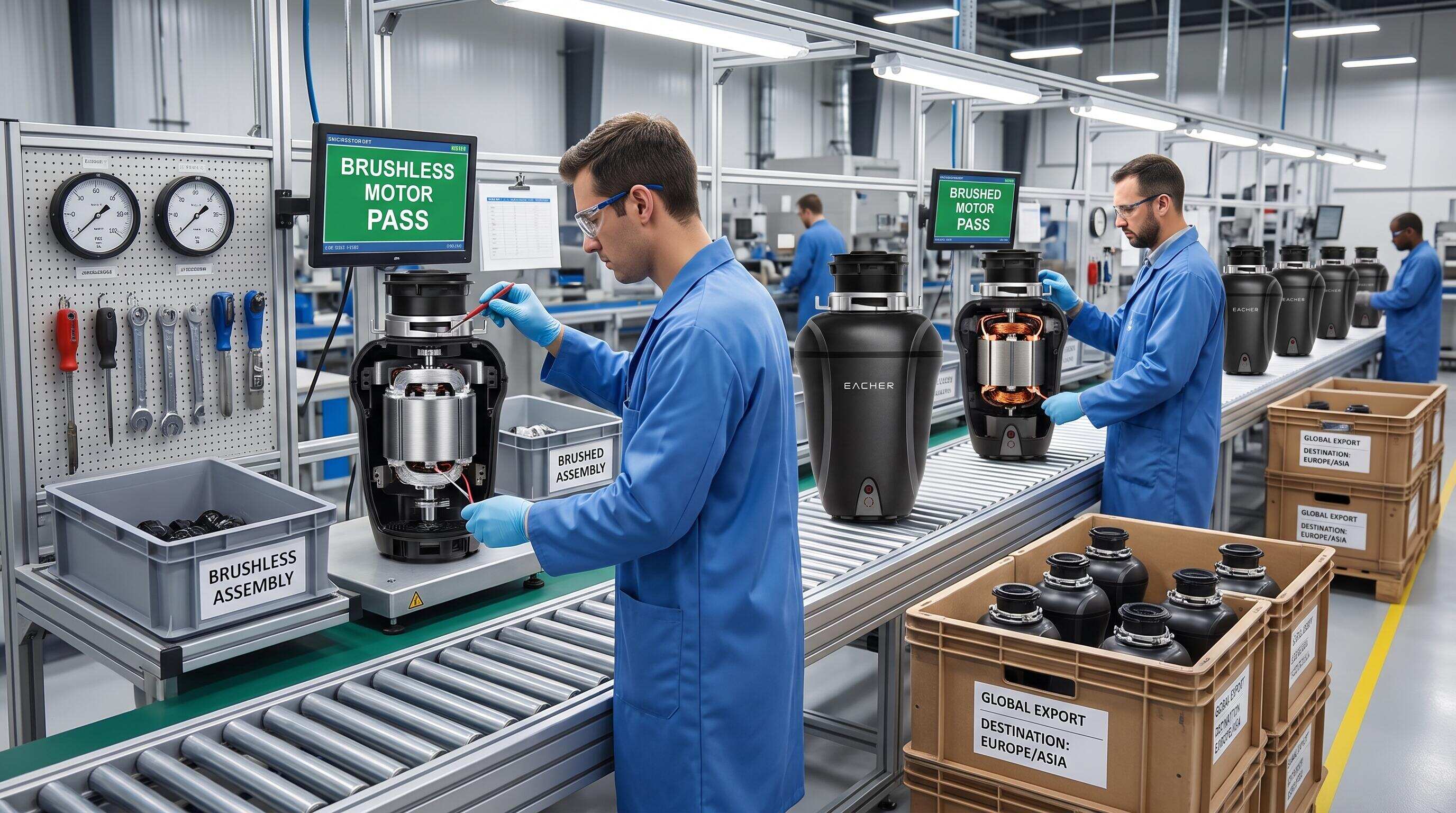
ALT: Food waste disposer performance testing lab validating units before mass production at OEM facility
Why Pre-Production Validation Defines the Quality of Every Disposer on the Market
A procurement manager receives a sample unit from a new manufacturing partner — it grinds efficiently on day one, passes a basic visual inspection, and ships to retail. Six months later, warranty claims begin piling up: motors burning out under sustained loads, seals leaking, and noise levels that customers describe as unacceptable. The root cause, almost invariably, is the same: inadequate performance validation before mass production began.
This is not a hypothetical scenario. In our work with B2B clients across the kitchen appliance sector, it is one of the most consistent patterns we observe when brands switch to a lower-cost supplier without scrutinizing the testing protocols behind the factory doors. The central finding of this article is straightforward — the rigor of a disposer manufacturer's pre-production validation lab is among the strongest predictors of long-term product reliability, warranty cost containment, and brand reputation in the market. Understanding what happens inside that lab, and why each test phase exists, is essential knowledge for any procurement manager, product development team, or brand owner making sourcing decisions today.
The Current Landscape of Disposer Validation Standards
Food waste disposer validation — the structured process of subjecting prototype and pre-production units to defined stress conditions to confirm they meet performance, safety, and durability benchmarks before full-scale manufacturing — has grown significantly more rigorous over the past decade. Rising consumer expectations around noise, energy efficiency, and longevity, combined with tighter regulatory environments in key markets, have pushed manufacturers to invest meaningfully in in-house testing infrastructure.
Historically, disposer testing was often limited to rudimentary electrical safety checks and basic grind performance trials. As markets such as North America, the European Union, and increasingly the Asia-Pacific region have expanded their appliance safety and environmental frameworks, the bar has risen. Per IEC standards governing household and similar electrical appliances — specifically the IEC 60335 family — motor-driven kitchen appliances must satisfy defined requirements for electrical insulation, thermal protection, abnormal operation, and mechanical strength before they can be certified for sale in major markets. Compliance with frameworks such as these is now a baseline expectation, not a differentiator.
At the same time, the global OEM/ODM model has matured. Brand owners who outsource manufacturing increasingly demand that their contract partners maintain validation capabilities comparable to an internal R&D lab, because any quality failure that reaches the market carries the brand's name — not the factory's. This dynamic has created a meaningful competitive divide between manufacturers who treat testing as a cost center to be minimized and those who treat it as a core engineering discipline.
EACHER, operating under Ningbo Yiju Environmental Technology Co., Ltd. with an annual production capacity of 300,000 units, sits firmly in the latter category. The validation framework described in this article reflects the kind of systematic, engineering-led approach that separates a dependable OEM partner from a commodity supplier.
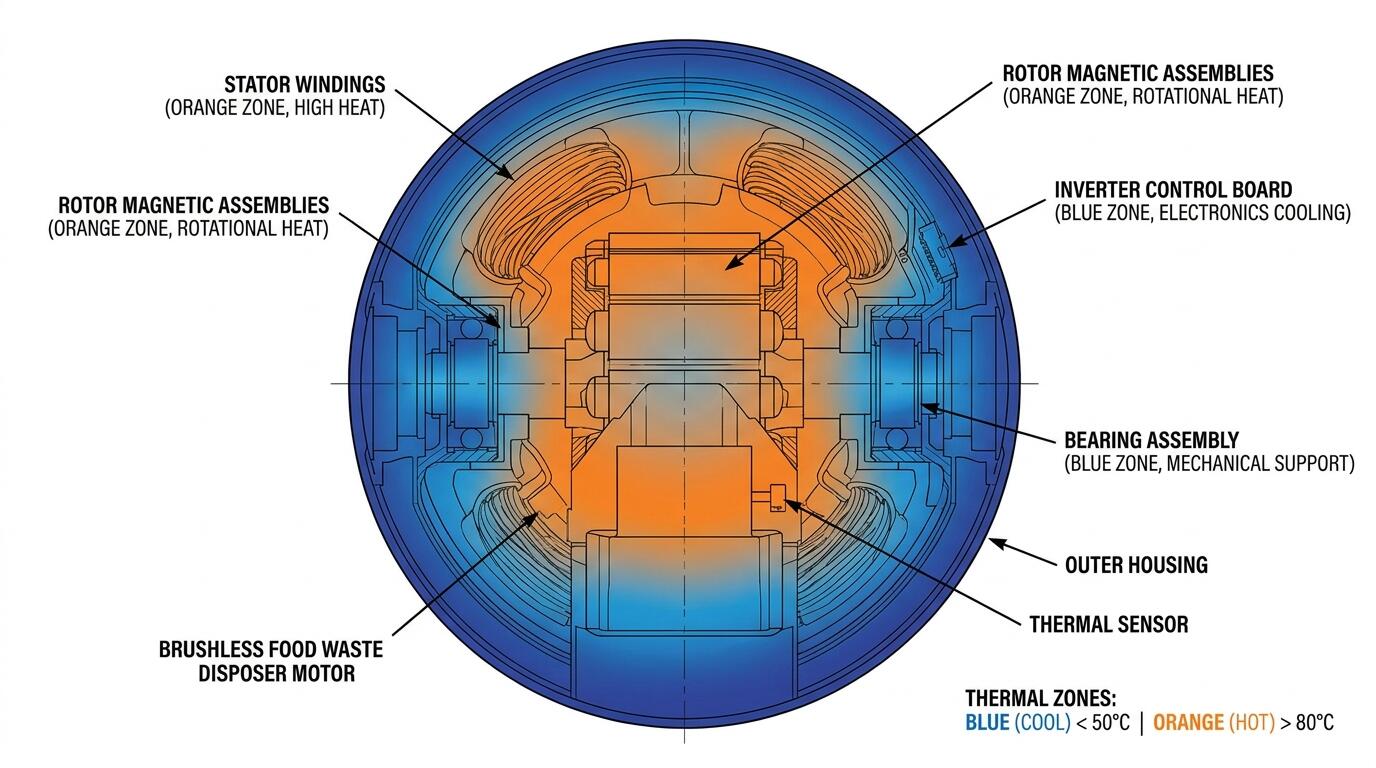
ALT: Cross-section diagram of a brushless food waste disposer motor undergoing endurance and thermal validation testing in an OEM lab
How a Disposer Is Tested: The Mechanisms Behind Each Validation Phase
Pre-production disposer validation is not a single test — it is a sequenced battery of distinct assessments, each targeting a different potential failure mode. Understanding the mechanism behind each phase explains why shortcuts at any stage translate directly into field failures.
Grind Performance and Throughput Testing
Grind performance testing is the most visible phase of disposer validation, and it involves running standardized food waste loads — typically calibrated mixtures of fibrous, starchy, and hard food materials — through prototype units under controlled conditions. The objective is to verify that the unit achieves consistent particle reduction to the size specified for drain compatibility, without jamming or requiring operator intervention. Testing engineers vary load volume, consistency, and feed rate to map the unit's operating envelope. A disposer that performs well with soft waste but jams on fibrous materials such as celery or corn husks reveals a fundamental mismatch between motor torque delivery and grinding chamber geometry — a problem that must be resolved before tooling is committed for mass production.
Motor Endurance and Thermal Stress Testing
Motor endurance testing subjects the disposer's drive system to repeated, extended operational cycles that simulate years of consumer use compressed into weeks of controlled laboratory conditions. For brushed motor models, engineers pay close attention to commutator and brush wear rates, as these components have defined service lives that must meet warranty period requirements. For brushless motor models — which eliminate mechanical commutation — the focus shifts to the permanence of magnetic assemblies, inverter board performance under thermal cycling, and bearing wear. Smart variable-frequency models introduce an additional layer of complexity: the control algorithm must be validated to confirm that automatic speed adjustment under load is both effective and thermally stable.
Thermal stress testing runs the unit continuously at or near its rated load until steady-state temperatures are reached, then verifies that internal temperatures at the motor windings, control board, and housing remain within limits specified by IEC 60335 and the unit's own thermal cutoff design. Units that fail thermal testing early in the validation cycle flag either an under-specified motor, inadequate ventilation, or a thermal protection circuit that trips prematurely under legitimate operating conditions.
Acoustic and Vibration Characterization
Acoustic validation is one of the most commercially sensitive test phases, because consumer noise perception is a primary driver of satisfaction scores and return rates in premium market segments. Testing is conducted in anechoic or semi-anechoic conditions, measuring sound pressure levels at defined distances and angles while the unit processes standardized loads. The results are compared against target specifications set during product development — specifications that are often defined in collaboration with the brand owner based on their target market and price positioning.
Vibration analysis accompanies acoustic testing. Excessive vibration not only generates noise but accelerates mechanical wear in mounting hardware, hose connections, and grind chamber components. Engineers use accelerometers to map vibration signatures at different operating speeds, identifying resonance frequencies that can be addressed through design modifications — damping materials, motor mounting geometry, or counterbalancing — before production tooling is finalized.
Ingress Protection and Seal Integrity Testing
Seal integrity and ingress protection (IP) testing validates that water and food particulate cannot penetrate the motor housing or electrical enclosure under the pressure and splash conditions a sink-mounted appliance realistically encounters. Per IEC 60529, the relevant ingress protection standard, test engineers subject units to defined water spray and immersion conditions and inspect for any moisture ingress at the motor or control board. Failures here represent both a safety hazard and a primary source of premature motor failure in the field.
Electrical Safety and Regulatory Compliance Verification
Electrical safety validation encompasses dielectric strength testing, insulation resistance measurement, and ground continuity verification — tests that confirm the unit will not present a shock hazard to users under fault conditions. This phase directly maps to requirements defined in standards such as IEC 60335-1 and the ANSI/UL 430 standard for waste disposers, which governs the North American market. For units targeting multiple geographies, engineers must validate compliance with each relevant framework simultaneously, which adds test iterations but ensures the finished product can be certified for sale without redesign.
Evidence, Trade-offs, and a Comparative View of Validation Approaches
Not all manufacturers invest equally in pre-production validation, and the trade-offs of different approaches become evident when products reach the market. The comparison below reflects patterns consistently observed in OEM manufacturing contexts.
| Validation Approach | Strengths | Trade-offs | Best Fit |
|---|---|---|---|
| Comprehensive in-house lab | Full control over test protocols; faster iteration between design and validation; protects IP | Higher capital investment; requires skilled testing engineers on staff | High-volume OEMs serving multiple brand clients; manufacturers with annual output above a defined threshold |
| Third-party testing only | Lower fixed cost; independent certification recognized by multiple markets | Slower feedback loops; limited ability to run iterative design tests; validation is pass/fail, not diagnostic | Small manufacturers; single-market products; early-stage brands |
| Hybrid (in-house screening + third-party certification) | Combines internal diagnostic speed with externally recognized certification outcomes | Requires coordination between internal and external teams; some test duplication | Mid-scale OEMs targeting multiple markets with different certification requirements |
| Minimal pre-production testing | Lowest upfront cost | High field failure risk; warranty cost exposure; potential regulatory non-compliance and market recall | Not recommended for any B2B client seeking sustainable brand positioning |
According to IEC's published guidelines on appliance testing, a systematic approach to pre-production validation — rather than reliance solely on end-of-line production sampling — is the most effective methodology for detecting design-related failure modes before they become field-scale quality events. This aligns with the engineering philosophy behind EACHER's manufacturing process: validation is treated as an integral phase of product development, not a final hurdle before shipment.
For B2B buyers, the practical implication is clear. When evaluating an OEM partner, requesting documentation of the pre-production test protocols — including which standards each test maps to, what pass/fail criteria are applied, and how test results feed back into design decisions — provides a far more reliable signal of manufacturing quality than a factory audit alone.
Where Disposer Validation Is Heading and What It Means for Buyers
The trajectory of pre-production disposer validation is moving in two clear directions simultaneously: greater depth and greater intelligence. On the depth side, markets are adding new performance dimensions — energy efficiency under variable load conditions, compatibility with water management systems, and end-of-life recyclability — that require new test methodologies. On the intelligence side, manufacturers are integrating sensor-based data acquisition into test rigs, enabling real-time monitoring of motor current, temperature, vibration, and acoustic signatures throughout extended endurance runs. This shift from periodic manual measurements to continuous digital monitoring accelerates failure detection and produces richer diagnostic data.
For brand owners and procurement teams, these trends have concrete implications. First, validation data is increasingly becoming a commercial asset — manufacturers who can share structured test reports demonstrating compliance with relevant IEC and ANSI standards provide buyers with documentation that supports market entry applications, retail partner qualification, and consumer-facing marketing claims. Second, as smart variable-frequency disposer models become more prevalent — a category that EACHER actively develops — the validation scope expands to include software and control algorithm testing alongside mechanical and electrical assessments.
The cost-effectiveness argument for rigorous pre-production validation is straightforward: the expense of thorough prototype and pre-production testing is a fraction of the cost of a field quality event. Warranty service logistics, replacement unit manufacturing, retailer penalty clauses, and brand reputation damage all carry costs that dwarf the investment in proper lab infrastructure. For procurement managers evaluating OEM partners on a total cost of ownership basis, a manufacturer's validation capability is a direct financial variable, not merely a technical specification.
Actionable guidance for B2B buyers approaching OEM partner selection in this space: request a written description of the validation sequence applied to new product introductions; ask specifically which international standards each test phase maps to; confirm whether grind performance, acoustic, thermal, seal, and electrical safety phases are all covered in-house or outsourced; and review sample test reports to assess the diagnostic depth of the documentation. Visit the EACHER website to explore how these capabilities are embedded in our OEM/ODM development process.
People Also Ask
Q1: How does a food waste disposer manufacturer validate motor performance before mass production?
Motor performance validation in food waste disposer manufacturing involves endurance cycling — running the motor under sustained load conditions that simulate extended consumer use — combined with thermal profiling to confirm temperatures remain within design limits at steady state. For brushless and smart variable-frequency models, control board and algorithm stability are also verified under load variation. The results are compared against specifications derived from applicable IEC 60335 requirements and the product's own design targets before production release approval is granted.
Q2: Are IEC or ANSI standards required for food waste disposer certification in major markets?
Market certification requirements vary by geography, but in practice, compliance with IEC 60335-1 (general household appliance safety) and its relevant specific parts is required for major markets including the EU and many Asia-Pacific countries, while ANSI/UL 430 governs waste disposer certification in North America. Manufacturers targeting multiple geographies must validate against all applicable frameworks. Working with an OEM partner whose in-house testing infrastructure is designed around these standards eliminates the risk of redesign costs at the certification stage.
Q3: How long does pre-production validation typically take, and how does it affect project timelines?
The duration of a complete pre-production validation cycle depends on the complexity of the product — whether it is a brushed, brushless, or smart variable-frequency model — and the number of design iterations required. Endurance testing alone, by nature, requires extended run hours to be meaningful. Buyers should factor validation lead time into product launch planning rather than treating it as compressible. An OEM partner with comprehensive in-house lab capability can run multiple validation phases in parallel, reducing overall cycle time compared to sequential external testing.
Summary
Pre-production performance validation is the engineering discipline that determines whether a food waste disposer reaches the market as a reliable product or a warranty liability. Three core points anchor the analysis in this article.
First, validation is multi-dimensional. Grind performance, motor endurance, thermal stability, acoustic behavior, seal integrity, and electrical safety each represent distinct potential failure modes that require dedicated, standards-referenced testing — not a single pass/fail check.
Second, the validation approach an OEM partner uses is a direct indicator of the total cost of ownership for the brand owner. Rigorous in-house testing reduces the probability of field quality events, which carry costs — warranty, logistics, brand damage — that substantially exceed the cost of thorough pre-production testing.
Third, the standards landscape is defined and auditable. IEC 60335, IEC 60529, and ANSI/UL 430 provide clear frameworks against which any manufacturer's validation protocols can be assessed. Buyers who request explicit mapping of test phases to these standards are in a stronger position to evaluate OEM partner quality than those who rely on general factory audit outcomes alone.
The next step for procurement managers and product development teams is to treat the validation lab as a non-negotiable line item in OEM partner qualification — ask for documentation, review sample reports, and confirm that the testing sequence covers every relevant performance dimension before committing to a mass production agreement.
Ready to bring your food waste disposer product to life with a trusted manufacturing partner? EACHER specializes in fully customized OEM/ODM solutions — from brushed and brushless to smart variable-frequency models — backed by an annual capacity of 300,000 units. Visit EACHER to explore our capabilities and request a tailored quote today.
Sources & Further Reading
- International Electrotechnical Commission (IEC). "IEC 60335-1: Household and Similar Electrical Appliances — Safety — General Requirements".
https://www.iec.ch - International Electrotechnical Commission (IEC). "IEC 60529: Degrees of Protection Provided by Enclosures (IP Code)".
https://www.iec.ch - American National Standards Institute / Underwriters Laboratories. "ANSI/UL 430: Standard for Waste Disposers".
https://www.ul.com - International Organization for Standardization (ISO). "ISO 9001: Quality Management Systems — Requirements".
https://www.iso.org - U.S. Environmental Protection Agency (EPA). "Resources and Guidance on Household Food Waste Management and Appliance Environmental Considerations".
https://www.epa.gov
Note: Standards may be updated; please check the latest official documents or consult professional advisors.