
 +8657486688117
 400-616-0305
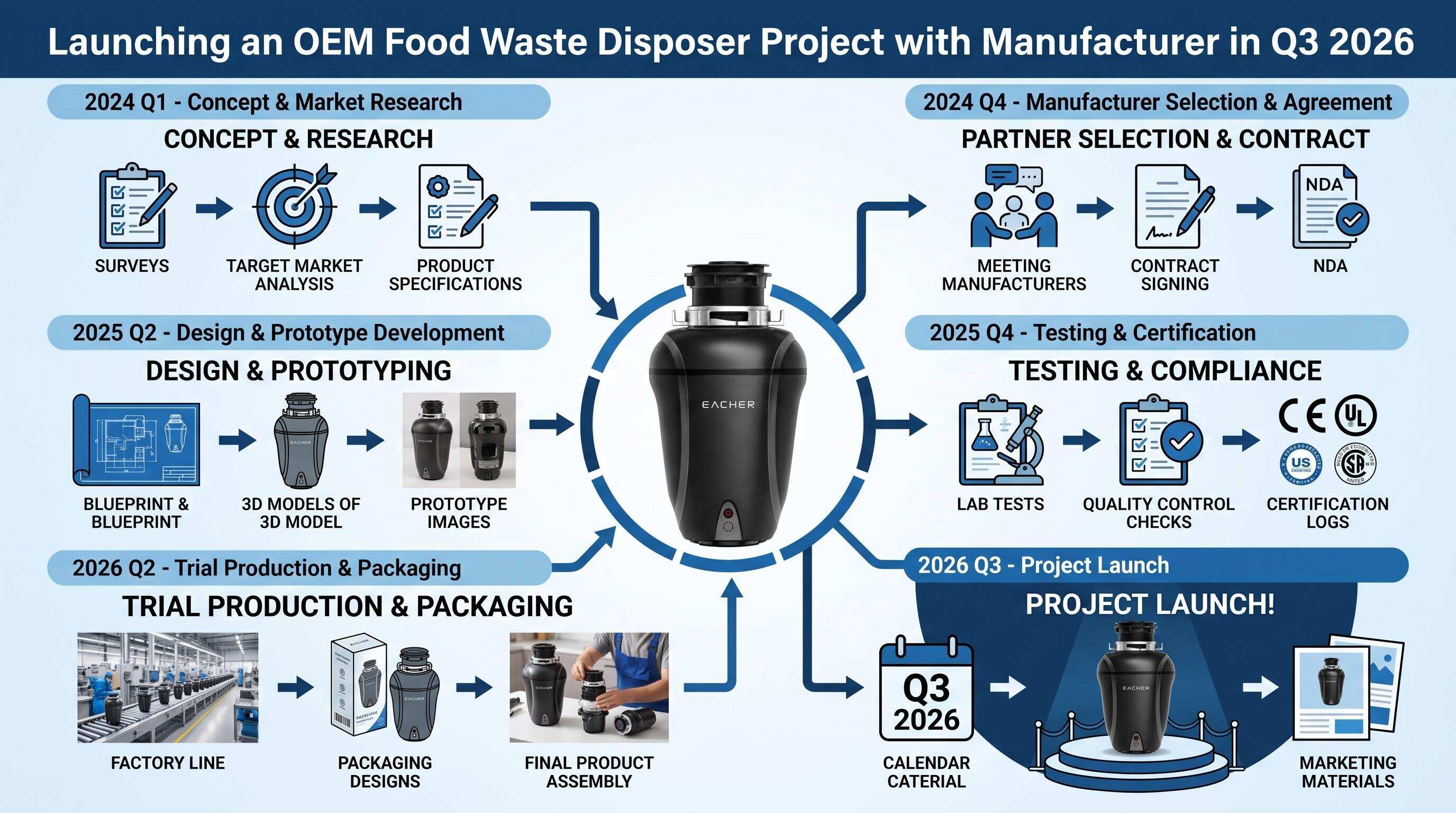
ALT: Step-by-step guide to launching an OEM food waste disposer project in Q3 2026 with a manufacturer
Why Q3 2026 Is a Strategic Window for Launching Your OEM Food Waste Disposer Project
Product managers and procurement teams sourcing food waste disposers for private-label or branded programs face a recurring challenge: timing. Launch too early and you are locked into specifications before the market stabilizes; move too late and you miss the seasonal restocking window that retailers depend on. For teams planning to place product on shelves or in distribution channels by late 2026 or early 2027, initiating an OEM food waste disposer project in Q3 2026 — July through September — represents the most practical path to hitting that window with a certified, market-ready product.
This guide is written for kitchen appliance brand managers, private-label buyers, importers, and procurement directors who are either starting their first OEM disposer engagement or systematizing a process they have run informally before. It draws on our day-to-day work at EACHER, where we manufacture brushed, brushless, and smart variable-frequency food waste disposers at a production capacity of 300,000 units per year for global clients. The steps, checkpoints, and cautions here reflect what we consistently see working — and what stalls projects unnecessarily.
Before You Start: Prerequisites and Preparation for Your OEM Disposer Program
Starting an OEM food waste disposer project without foundational preparation is one of the most common reasons timelines slip. Before you engage any manufacturer, you need a clear picture of your market, your product concept, and your organizational readiness. This preparation phase is not a formality — it is the input that determines the quality of every quote, sample, and tooling decision that follows.
Market and Regulatory Clarity
Food waste disposers are regulated differently across jurisdictions. In North America, products must comply with standards governed by organizations such as UL (Underwriters Laboratories) and NSF International. In Europe, the CE marking framework applies, covering electromagnetic compatibility (EMC) and low-voltage directives. According to IEC standards relevant to household motor-operated appliances, disposer motors and electrical systems must meet defined safety and performance criteria before market entry. Know which markets you are entering before you write a single specification.
Product Concept Definition
You should be able to articulate whether you need a brushed motor disposer (cost-effective, proven for mid-market price points), a brushless motor disposer (quieter, longer service life, premium positioning), or a smart variable-frequency model (app control, adaptive grinding, energy optimization). Each technology path has different tooling lead times, component sourcing requirements, and certification timelines.
Organizational Readiness
Identify internally who owns supplier qualification, quality sign-off, and logistics coordination. Projects stall most often not at the factory — but because the client-side approvals chain is undefined.
Checklist before starting:
- Target market(s) confirmed, with applicable electrical standards (voltage, frequency, plug type) documented
- Motor technology type selected: brushed, brushless, or smart variable-frequency
- Annual volume estimate (minimum order quantity discussions require a number, even if approximate)
- Budget range established, including tooling, sampling, and certification cost provisions
- Internal stakeholders identified: procurement lead, product development contact, quality/compliance owner
- Target retail or distribution timeline confirmed, working backward to set a factory engagement deadline
- NDA or confidentiality framework ready for initial specification discussions with manufacturers
Time and effort: the preparation phase typically runs two to four weeks if internal alignment exists. Teams without a defined product concept or regulatory map should plan for longer.
Step-by-Step Instructions: Launching Your OEM Food Waste Disposer Project in Q3 2026
Step 1: Define Your Product Specification Brief with Precision
A specification brief is the single most important document in an OEM food waste disposer project. It translates your commercial requirements into engineering parameters that a manufacturer can actually work from.
Your brief should cover motor type and power range (described qualitatively if exact figures are not yet confirmed), grinding chamber material, feed type (continuous or batch), noise targets, cord length and plug standard, color and finish requirements, and any smart features such as variable-frequency control or mobile connectivity. Include your target retail price, because this directly shapes component-grade decisions on the factory side. Also specify which third-party certifications the final product must carry — UL, CE, RoHS, NSF, or others depending on your markets.
In our work with clients, the briefs that move fastest through engineering review are those that distinguish between non-negotiable requirements and preferred-but-flexible parameters. This distinction gives the manufacturer's engineering team room to propose cost-efficient alternatives without repeatedly going back to the client for scope clarification.
Tip: Create a two-column format: "Must Have" versus "Nice to Have." Share this with your manufacturer contact at the first meeting. It compresses the initial back-and-forth significantly.
Step 2: Qualify and Select Your OEM Manufacturing Partner
Selecting the right OEM food waste disposer manufacturer is not simply a matter of finding the lowest unit cost. It requires evaluating a supplier's engineering capability, production capacity, quality management infrastructure, and experience with the regulatory requirements of your target markets.
When evaluating manufacturers, ask for evidence of annual production volume, the breadth of motor technologies they can produce in-house, and their existing certification portfolio. A manufacturer with demonstrable brushed, brushless, and variable-frequency production lines — rather than a single motor type — gives you future flexibility as your product line expands. EACHER's manufacturing facility, operated under Ningbo Yiju Environmental Technology Co., Ltd., runs an annual production capacity of 300,000 units across all three motor technology categories, which reflects the kind of scale that ensures component sourcing stability and consistent production scheduling.
Request references or case study descriptions (without confidential client names) that demonstrate experience with export markets comparable to yours. Ask specifically about their process for managing certification testing — whether they coordinate with third-party labs directly or expect the client to manage that relationship.
Tip: Issue a Request for Quotation (RFQ) that includes your specification brief, volume estimate, and target delivery timeline. Evaluate not just price but the quality and specificity of the manufacturer's technical response — a vague response to a detailed RFQ is a meaningful signal.
Step 3: Conduct Factory Audit or Remote Qualification Assessment
For OEM programs above a certain volume threshold or for first-time manufacturer engagements, a factory audit is standard practice. This can be an in-person visit to the manufacturing facility or a structured remote assessment using documented evidence — particularly common for international buyers managing travel costs.
A credible factory assessment covers quality management system certification (ISO 9001 is the baseline standard for quality management systems, per the International Organization for Standardization), production floor organization, incoming material inspection processes, and finished goods testing protocols. Pay specific attention to how the manufacturer handles motor assembly and grinding chamber inspection, as these are the two subsystems most likely to generate field failures.
Remote audits should request photographic and video documentation of production lines, calibration records for test equipment, and copies of existing product certifications. For clients in regulated markets, verifying that the manufacturer's internal testing aligns with the requirements of standards bodies — such as IEC technical committees governing household appliances — is essential due diligence.
Tip: Prepare a structured audit questionnaire in advance and share it with the manufacturer before the visit or remote session. Manufacturers who object to detailed pre-audit questions are worth scrutinizing further.
Step 4: Finalize Product Design and Engineering Samples
Once a manufacturing partner is selected and specifications are aligned, the project moves into engineering sample development. This phase produces physical prototypes for functional and aesthetic evaluation before any production tooling investment is committed.
Engineering samples are typically used to validate motor performance, grinding efficiency, noise levels, fit and finish, and user interface behavior for smart models. Expect an iterative cycle — the first sample rarely meets all requirements simultaneously, and two to three revision rounds before sample approval is a normal pattern in our experience. Document every revision request in writing against the original specification brief, so the change history is traceable.
For smart variable-frequency models, this phase also includes firmware review and mobile app integration testing if applicable. Ensure that your internal product team — not just procurement — is involved in sample evaluation, as engineering trade-offs made here affect the product's market positioning.
Tip: Align on a formal sample sign-off protocol before samples arrive. Undefined approval processes are a leading cause of project delays at this stage, as revision requests without documented closure keep engineering cycles open indefinitely.
Step 5: Initiate Certification and Compliance Testing
Certification is not a final step — it is a parallel workstream that should begin as soon as engineering samples are sufficiently stable. Waiting until production is ready to start certification is a planning error that adds months to your timeline.
For North American markets, UL certification for food waste disposers is the primary safety standard. NSF certification may apply depending on installation context. For European markets, CE marking requires conformity assessment against applicable directives, with EMC and low-voltage directives most commonly relevant. For markets in Asia-Pacific or the Middle East, additional national certifications may apply.
Work with your manufacturer to understand which certifications they hold at the product platform level versus which will require new testing for your specific configuration. A manufacturer with an established certification portfolio for comparable product platforms can significantly reduce the time and cost of compliance testing for derivative designs. Per IEC standards for household motor-operated appliances, motor insulation, thermal cut-off, and grounding requirements are among the key technical parameters assessed in testing.
Tip: Engage your target certification body early — before samples are finalized — to confirm current test requirements and expected turnaround times, which can vary by laboratory capacity and jurisdiction.
Step 6: Confirm Production Tooling, Packaging, and Labeling
Custom OEM programs typically require tooling investment for branded components — front panels, housing colors, control interfaces — and often for packaging dies and inserts as well. This investment is front-loaded: tooling is paid before production runs begin and is amortized across the contracted volume.
Confirm tooling specifications in writing, including ownership terms (client-owned tooling held at the factory is standard practice), estimated tooling lead time, and the process for tooling approval samples. Packaging and labeling must reflect your market's regulatory requirements — ingredient warnings, electrical safety marks, disposal instructions, and country-of-origin marking are all jurisdiction-specific.
In our work with international clients, a pattern we consistently see is underestimating the complexity of multi-market packaging. If you sell into both North America and Europe, running unified packaging with bilingual content and dual-certification marks is achievable — but requires a precise briefing process with the manufacturer to avoid reprints.
Tip: Request a pre-production packaging mockup for sign-off before any large-scale print run. Packaging corrections after printing are expensive and delay shipment schedules.
Step 7: Place Production Order and Plan Logistics
With samples approved, certifications confirmed (or in process with a confirmed schedule), and tooling signed off, the project moves to production order placement. At this stage, confirm your production slot in writing, including start date, expected completion, and quality inspection plan.
For Q3 2026 project initiations targeting late-2026 or Q1 2027 market availability, production scheduling should account for pre-shipment inspection (either third-party or client-managed), ocean freight lead times, and any import customs clearance timelines in your destination market. Third-party inspection organizations such as SGS or Bureau Veritas are commonly used for pre-shipment quality checks on appliance shipments.
Define incoterms clearly in your purchase agreement — FOB, CIF, or DDP depending on your logistics preference and capability. Incoterm selection directly affects where financial risk transfers between manufacturer and buyer, and it determines who manages export documentation and destination customs clearance.
Tip: Build a production-to-delivery Gantt chart that maps every milestone from production start through to warehouse receipt, with buffer time built in for customs clearance variability. Share this with your manufacturer contact so both parties are managing to the same schedule.
Common Mistakes and Troubleshooting in OEM Food Waste Disposer Projects
| Symptom | Likely Cause | How to Fix |
|---|---|---|
| Specification brief generates inconsistent quotes from different manufacturers | Brief lacks specificity — motor type, power, certifications, and target price are undefined or ambiguous | Revise brief using a structured template covering technical, regulatory, and commercial parameters before re-issuing RFQs |
| Engineering samples fail noise or vibration requirements across multiple revision rounds | Motor mounting design or grinding chamber geometry is mismatched to the motor technology selected | Escalate to a joint engineering review with the manufacturer; consider switching motor type if the mismatch is fundamental |
| Certification testing timeline overruns project schedule | Certification engagement started too late, after production readiness rather than in parallel | Build certification initiation into the engineering sample phase; treat compliance testing as a parallel workstream, not a sequential final step |
| Packaging arrives at destination with incorrect regulatory marks or missing language | Multi-market packaging requirements were not specified in detail early enough | Issue a formal packaging brief with a per-market regulatory checklist; require pre-production mockup sign-off before any print run |
| Production slot is delayed or bumped by the manufacturer | Order was placed without a confirmed purchase agreement and production schedule | Confirm production scheduling in writing with a signed purchase order before committing to downstream logistics bookings |
| Custom tooling does not match approved sample aesthetics | Tooling specifications were communicated verbally or as rough sketches rather than formal engineering drawings | Require 2D/3D engineering drawings for all tooled components, with a tooling sample approval step before production tooling is finalized |
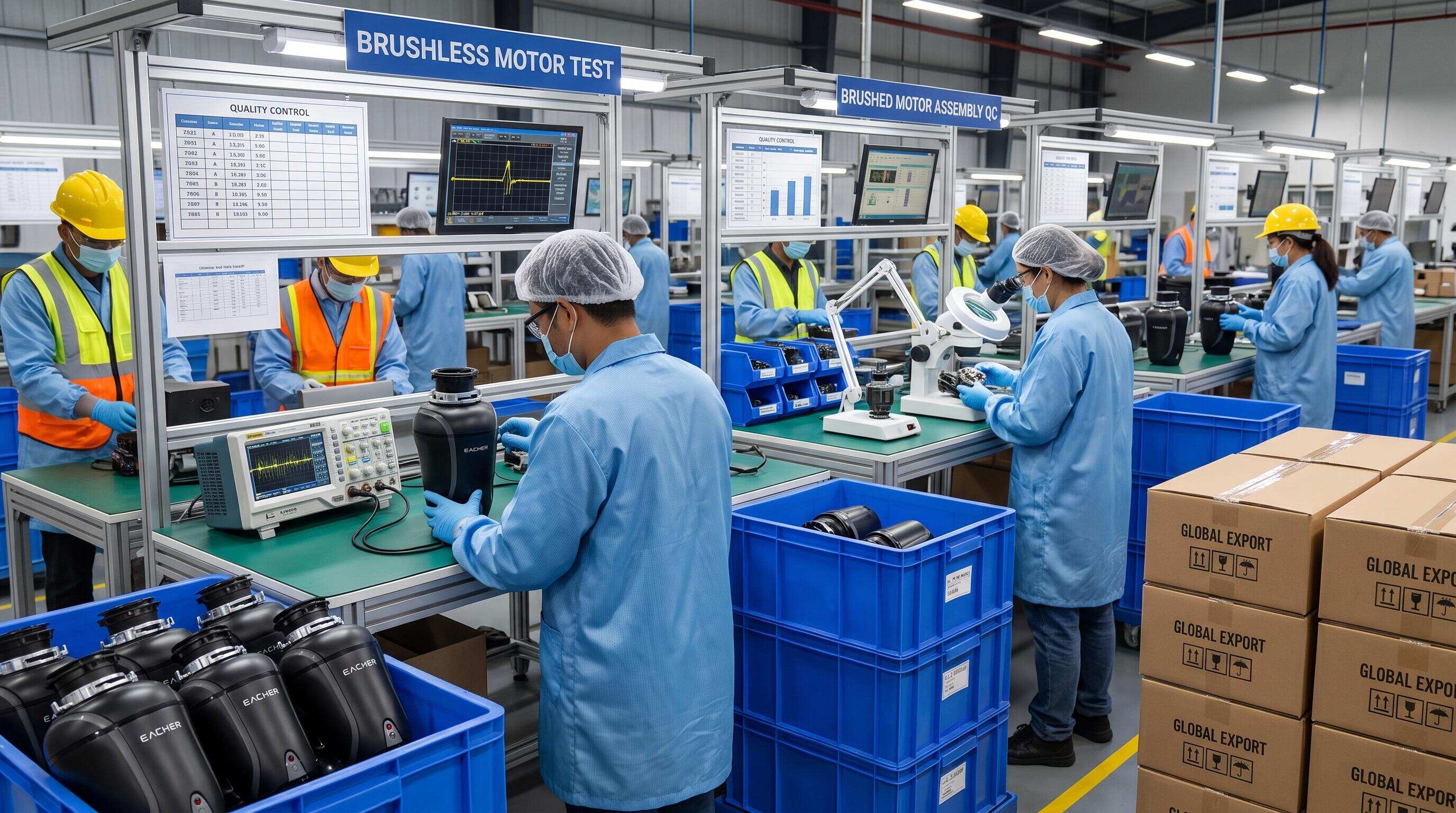
ALT: OEM food waste disposer production line quality inspection at a manufacturer facility, verifying brushless and brushed motor assembly for global export
Pro Tips for Better Results in Your OEM Disposer Program
Lock in motor technology before tooling, not after. A pattern we consistently see in stalled projects is clients who begin tooling development while still undecided between brushless and brushed motor configurations. The two motor types have different mounting geometries and noise profiles that propagate through the housing and mounting design. Changing motor type after tooling is committed is expensive and time-consuming.
Treat your manufacturer's engineering team as a co-development resource. Manufacturers with genuine R&D capability — particularly those working across brushed, brushless, and variable-frequency platforms — have resolved most of the engineering challenges your project will encounter before you arrive. Engage them at the specification stage rather than just the quotation stage. The specification brief you receive back will be materially better.
Build certification cost into your COGS model from the start. A common misconception among first-time OEM buyers is that certification is a one-time sunk cost that disappears after the first product launch. In reality, certifications must be maintained, any specification change that affects a certified parameter triggers re-testing, and entering new markets means new certification programs. Model this as a recurring operational cost, not a project-phase expense.
Plan for a second-generation design from day one. The specification and engineering decisions you make in your first OEM project create the technical foundation for subsequent iterations. Manufacturers who retain tooling records, firmware versions, and component sourcing documentation in a structured way make second-generation development significantly faster. Ask your manufacturer about their design archive and change management practices before committing to a long-term partnership.
Do not underestimate the value of local-language regulatory expertise. For markets in the EU or countries with evolving appliance regulations, having a compliance advisor who monitors regulatory updates — rather than relying solely on the manufacturer's interpretation — adds a meaningful layer of risk management to your program.
Frequently Asked Questions FAQ
Q1: How long does a complete OEM food waste disposer project typically take from brief to first shipment?
An OEM food waste disposer project from initial specification brief to first production shipment spans a range that varies considerably based on product complexity, certification requirements, and tooling scope. For straightforward configurations built on an existing platform, the timeline is shorter; for fully custom designs requiring new tooling and first-time certification in multiple markets, the process is longer. Q3 2026 initiation is well-positioned to target late-2026 or Q1 2027 market availability if the preparation work outlined in this guide is completed before factory engagement begins.
Q2: Is it possible to source brushed and brushless motor disposers from the same OEM manufacturer?
Yes, sourcing both brushed and brushless motor food waste disposers from a single manufacturer is possible and generally advisable for brand consistency and supply chain simplicity — provided the manufacturer has genuine in-house production capability across both motor technologies. EACHER manufactures brushed, brushless, and smart variable-frequency models within the same production facility, which allows clients to manage a tiered product line across price points without managing multiple factory relationships. Verify capability by requesting sample products from each motor category, not just a product catalog.
Q3: What is the typical minimum order quantity for a private-label OEM food waste disposer program?
Minimum order quantities for OEM food waste disposer programs vary by manufacturer, product complexity, and whether custom tooling is involved. Manufacturers with high production capacity — such as facilities running at the scale of 300,000 units per year — can often accommodate lower entry-level MOQs for clients with strong long-term volume potential, though custom-tooled programs typically require higher initial commitments to offset tooling amortization. The most reliable way to determine applicable MOQs is to present your volume forecast alongside your specification brief when making initial contact with a manufacturer.
Key Takeaways
An OEM food waste disposer project initiated in Q3 2026 is achievable and strategically sound for brands targeting late-2026 or early-2027 market availability — but only if the preparation, partner selection, and certification planning described in this guide are executed in sequence and without the delays that commonly compress timelines at the back end.
Three points deserve particular emphasis. First, the specification brief is the project's foundation: its quality determines the quality of everything downstream, from quotes to samples to certifications. Second, certification is a parallel workstream, not a final step — teams that initiate compliance testing at the engineering sample stage rather than at production readiness consistently hit their launch targets. Third, manufacturer selection should prioritize engineering depth and multi-technology capability over unit price alone — a manufacturing partner who can support brushed, brushless, and variable-frequency platforms within a single facility gives your program the flexibility to evolve without supplier transitions.
The next practical action is to complete your preparation checklist, finalize your specification brief, and begin manufacturer qualification in parallel. The Q3 2026 window is specific enough to create useful urgency without being so compressed that a well-organized team cannot execute it properly.
Ready to bring your next food waste disposer product to life? EACHER offers end-to-end OEM/ODM manufacturing solutions — from brushed and brushless motors to smart variable-frequency models — backed by a production capacity of 300,000 units per year. Visit the EACHER website today to explore customization options, request a product catalog, or connect with our engineering team for a tailored quote.
Sources & Further Reading
- International Organization for Standardization (ISO). "ISO 9001 — Quality Management Systems."
https://www.iso.org - International Electrotechnical Commission (IEC). "IEC Standards for Household and Similar Electrical Appliances."
https://www.iec.ch - Underwriters Laboratories (UL). "UL Standards and Certification Programs for Household Appliances."
https://www.ul.com - NSF International. "NSF Certification and Standards for Food Equipment and Plumbing."
https://www.nsf.org - European Commission. "CE Marking — Requirements for Electrical and Electronic Equipment Placed on the EU Market."
https://ec.europa.eu
Note: Standards may be updated; please check the latest official documents or consult professional advisors.