
 +8657486688117
 400-616-0305
ALT: Brushless variable-frequency motor food waste disposer powering global kitchen appliance market growth
The Motor Technology Shift Redefining Global Food Waste Disposer Markets
Why are brushless variable-frequency motors — once a premium differentiator found only in high-end segments — rapidly becoming the default motor architecture across global food waste disposer product lines? The direct answer is this: a convergence of tightening energy regulations, rising consumer expectations for quiet and intelligent appliances, and the maturation of variable-frequency drive technology has made brushless motor platforms the structurally superior choice across a widening range of market conditions. This shift is no longer a future trend to monitor — it is already reshaping procurement decisions, OEM development roadmaps, and sourcing strategies for importers and private-label brands worldwide.
Understanding this transition is critical for any B2B buyer, distributor, or product developer working in the kitchen appliance or environmental technology space. The motor at the core of a food waste disposer determines its performance envelope, service life, energy footprint, noise profile, and ultimately its viability in markets where consumer and regulatory standards are rising in tandem. Getting the motor architecture right at the sourcing stage is not an engineering detail — it is a strategic product decision.
Background and Current Landscape: From Brushed Motors to Smart Variable-Frequency Drives
Food waste disposers have been a fixture in residential kitchens — particularly in North American markets — for decades, and for most of that history, the brushed motor was the industry standard. Brushed motors are mechanically straightforward: carbon brushes make physical contact with a rotating commutator to transfer electrical current, generating torque. This simplicity kept manufacturing costs low and made brushed disposers accessible at mass-market price points globally.
The limitations of brushed motor technology, however, are well documented in electrical engineering literature. Physical contact between brushes and commutator creates continuous friction and heat, leading to gradual brush wear, commutator degradation, and an eventual service life ceiling. Noise output is also inherently higher in brushed designs because of mechanical commutation vibration. For markets where consumers increasingly demand quiet, durable, and energy-efficient appliances — particularly in Europe, East Asia, and premium North American segments — brushed disposers have faced growing headwinds.
The emergence of brushless DC motors (BLDC motors) in consumer appliance applications changed the engineering calculus. A brushless DC motor is a motor that eliminates the physical brush-commutator interface entirely, replacing mechanical commutation with electronic control via a motor controller or inverter. This removal of friction-generating components extends operational lifespan significantly and reduces heat generation. According to research tracked by MarketsandMarkets, the global brushless DC motor market is projected to reach approximately $20.68 billion by 2030, reflecting accelerating adoption across appliance, automotive, HVAC, and industrial segments — a trajectory that the food waste disposer category is clearly participating in.
The next layer of this evolution is the introduction of variable-frequency drive (VFD) technology, also called inverter control, into the disposer motor system. A variable-frequency drive is an electronic controller that adjusts the frequency and voltage supplied to a motor, allowing precise speed and torque modulation in response to load conditions. According to Precedence Research, the global variable frequency drive market is on a trajectory toward USD 3.43 billion, driven by industrial energy-efficiency mandates and the expanding application of inverter-controlled motors in consumer goods. In the context of food waste disposers, pairing a brushless motor with a variable-frequency controller produces what the industry now refers to as a smart variable-frequency disposer — a product category that is gaining measurable share in global sourcing inquiries and retailer line-ups.
At EACHER, a professional food waste disposer manufacturer operating under Ningbo Yiju Environmental Technology Co., Ltd., we have observed this transition accelerating in real time. Client briefs that previously specified brushed motor platforms for cost efficiency are increasingly opening with brushless or variable-frequency requirements as baseline specifications, not premium add-ons. The pattern is consistent across inquiries from European distributors, North American private-label brands, and Southeast Asian importers.
Root-Cause Analysis: Why Brushless Variable-Frequency Motors Are Winning Market Share
The shift toward brushless and variable-frequency motor architectures in food waste disposers is not driven by a single factor. It is the result of several distinct and mutually reinforcing forces, each of which merits careful examination.
Energy Efficiency Mandates Are Tightening Globally
Regulatory pressure on appliance energy consumption is intensifying across the world's major import markets. The European Union's Ecodesign Regulation framework, administered under directives that establish minimum energy performance standards for household appliances, has progressively extended its scope to include kitchen and food preparation devices. Markets in Asia — particularly South Korea and Japan — maintain their own rigorous energy-efficiency labeling and certification regimes. In the United States, the Department of Energy continues to expand its energy conservation standards program.
Variable-frequency motor control directly addresses these regulatory pressures by dynamically matching motor power output to the actual processing load. A conventional brushed motor operating at fixed speed draws consistent power regardless of whether it is processing a light load of vegetable scraps or grinding a tough, fibrous waste load — an inherently inefficient operating profile. A brushless variable-frequency disposer, by contrast, modulates speed and torque continuously, consuming power commensurate with actual demand. For OEM clients targeting markets with mandatory energy ratings, this difference can determine product eligibility for sale in key retail channels.
Consumer Demand for Quieter, Smarter Appliances
In our work with clients across multiple continents, noise performance is among the most consistent product differentiators cited by distributors and end-market retailers. Kitchen environments — particularly in open-plan living spaces prevalent in European and East Asian urban housing — have made appliance noise a genuine purchase-decision factor. Brushed motors, with their mechanical commutation, produce a characteristic noise signature that is difficult to suppress through enclosure design alone.
Brushless motors operate without mechanical commutation contact, which removes the primary source of high-frequency electrical noise and reduces overall vibration. When combined with variable-frequency speed control, the motor can also be programmed to ramp speed gradually rather than engaging at full power instantaneously — a feature that further reduces perceived startup noise. For distributors building premium product lines for urban markets, this noise advantage translates directly into higher customer satisfaction ratings and reduced return rates.
Extended Service Life and Lower Total Cost of Ownership
The total cost of ownership calculation for a food waste disposer extends well beyond the unit purchase price. Service calls, warranty claims, and replacement cycles are real costs borne by importers, retailers, and end consumers. Brushed motors face an unavoidable wear mechanism in their brush-commutator interface; as brushes degrade, motor efficiency drops and failure risk increases. Brushless motor platforms eliminate this wear mode entirely, producing service life characteristics that are substantially superior under equivalent operating conditions.
According to market analysis tracked by Market.us covering the global brushless DC motor market, adoption of BLDC motors in appliance segments is accelerating precisely because manufacturers and their downstream partners recognize the lifecycle cost advantage. For OEM clients building private-label disposer lines that carry multi-year warranty obligations, the reliability delta between brushed and brushless platforms has direct financial implications for after-sales costs.
Smart Home Integration and IoT Compatibility
Modern kitchen appliances are increasingly expected to participate in smart home ecosystems. Smart variable-frequency disposers — disposers equipped with brushless motors and inverter control systems — are inherently more compatible with smart home integration because their electronic control platforms can communicate status, load data, and fault diagnostics to external systems. This creates a product architecture that can support features such as over-current protection, jam detection with auto-reverse, speed adaptation for different waste types, and app-based monitoring.
For private-label brands targeting premium retail segments or building product lines for smart home platform integration, the electronic control infrastructure of a brushless variable-frequency disposer provides a development foundation that brushed motor platforms fundamentally cannot offer. In our experience, clients who have initially sourced brushed models and later sought to add smart features have encountered significant re-engineering costs — a pattern that makes the upfront investment in brushless architecture increasingly compelling.
Manufacturing Cost Curve Improvements
Historically, the cost premium of brushless motors and associated inverter electronics represented a meaningful barrier for price-sensitive market segments. That cost gap has been narrowing consistently as global BLDC motor production volumes increase and as the electronics supply chain for motor controllers becomes more efficient. The growth trajectory of the brushless DC motor market — toward the $20.68 billion milestone cited by MarketsandMarkets — is itself partly a function of scale economies reducing per-unit costs and enabling brushless technology to penetrate mid-market price points previously held exclusively by brushed designs.
Evidence and Multi-Angle Comparison: Assessing the Trade-offs Across Motor Technologies
The case for brushless variable-frequency motors is strong, but a rigorous analysis requires acknowledging the genuine trade-offs across technology approaches. Different markets, product segments, and buyer priorities do not yield a single universal answer — the right motor architecture depends on the specific deployment context.
| Perspective / Approach | Strengths | Trade-offs | Best Fit |
|---|---|---|---|
| Brushed Motor Disposer | Lower unit cost, mechanically simple, established supply chain, straightforward maintenance | Shorter service life due to brush wear, higher noise output, fixed speed operation, limited smart home compatibility | Price-sensitive entry-level markets, high-volume commodity retail, markets with minimal energy-efficiency regulations |
| Brushless Motor Disposer | Extended service life, lower operational noise, no brush wear mechanism, higher efficiency at sustained loads | Higher component cost, requires electronic motor controller, more complex OEM tooling for new entrants | Mid-to-premium retail segments, warranty-sensitive private-label programs, markets with moderate energy-efficiency requirements |
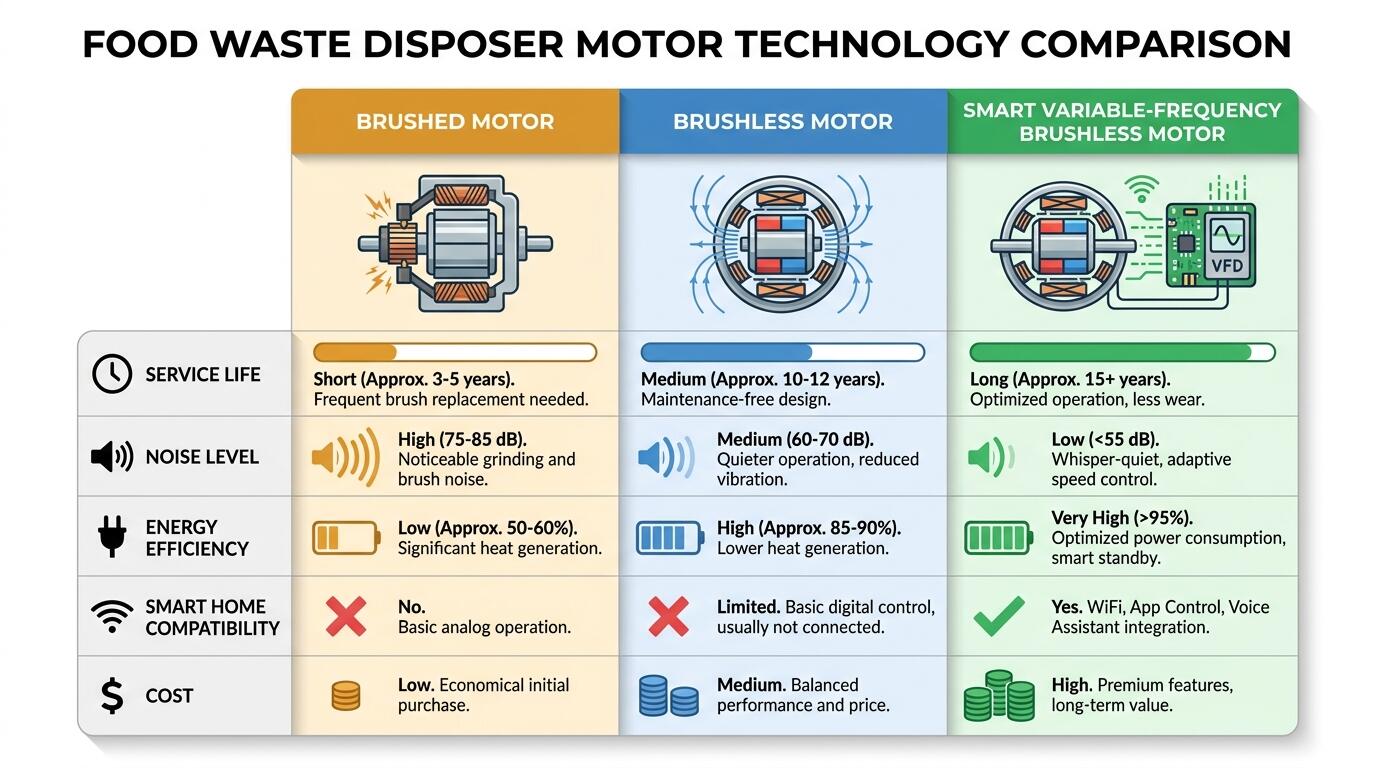
| Smart Variable-Frequency Brushless Disposer | Maximum energy efficiency through load-adaptive speed control, lowest noise profile, smart home integration capability, auto-protection features, superior performance across waste type variations | Highest initial unit cost, most complex electronic system, requires qualified after-sales support infrastructure | Premium retail, smart home ecosystem integration, markets with stringent energy labeling, brand-differentiation-focused OEM clients |
ALT: Comparison table showing brushed, brushless, and smart variable-frequency food waste disposer motor technologies for global OEM manufacturing clients
The table above illustrates that the competitive landscape is not a simple binary between old and new technology. Brushed motors retain genuine market relevance in specific deployment contexts. The meaningful insight for procurement managers and OEM clients is that the addressable market for brushed motors is contracting — particularly as energy regulations extend their scope to mid-range appliance categories and as consumers in more markets become sensitized to noise and durability performance.
Distributors who have shared sourcing patterns with us consistently report that retailer buyers — especially in European and East Asian markets — are applying increasingly stringent energy and noise performance criteria at the product qualification stage. Products that cannot meet these criteria, regardless of price, are being delisted from premium shelf positions and online flagship stores. The market pressure is structural, not cyclical.
The IEC (International Electrotechnical Commission) publishes relevant standards governing motor efficiency classifications and appliance electromagnetic compatibility — frameworks that are directly applicable to the motor systems used in food waste disposers and that favor the performance characteristics of brushless, electronically controlled motor designs. Compliance with such standards is often a prerequisite for market access in regulated regions.
Outlook and What It Means for Global OEM and Sourcing Decisions
Brushless variable-frequency motors are on a clear trajectory to become the dominant motor architecture in food waste disposers across global mid-to-premium market segments within the near term. The structural forces driving this shift — regulatory tightening, consumer preference evolution, supply chain cost normalization, and smart home platform growth — are not reversing. They are intensifying.
For B2B buyers, importers, and private-label brand developers, the practical implications are significant:
Product roadmap planning should assume brushless as the default, not an upgrade path. Brands that design their core product lines around brushed motors today face a higher probability of needing disruptive platform transitions as energy regulations expand scope. Building on a brushless variable-frequency foundation from the outset is lower-risk over a multi-year product lifecycle.
Sourcing partners matter more as technical complexity increases. Brushless and variable-frequency disposer manufacturing requires tighter quality control over electronic motor controllers, firmware behavior, and electromagnetic compatibility than brushed alternatives. Evaluating OEM partners on their R&D capability, engineering support structure, and production quality systems — not just unit price — becomes proportionally more important.
Market positioning is becoming technology-stratified. The food waste disposer category is bifurcating: commodity brushed products competing on price at the entry tier, and brushless/variable-frequency products commanding premium positioning based on documented performance advantages. Brands that want to occupy premium shelf space in mature markets need product specifications to match.
For procurement teams evaluating new OEM relationships, this is an appropriate moment to assess whether existing supplier relationships can support brushless and variable-frequency product development — or whether sourcing diversification is warranted. At EACHER, our manufacturing platform is built to serve all three technology tiers — brushed, brushless, and smart variable-frequency — within a single OEM/ODM customization framework backed by an annual production capacity of 300,000 units, enabling clients to manage multi-product portfolios within a single sourcing relationship. Explore our full range of custom disposer solutions at the EACHER website.
Frequently Asked Questions FAQ
Q1: How does a variable-frequency drive improve food waste disposer performance compared to a fixed-speed motor?
A variable-frequency drive improves food waste disposer performance by continuously adjusting motor speed and torque to match the actual processing load in real time. During light-waste cycles, the motor operates at reduced speed, lowering energy consumption and noise. During dense or fibrous waste loads, the controller increases output dynamically to maintain throughput. This load-adaptive operation also reduces mechanical stress on grinding components, contributing to longer product service life.
Q2: Are brushless motor disposers compatible with international energy efficiency certification requirements?
Brushless motor food waste disposers are generally well positioned for energy efficiency certification programs because their operating efficiency is inherently higher than brushed equivalents at equivalent load points — particularly when combined with variable-frequency control. However, specific certification compliance depends on the regulatory framework of the target market and the precise product design. Buyers should work with their OEM manufacturer to verify applicable standards — such as those published by the IEC or relevant regional regulatory bodies — early in the product development cycle to ensure specification alignment.
Q3: How much does the transition from brushed to brushless motor disposers affect OEM development timelines and costs?
Transitioning from a brushed to a brushless motor platform in an OEM disposer program involves additional engineering work in motor controller selection, firmware development, and electromagnetic compatibility validation — elements not required in brushed motor programs. The development timeline and cost impact depend on the degree of customization required and the OEM partner's existing engineering infrastructure. Working with a manufacturer that already has established brushless and variable-frequency platforms — rather than one developing the capability from scratch — significantly reduces both timeline and non-recurring engineering costs for the client.
Key Takeaways
Three core points summarize the analysis in this article and should directly inform sourcing and product development decisions:
First, brushless variable-frequency motors are gaining global disposer market share because they deliver structurally superior performance across the dimensions that matter most in today's regulatory and consumer environment: energy efficiency, noise reduction, service life, and smart home compatibility. This shift is driven by durable structural forces, not short-term market dynamics.
Second, the trade-offs between motor technologies are real but market-specific. Brushed motors retain viability in price-sensitive, regulation-light market segments. For mid-to-premium positioning across regulated markets in Europe, East Asia, and North America, brushless and variable-frequency platforms are increasingly the only competitive option.
Third, the manufacturer relationship is the critical variable. As motor technology complexity increases, so does the importance of selecting an OEM partner with genuine R&D capability, quality systems tuned for electronic motor assembly, and the engineering support to take clients from specification through production efficiently.
The next step for procurement teams and brand developers is to engage with OEM partners early — before product specification is finalized — to understand the full capability range available and to build product roadmaps that position their brands for the market conditions taking shape right now.
Ready to bring your food waste disposer product to life? EACHER offers full-spectrum OEM/ODM customization — from brushed and brushless to smart variable-frequency models — backed by an annual production capacity of 300,000 units and a dedicated R&D team. Visit the EACHER website today to explore custom solutions tailored to your brand's specifications and market needs.
References & Further Reading
- Precedence Research. "Variable Frequency Drive Market Size to Hit USD 3.43 Bn..."
https://www.precedenceresearch.com/variable-frequency-drive-market - MarketsandMarkets. "Brushless DC Motor Market worth $20.68 billion by 2030"
https://www.marketsandmarkets.com/PressReleases/brushless-dc-motor.asp - Market.us. "Brushless DC Motor Market Size, Share"
https://market.us/report/global-brushless-dc-motor-market/ - International Electrotechnical Commission (IEC). Standards and publications on motor efficiency classifications and appliance electromagnetic compatibility.
https://www.iec.ch - U.S. Department of Energy. Energy Conservation Standards Program for Appliances and Equipment.
https://www.energy.gov
Note: Standards may be updated; please check the latest official documents or consult professional advisors.