
 +8657486688117
 400-616-0305
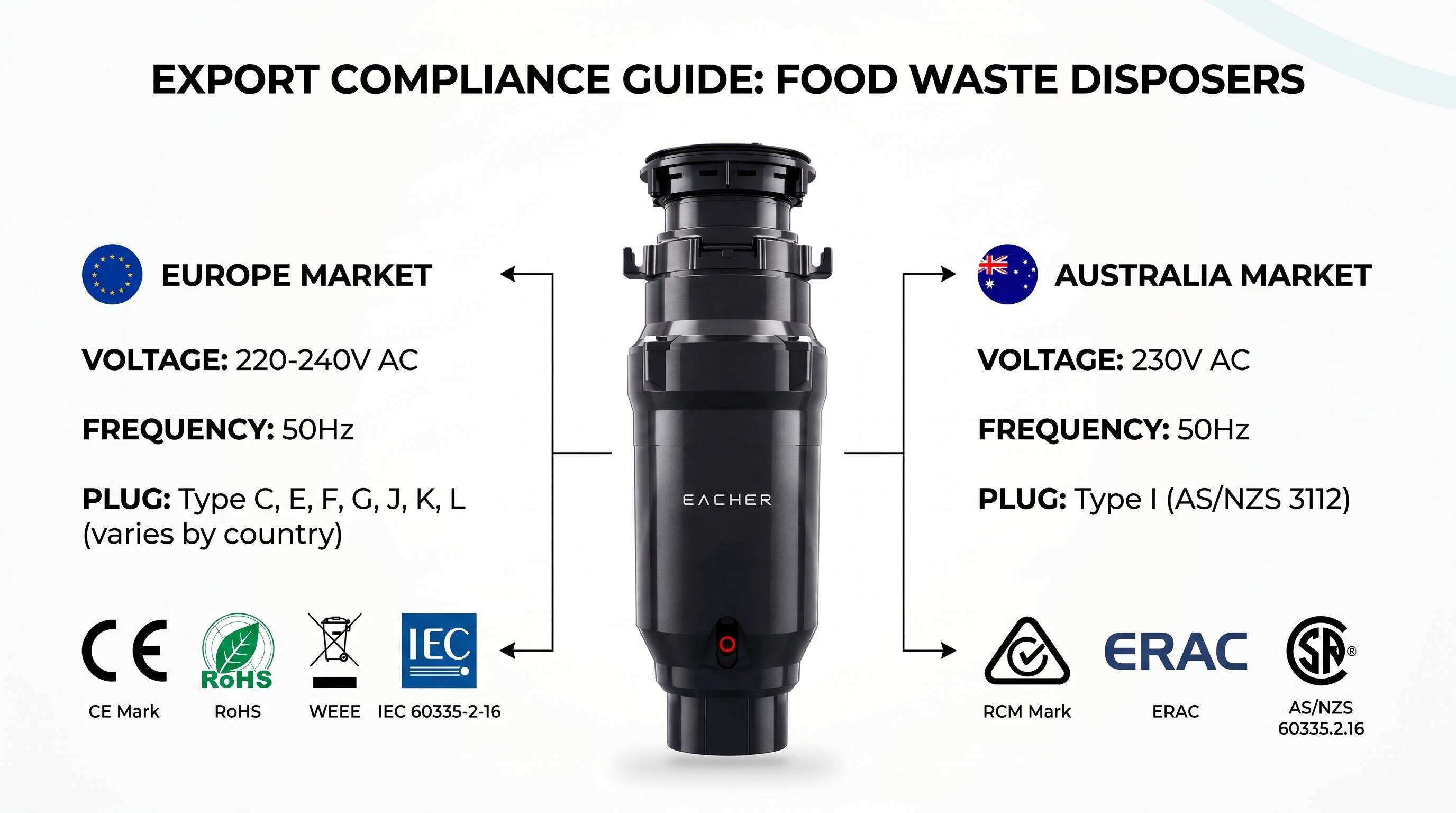
ALT: Voltage and electrical compliance guide for exporting food waste disposers to Europe and Australia markets
What This Guide Helps You Achieve: Full Electrical Compliance for Food Waste Disposer Exports
Key Conclusion: Exporting food waste disposers to Europe and Australia requires more than a quality product — it demands strict adherence to regional voltage standards, mandatory certification frameworks (CE marking for Europe, RCM for Australia), WEEE-compliant end-of-life protocols, and precise OEM/ODM engineering decisions that align motor architecture with local grid requirements. This guide walks procurement managers and brand owners through every critical checkpoint, from power specification mapping to conformity documentation, so your product clears customs, earns regulatory approval, and performs reliably in the field.
Entering the European and Australian markets with a food waste disposer product is not simply a matter of translating your packaging and adjusting your pricing. Electrical systems in these regions operate under distinct voltage regimes, safety standards, and certification mandates that, if overlooked, can result in shipment detention, costly product recalls, or outright market bans. This guide is written for B2B buyers, private-label importers, and OEM/ODM procurement managers who need a practical, technically grounded roadmap for achieving and maintaining electrical compliance — from the earliest engineering brief through to in-market product monitoring.
Before You Start: Prerequisites and Preparation for Electrical Compliance
Achieving electrical compliance for food waste disposer exports is a multi-disciplinary process that sits at the intersection of product engineering, regulatory affairs, and supply chain management. Before engaging a manufacturing partner or submitting a product for third-party testing, buyers and brand owners need to establish a clear picture of their target market requirements and confirm that their chosen manufacturing partner has the technical infrastructure to deliver compliant units.
The foundation of any export-compliance program is understanding what "compliance" actually means in each destination market. Europe's regulatory landscape is governed by the European Union's Low Voltage Directive (LVD) and the Electromagnetic Compatibility (EMC) Directive, both of which require CE marking before a product can be placed on the EU market. Australia's mandatory safety framework, administered by the Australian Competition and Consumer Commission (ACCC), requires products to carry the Regulatory Compliance Mark (RCM), which consolidates electrical safety and EMC requirements under a single mark. These are not optional quality endorsements — they are legal prerequisites for market entry.
A pattern we consistently see at EACHER is that buyers who arrive without a clear regulatory brief require significantly more lead time and revision cycles than those who come prepared. The following checklist represents the minimum preparation a procurement manager should complete before initiating an OEM/ODM engagement for export-bound disposers.
Checklist before starting:
- Confirm the destination market's nominal voltage and frequency (230V/50Hz for EU and Australia as a baseline, with nuances by country and installation type)
- Identify all applicable directives and standards for your product category (LVD, EMC Directive, RoHS Directive for EU; AS/NZS standards for Australia)
- Determine whether your product requires a continuous-use or intermittent-use motor rating, as this affects thermal class and insulation specifications
- Establish whether your product falls within the WEEE Directive's scope for EU exports and prepare producer registration documentation accordingly
- Confirm your manufacturing partner holds or can support the necessary third-party test reports (e.g., from a notified body for CE, or an accredited lab for RCM)
- Allocate sufficient time in your project schedule for prototype testing, documentation review, and potential design iterations
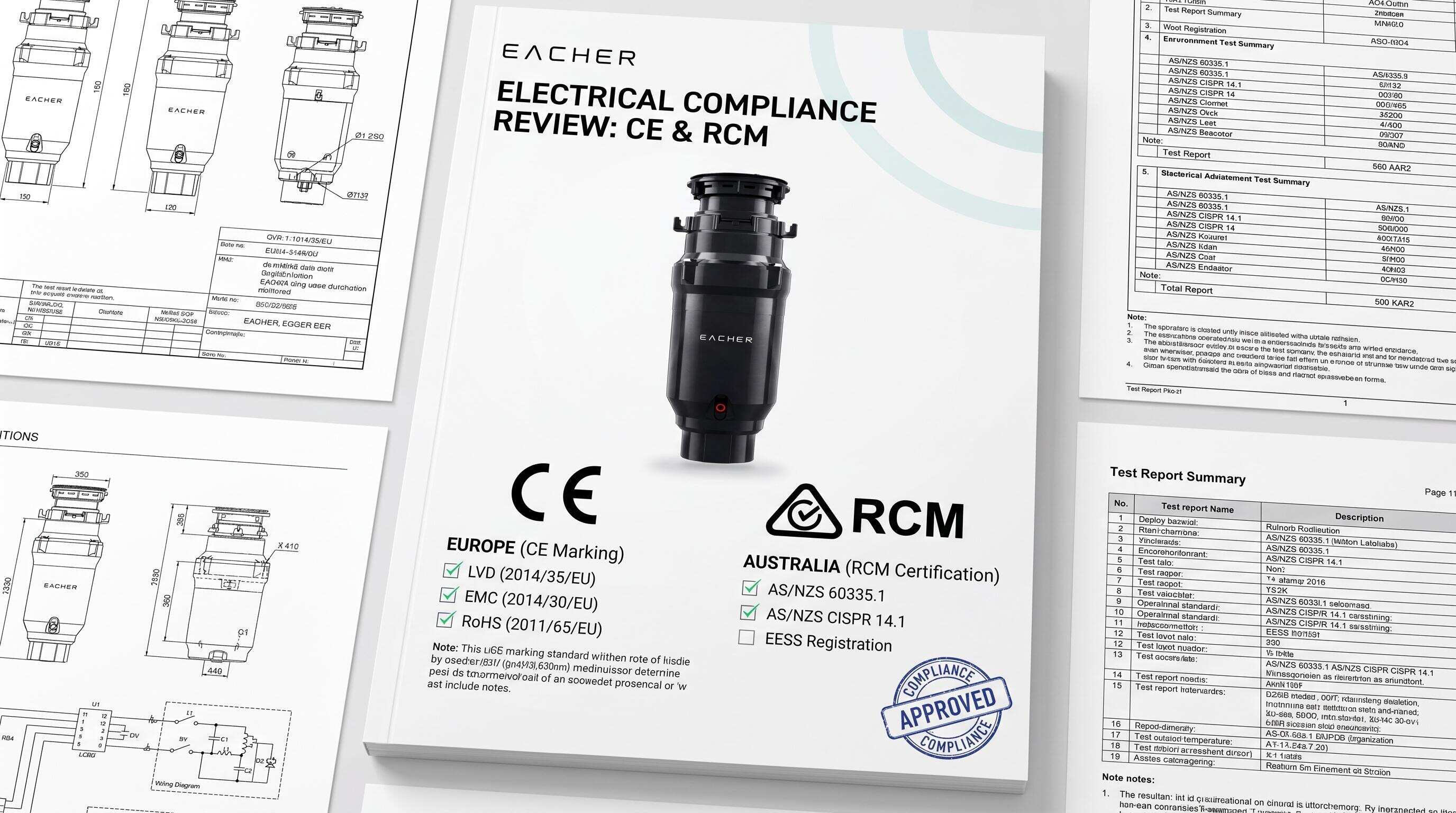
ALT: OEM/ODM food waste disposer electrical compliance documentation review for CE marking and RCM certification in Europe and Australia
Step-by-Step: Navigating Voltage Standards and Electrical Certification for Food Waste Disposer Exports
Step 1: Map Your Target Market Voltage and Frequency Requirements
The first and most foundational step is confirming the electrical grid parameters for each target market — and engineering your disposer's motor and control system to match them precisely.
Europe operates predominantly on 230V AC at 50Hz, a standard harmonized across EU member states and aligned with IEC 60038, the International Electrotechnical Commission's reference document for standard voltages. Australia also operates on 230V/50Hz following alignment with IEC 60038, though older Australian infrastructure may still present nominal voltages closer to 240V in practice, meaning a compliant product should tolerate a defined voltage tolerance band above and below the nominal rating.
For food waste disposer manufacturers, this matters at the motor level. Brushed AC induction motors designed for 120V/60Hz North American grids cannot simply be redeployed in a 230V/50Hz configuration without fundamental redesign of the motor windings, capacitors, and thermal protection systems. At EACHER, our engineering team treats voltage and frequency specification as the first fixed parameter in any OEM/ODM brief — because every downstream component decision, from insulation class to motor run capacitors, flows from this baseline.
Tip: Request a written voltage tolerance specification from your manufacturing partner — products for EU and Australian markets should typically be engineered to handle the voltage variation ranges described in IEC 60038, not just the nominal value.
Step 2: Align Motor Architecture with Regional Power Characteristics
Once the grid parameters are confirmed, the next step is selecting and engineering the correct motor architecture for reliable, long-term performance under those conditions.
Food waste disposers are available in three primary motor configurations relevant to export decisions: brushed motor models, brushless motor models, and smart variable-frequency (inverter-driven) models. Each has distinct implications for electrical compliance in 230V/50Hz markets. Brushed motor designs, while cost-effective, generate electromagnetic interference (EMI) that must be suppressed to meet EU EMC requirements — a fact that is frequently underestimated in early-stage product planning. Brushless motors, by contrast, produce lower EMI and typically achieve higher energy efficiency ratings, which simplifies compliance with the EU's Ecodesign framework. Smart variable-frequency models offer the highest degree of adaptability, since their inverter control units can be configured for different input voltages and frequencies — but the inverter itself must be independently certified for its switching characteristics and harmonic emissions.
In our work with clients developing disposers for the European market, brushless and variable-frequency architectures consistently deliver cleaner compliance pathways, particularly as the EU's energy efficiency and EMC expectations continue to tighten.
Tip: When requesting an OEM/ODM quotation, specify motor architecture explicitly rather than leaving it to a default selection — the difference between motor types has meaningful cost, certification, and timeline implications.
Step 3: Achieve CE Marking for the European Market
CE marking is the mandatory conformity declaration required before any food waste disposer can be legally placed on the EU market. CE marking is not a certification issued by a single body — it is a self-declaration by the manufacturer or importer that the product meets all applicable EU directives.
For food waste disposers, the relevant EU directives typically include the Low Voltage Directive (which governs electrical safety for products operating within defined voltage ranges), the EMC Directive (which governs electromagnetic emissions and immunity), and the RoHS Directive (which restricts the use of hazardous substances including lead, mercury, cadmium, and certain flame retardants). Per the EU's regulatory framework, most food waste disposer designs will require testing by an accredited third-party laboratory and the preparation of a Technical File — a structured body of documentation that includes design drawings, test reports, risk assessments, and the Declaration of Conformity.
According to the European Commission's guidance on product safety, the importer bears legal responsibility for CE marking if the manufacturer is located outside the EU — a point that many private-label importers discover later than they should. Appointing an EU-authorized representative is a practical mechanism for managing this obligation.
Tip: Begin assembling your Technical File in parallel with prototype development, not after it. Retroactive documentation is time-consuming and often reveals gaps that require engineering changes.
Step 4: Obtain RCM Certification for the Australian Market
The Regulatory Compliance Mark (RCM) is the mandatory conformity mark required for electrical products sold in Australia and New Zealand, administered under the Electrical Equipment Safety System (EESS) framework. RCM combines electrical safety and electromagnetic compatibility requirements into a single mark, replacing the older SAA and C-tick marks.
For food waste disposers, achieving RCM status requires product testing against the relevant AS/NZS harmonized standards, followed by supplier registration in the EESS database and (in most Australian states) registration of the responsible supplier. The AS/NZS standards relevant to food waste disposers are harmonized with IEC standards where applicable, meaning that a product already tested to IEC 60335 (the IEC safety standard for household and similar electrical appliances) may be able to leverage that test data to streamline RCM conformance — though this must be verified against the current harmonized standard list maintained by the ACCC.
A pattern we observe in cross-market projects is that buyers targeting both EU and Australia simultaneously can achieve meaningful testing efficiencies by aligning their IEC-based test program with both CE and RCM requirements from the outset, rather than running two sequential certification campaigns.
Tip: Register your product in the EESS database before shipment, not after arrival in Australia. Unregistered products intercepted at Australian customs can be refused entry regardless of physical compliance.
Step 5: Address WEEE and End-of-Life Electrical Compliance for EU Exports
The Waste from Electrical and Electronic Equipment (WEEE) Directive is a mandatory EU framework that places legal obligations on producers — including importers — of electrical and electronic equipment placed on the EU market. Food waste disposers, as powered household appliances, fall squarely within the WEEE Directive's scope.
Per the European Commission's official guidance on WEEE (available at the EU Environment topic page), producers must register in each EU member state where they market their products, join a national producer compliance scheme, and ensure that end-of-life collection and recycling obligations are funded. Failure to comply with WEEE registration requirements is a common and costly oversight among first-time EU exporters, as some member states impose significant penalties for non-registration.
The WEEE Directive also has design implications: products should be engineered to facilitate disassembly and material separation, and the WEEE symbol (a crossed-out wheeled bin) must appear on the product and its packaging. At EACHER, we routinely incorporate WEEE-compliant design features — including modular component access and labeling provisions — into our OEM/ODM tooling for EU-bound products.
Tip: WEEE obligations apply per member state, not at the EU level as a whole. If you are distributing across multiple EU countries, you need separate registrations in each relevant jurisdiction.
Step 6: Prepare Export Documentation and Electrical Compliance Records
Technical compliance alone is insufficient for smooth export clearance — the associated documentation must be accurate, complete, and formatted to meet the expectations of customs authorities and market surveillance bodies in the destination country.
For EU exports, the core documentation package includes the Declaration of Conformity (a formal statement that the product meets all applicable directives), the CE Technical File, and RoHS substance declarations. Per the UK Government's guidance on exporting commercial goods, exporters must also ensure that product classifications, HS codes, and country-of-origin declarations are correct, as errors in trade documentation can trigger customs holds independent of product compliance status.
For Australian exports, the EESS supplier registration certificate and the relevant test reports against AS/NZS standards form the primary compliance documentation. It is also advisable to retain IEC test reports, as Australian customs authorities and state electrical inspectors may request them during market surveillance activities.
Tip: Maintain a living compliance dossier that is updated whenever a component change occurs in production. Even a change in motor supplier or capacitor specification can trigger a need to re-test or revise the Declaration of Conformity.
Step 7: Implement Ongoing Compliance Monitoring and Component Change Control
Regulatory compliance is not a one-time certification event — it is an ongoing manufacturing and quality management obligation. Both the EU and Australia maintain active market surveillance programs that test products after they have entered the market, and products found to be non-compliant can be subject to mandatory recall, market withdrawal, and financial penalties.
Effective ongoing compliance requires a formal change control process within your manufacturing partnership. Any modification to electrical components — motor specifications, wiring harness materials, control board firmware, or protective devices — must be evaluated against the existing approval and test basis before being introduced into production. At EACHER, our quality management processes include component change impact assessments as a standard part of our production management workflow, so that OEM/ODM clients are not exposed to unnoticed compliance drift over time.
Per guidance from the U.S. Environmental Protection Agency on international requirements for electrical and electronic waste, compliance obligations for exported electrical products are continuing to expand globally, reinforcing the need for a proactive rather than reactive approach to regulatory management.
Tip: Establish a contractual obligation with your manufacturing partner for advance notification of any material or component changes — and require that such changes are evaluated for compliance impact before implementation.
Common Mistakes and Troubleshooting in Food Waste Disposer Export Compliance
| Symptom | Likely Cause | How to Fix |
|---|---|---|
| Shipment detained at EU customs | Missing or incorrectly formatted Declaration of Conformity, or CE mark applied to a product without a complete Technical File | Prepare a complete CE Technical File prior to shipment; ensure the Declaration of Conformity names the correct directives and is signed by an authorized EU representative |
| Product fails EMC testing for EU market | Brushed motor generating excessive electromagnetic interference without adequate suppression components | Redesign the motor control circuit to include EMI filtering; consider transitioning to a brushless motor architecture, which inherently produces lower emissions |
| RCM rejection or EESS registration failure for Australia | Product tested against non-harmonized standards or supplier not registered in EESS before shipment | Confirm that test reports reference current AS/NZS harmonized standards; complete EESS supplier registration before the product ships |
| WEEE compliance penalty in EU member state | Failure to register as a producer in the destination member state before marketing the product | Engage a local compliance scheme in each relevant EU member state; appoint an EU-authorized representative to manage ongoing registration obligations |
| In-field motor failure in 230V/50Hz markets | Motor designed for a different voltage or frequency without adequate re-engineering of windings and thermal protection | Work with the manufacturing partner to conduct full motor re-engineering for the target voltage/frequency; validate with a thermal endurance test |
| RoHS non-conformance flagged during market surveillance | Restricted substances present in component materials sourced without adequate supply chain verification | Implement a full RoHS substance verification program across all sub-tier suppliers; request material declaration documentation for every electrical component |
Pro Tips for Better Results in Multi-Market Electrical Compliance
Experienced export compliance practitioners approach multi-market projects with a "compliance-by-design" mindset, engineering regulatory requirements into the product architecture from the earliest concept stage rather than treating them as a post-development checklist.
A practical approach is to design for the most demanding market first. If your product roadmap includes both the EU and Australia, engineering to the EU's combined LVD, EMC, and RoHS requirements will typically satisfy a large proportion of Australia's AS/NZS and RCM obligations as well, because both frameworks draw heavily from IEC harmonized standards. This reduces the total volume of unique testing required and shortens overall time to market.
A common misconception worth addressing directly: many buyers assume that CE marking automatically satisfies Australian RCM requirements, or vice versa. This is incorrect. While there is significant overlap in the underlying IEC standards referenced by both frameworks, they are administered by different regulatory bodies, require separate declarations and registrations, and have distinct procedural requirements. Conflating the two is a reliable pathway to compliance gaps.
Smart variable-frequency disposer models — those incorporating inverter-driven motor control — deserve particular attention in the compliance planning phase. Their switching power supplies introduce harmonic emissions that must be characterized and controlled to meet both IEC 61000-series EMC standards (referenced by the EU EMC Directive) and the equivalent AS/NZS harmonized requirements. Buyers specifying these advanced motor architectures should plan for a more comprehensive EMC test program from the outset.
Finally, do not underestimate the value of a manufacturing partner with documented experience in the specific export markets you are targeting. At EACHER, our R&D and compliance team works directly with clients to map applicable standards to each product variant, advise on motor and control architecture selection for specific grid conditions, and coordinate with accredited testing laboratories to support efficient certification campaigns — a level of integrated support that is difficult to replicate when working with a generalist contract manufacturer.
Common Questions
Q1: How do I determine which EU directives apply to my food waste disposer export?
The applicable EU directives depend on the product's voltage range, functional characteristics, and materials. For most food waste disposers, the Low Voltage Directive, EMC Directive, and RoHS Directive are all relevant. The EU's NANDO (New Approach Notified and Designated Organisations) database can help identify applicable harmonized standards. Your manufacturer or an EU regulatory consultant can conduct a formal applicability assessment based on your specific product's specifications and intended use.
Q2: Is a single CE certification valid for all EU member states?
Yes — CE marking, once properly achieved, is valid across all EU member states without the need for separate national certifications. However, the WEEE Directive and certain national electrical installation standards can require country-specific registrations or compliance actions on top of CE marking. Private-label importers acting as the EU "producer" must also ensure they are registered for WEEE obligations in each member state where the product is marketed, as WEEE compliance is managed at the national level.
Q3: How long does the CE and RCM certification process typically take for a new food waste disposer model?
The timeline depends on the complexity of the product, the completeness of design documentation at the time testing begins, and the backlog of the testing laboratory. For a new food waste disposer design, the combined process of prototype testing, Technical File preparation, and conformity declaration is rarely completed in fewer than several weeks, and complex models with inverter-driven motors may require longer campaigns. Beginning compliance testing in parallel with final production tooling — rather than sequentially — is the most effective way to compress the overall project schedule.
Final Thoughts
Electrical compliance for food waste disposer exports to Europe and Australia is a structured, manageable process — provided it is approached with the right preparation, the right manufacturing partner, and a clear understanding of the regulatory landscape in each target market.
Key Takeaways:
- Europe (230V/50Hz) and Australia (230V/50Hz) share grid parameters but operate under distinct certification frameworks — CE marking and RCM are separate legal requirements, not interchangeable marks.
- Motor architecture selection (brushed, brushless, or variable-frequency) has direct implications for EMC compliance difficulty and energy efficiency performance in both markets.
- WEEE registration in the EU is a producer-level legal obligation that applies per member state and must be established before products enter the market.
- A compliance-by-design approach — engineering to the most demanding market's requirements first — reduces total testing cost and accelerates time to market across multiple geographies.
- Ongoing change control is essential: a compliant product at launch can become non-compliant if component changes are introduced without a formal re-evaluation process.
The most effective next step for any buyer or brand owner preparing to export food waste disposers to Europe or Australia is to engage your manufacturing partner in a structured compliance planning session before finalizing your product specification — not after. This upstream alignment is where the greatest savings in time, cost, and risk exposure are achieved.
Ready to bring your food waste disposer project to life? EACHER specializes in full-cycle OEM/ODM manufacturing — from brushed and brushless to smart variable-frequency models — tailored precisely to your brand's specifications and target-market compliance requirements. Visit the EACHER website to explore our customization capabilities, request a factory audit, or get a competitive quote today.
References & Further Reading
- European Commission, Environment Directorate-General. "Waste from Electrical and Electronic Equipment (WEEE)".
https://environment.ec.europa.eu/topics/waste-and-recycling/waste-electrical-and-electronic-equipment-weee_en - UK Department for Business and Trade. "Exporting Commercial Goods".
https://www.bis.gov/media/1252 - U.S. Environmental Protection Agency. "New International Requirements for Electrical and Electronic Waste".
https://www.epa.gov/hwgenerators/new-international-requirements-electrical-and-electronic-waste - International Electrotechnical Commission (IEC). "IEC 60038 — IEC Standard Voltages".
https://www.iec.ch - International Electrotechnical Commission (IEC). "IEC 60335 — Safety of Household and Similar Electrical Appliances".
https://www.iec.ch
Note: Standards and regulatory requirements may be updated; please verify the latest official documents with the relevant regulatory authorities or qualified compliance advisors before acting on the information in this guide.