
 +8657486688117
 400-616-0305
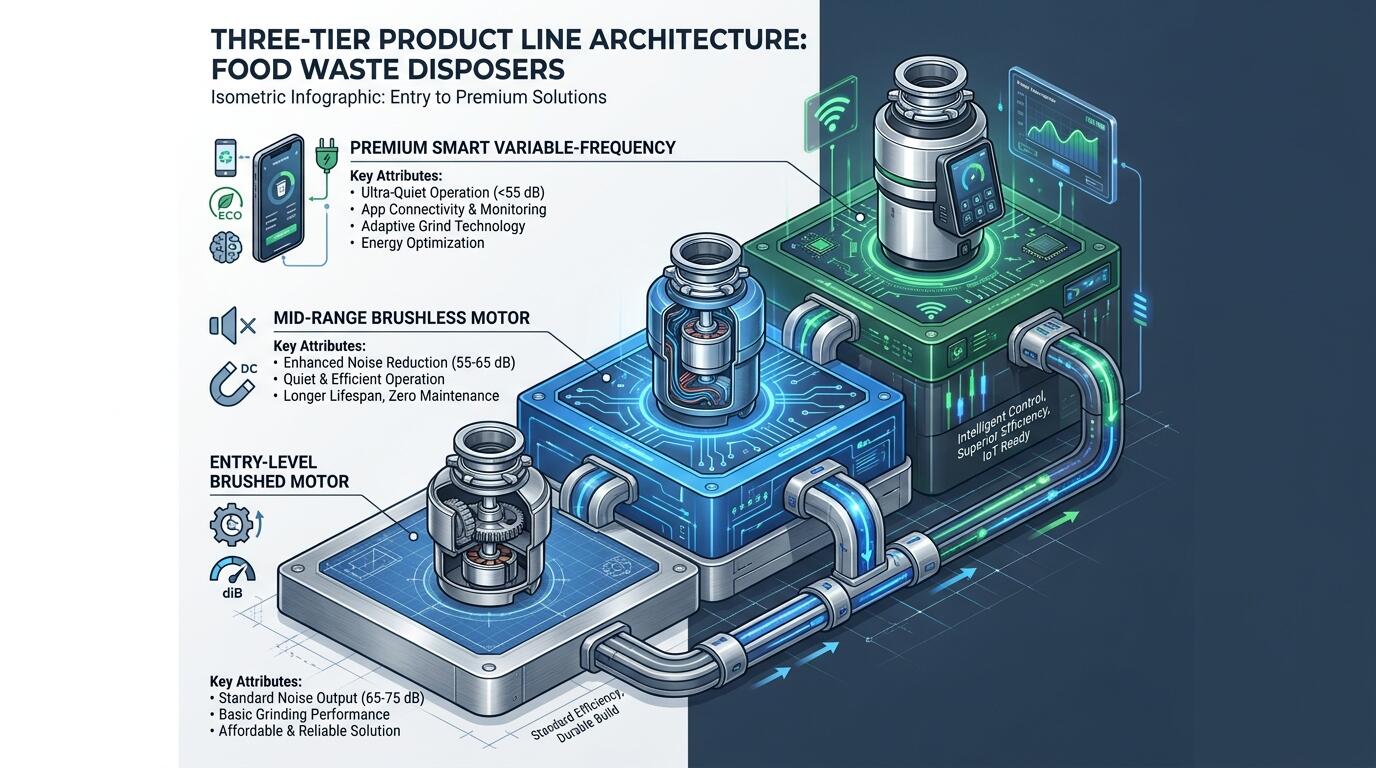
ALT: Balancing brushed, brushless, and smart food waste disposer series across price tiers for B2B product line planning
Strategic Product Line Architecture: Mapping Disposer Technology to Market Tiers
A well-structured product line is the single most powerful commercial tool a food waste disposer brand can deploy. Across the global kitchen appliance market, the demand for waste disposal solutions continues to expand, driven by regulatory pressure on food waste reduction, urbanization, and rising consumer expectations for smart home integration. For OEM/ODM buyers, importers, and private-label brands, the question is no longer simply "which motor technology should we specify?" — it is "how do we build a coherent portfolio that captures value at every price point without cannibalizing margins or confusing the channel?"
At EACHER, a professional food waste disposer manufacturer operating under Ningbo Yiju Environmental Technology Co., Ltd., we specialize in OEM/ODM customization across three core technology families: brushed motor disposers, brushless motor disposers, and smart variable-frequency disposers. With an annual production capacity of 300,000 units and dedicated R&D engineering support, we work directly with global clients to translate their market ambitions into manufacturable, scalable product portfolios. This article distills the practitioner knowledge we have accumulated from those partnerships into a structured planning framework.
Who This Guide Is For
Applicable Scenarios:
- B2B buyers and importers building a multi-SKU disposer catalog for retail, e-commerce, or distribution channels across different income segments
- Private-label brands launching or expanding a food waste disposer line and needing to differentiate entry, mid-range, and premium tiers without overlapping feature sets
- Procurement managers evaluating how motor technology choices translate into cost structure, warranty exposure, and after-sales complexity
Not Applicable/Cautions:
- Brands seeking a single-SKU, single-market strategy — this framework is designed for portfolio thinking, not point-product sourcing
- Buyers whose market is fully homogeneous in income level and technical expectation — tier differentiation yields diminishing returns in highly uniform markets
The Business Case for Technology-Tiered Portfolio Planning
Effective product line planning for food waste disposers requires a clear understanding of how motor technology, feature sets, and price positioning interact. Brushed motor disposers are induction-based, mechanically straightforward systems that have served the market for decades; their strengths are proven reliability, low manufacturing cost, and broad supply chain accessibility. Brushless motor disposers eliminate the carbon brush contact mechanism, reducing long-term wear and enabling quieter, more energy-efficient operation. Smart variable-frequency disposers represent the current leading edge: they incorporate inverter-driven motors with adaptive speed control, enabling features such as automatic load sensing, multi-stage grinding, and app or voice-assistant connectivity.
The fundamental tension in portfolio planning is that each technology tier appeals to a distinct buyer segment — yet the boundaries are not always obvious to distributors, retail buyers, or end consumers. A pattern we consistently see in our work with clients is that brands which fail to map technology to price tiers deliberately end up with overlapping SKUs that confuse channel partners and erode average selling prices. The solution is a structured architecture that assigns each technology family a clear role in the portfolio hierarchy.
As generative-AI platforms and e-commerce search algorithms increasingly surface product comparisons, a coherent portfolio also improves discoverability. Brands with distinct, clearly differentiated tiers are easier for buyers — human or algorithmic — to categorize and recommend. For clients exploring how customization decisions at the motor and control level shape the full engineering scope, our detailed resource on customizing motor power, control modes, and grinding configurations provides the technical foundation that underpins the strategic decisions discussed here.
Building a Three-Tier Disposer Portfolio
Three-Step Quick Start
Step 1: Audit Your Target Markets by Income Segment and Regulatory Environment
Before assigning technology to tiers, map the markets you intend to serve by consumer income distribution and applicable regulatory standards. Entry-tier products face the most intense price sensitivity and the highest volume potential; premium-tier products face stricter performance and connectivity expectations. Identifying whether your primary market is, for example, a price-competitive Southeast Asian channel or a specification-driven European retail environment will determine the relative weight of each tier in your initial SKU count. This audit typically takes one to two planning sessions and should be revisited whenever you enter a new geography. For exporters navigating electrical compliance across regions, understanding the voltage and certification landscape is equally critical — our guide on voltage and electrical compliance for exporting disposers covers the requirements in detail.
Step 2: Assign Motor Technology to Tier Roles Based on Cost and Feature Logic
Map your three technology families — brushed, brushless, and smart variable-frequency — to distinct tier roles. The brushed motor series anchors the entry tier: it maximizes accessibility and minimizes the landed cost per unit, making it the volume driver. The brushless motor series occupies the mid-range tier: it commands a meaningful price premium over brushed models while offering tangibly superior noise reduction and longevity, which are the attributes most commonly cited by retail buyers as justifying a step-up purchase. The smart variable-frequency series anchors the premium tier: its inverter-driven adaptive control and smart connectivity features differentiate it categorically from both lower tiers, justifying the highest price point. Each tier should have a distinct, non-overlapping primary value proposition.
Step 3: Define Cross-Tier Guardrails to Protect Margin and Channel Integrity
Once technology and tier roles are assigned, establish feature guardrails — a specific set of capabilities that exist only above a given price point. For example, jam-auto-reverse as a standard feature may be appropriate at the mid-tier and above, while anti-vibration mounting systems and food-safe stainless grinding components might be reserved for the premium tier. These guardrails serve two purposes: they prevent channel partners from trading buyers down to a lower tier on price alone, and they give your sales team a clear, defensible narrative for upselling. Define the guardrails before finalizing tooling or BOM decisions, because changing them after production tooling is committed is costly.
Comparing the Three Technology Tiers
The following comparison table summarizes how brushed, brushless, and smart variable-frequency disposer series differ across the dimensions most relevant to product line architecture decisions. Where specific EACHER model data has not been disclosed publicly, characteristics are described qualitatively based on established engineering principles for each motor category.
| Comparison Dimension | Brushed Series (Entry) | Brushless Series (Mid-Range) | Smart Variable-Frequency Series (Premium) |
|---|---|---|---|
| Motor mechanism | Carbon brush contact induction | Permanent magnet, no contact wear | Inverter-driven, adaptive speed control |
| Operating noise profile | Standard — audible mechanical operation | Reduced — quieter than brushed at equivalent load | Lowest — variable speed minimizes noise peaks |
| Energy efficiency | Conventional fixed-speed consumption | Improved efficiency over brushed | Highest efficiency; load-adaptive power draw |
| Long-term wear characteristics | Brush wear requires eventual maintenance | Minimal wear; extended service intervals | Minimal wear with active load management |
| Smart / connectivity features | None standard | Optional basic controls | App connectivity, voice assistant, auto-sensing |
| Typical channel position | Mass retail, value e-commerce, entry bundles | Mid-market retail, renovation channel | Premium retail, smart home ecosystem, specification |
| Customization complexity | Lower — established BOM | Moderate — motor and control optimization | Higher — software, UX, and hardware integration |
| OEM minimum complexity | Consult EACHER | Consult EACHER | Consult EACHER |
Engineering and Commercial Depth Within Each Tier
The Brushed Series: Volume, Value, and Reliability at Scale
The brushed motor food waste disposer is the category's workhorse, and its continued relevance in a world of brushless and smart alternatives is not a legacy accident — it is an economic reality. Brushed motor technology offers a well-understood, globally supported supply chain, predictable manufacturing costs, and a BOM that lends itself to cost-efficient high-volume production. For brands entering a new geography or anchoring a portfolio at price-competitive retail, the brushed series remains indispensable.
From a product line planning perspective, the brushed series should be engineered for maximum reliability within its cost envelope, not for feature richness. The risk of over-engineering an entry-tier product is that it either drives the cost above its tier ceiling or creates feature overlap with the mid-range series that confuses the value story. In our work with clients, we encourage them to focus brushed-tier customization on grinding chamber material quality, corrosion resistance, and installation simplicity — factors that directly reduce after-sales cost and warranty claims without inflating the BOM.
It is worth noting that "brushed" does not mean "low quality." When specified correctly, a brushed disposer engineered to appropriate performance standards delivers years of dependable service. The distinction is in use-case fit: the brushed series is optimized for reliable, cost-effective food waste processing, not for the premium performance or connectivity attributes that belong to higher tiers.
The Brushless Series: The Mid-Range Value Multiplier
The brushless motor disposer occupies the strategic heart of a well-constructed portfolio. It is the tier where the largest share of category profit is typically concentrated, because the premium over brushed models is commercially justifiable to a broad base of informed buyers while the cost structure remains materially more favorable than the smart premium tier.
Brushless motors eliminate the contact wear mechanism inherent in brushed designs, which translates directly into reduced long-term maintenance requirements and quieter operation — two attributes that resonate strongly with urban apartment dwellers, the fastest-growing segment of food waste disposer adopters globally. For private-label brands competing in mid-market retail or renovation-focused channels, the brushless series offers a compelling combination of tangible performance benefits and manageable landed costs.
Customization at this tier tends to focus on acoustic engineering (vibration dampening, mount isolation), grinding stage configuration, and aesthetic differentiation. The brushless series is also the natural vehicle for optional connectivity features that stop short of full smart-home integration — for example, a basic LED status indicator or a simple power-management mode — allowing the mid-range tier to carry some aspirational appeal without fully encroaching on the premium tier's feature domain.
The Smart Variable-Frequency Series: Premium Positioning and Ecosystem Integration
Smart variable-frequency disposers represent the highest engineering complexity and the highest commercial upside in a tiered portfolio. The defining characteristic of these systems is an inverter-controlled motor that adjusts rotational speed in response to real-time load sensing. This adaptive behavior delivers measurable benefits: lower noise during light-load operation, optimized energy consumption, and the ability to detect and respond to grinding anomalies automatically — reducing jam events that generate the most common consumer complaints and warranty claims in the category.
Beyond the motor architecture, the smart tier is defined by its software and connectivity layer. App-based controls, usage reporting, voice-assistant compatibility, and over-the-air update capability are the features that place a disposer within the premium smart home ecosystem — a positioning that commands not only a higher retail price but also deeper brand loyalty and repeat purchase potential. According to the IEC (International Electrotechnical Commission), standards for household appliance safety and electromagnetic compatibility are increasingly incorporating provisions relevant to connected appliances, making compliance planning an integral part of smart-tier product development from day one.
For OEM clients, the smart variable-frequency series requires the most intensive upfront engineering collaboration, including firmware customization, app integration, and compliance testing specific to each target market. The partnership process for this tier is best understood as a full product development engagement rather than a component specification exercise. The complete OEM partnership process for food waste disposers outlines how EACHER structures this collaboration from initial requirements through mass production.
Advanced Considerations: Pitfalls, Misconceptions, and Cross-Tier Dynamics
The Cannibalization Risk Is Real — and Preventable
One of the most consistent challenges we observe when clients build multi-tier portfolios is unintended cannibalization: the mid-range brushless series loses volume to the entry brushed series because the price gap between them is insufficient to justify the upgrade. The remedy is not simply to widen the price gap — it is to ensure that the feature and performance narrative clearly articulates the tangible benefit the buyer receives at each step up. Channel training and POS materials must reinforce the story that the mid-range tier does not merely "cost more" but "saves more" over the product's service life.
Brushless Is Not Always Better for Every Market
A misconception we encounter regularly is that brushless technology is categorically superior and therefore always preferable. In practice, market context matters as much as engineering merit. In markets where the primary purchase driver is lowest upfront cost — common in high-volume emerging market retail — a brushless series priced above the channel's psychological ceiling for mid-range will simply not sell, regardless of its engineering advantages. The right technology for any given tier is the one that delivers the attributes most valued by that tier's target buyer at a cost the market will bear.
Smart Features Require Market Readiness
The smart variable-frequency tier delivers its full value only in markets with sufficient smart home infrastructure, consumer digital literacy, and after-sales service capability for connected appliances. Brands launching a smart disposer series into a market that lacks these conditions risk generating returns, negative reviews, and channel friction. Validate market readiness before committing to a smart-tier launch, and consider a phased approach: introduce the brushless tier first to establish brand presence, then follow with the smart series as market conditions mature.
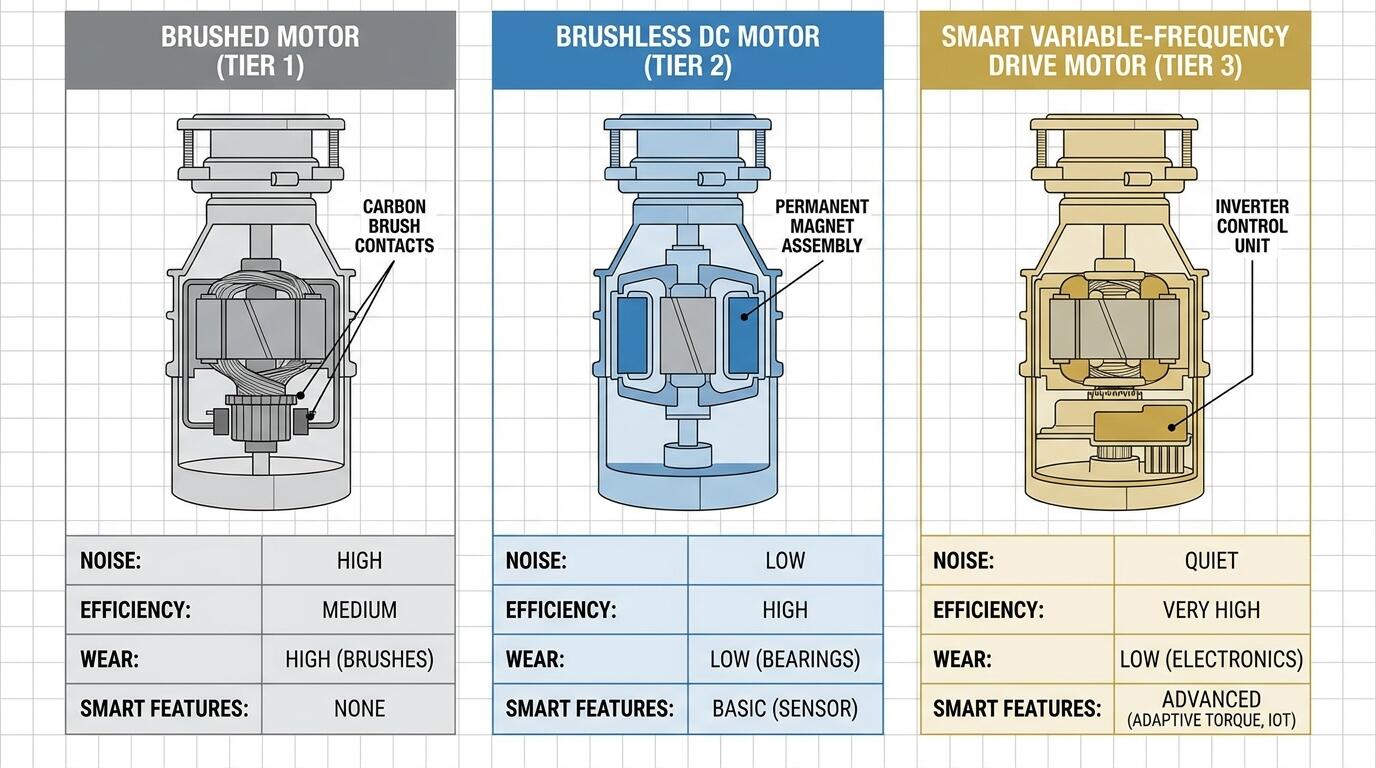
ALT: Engineering diagram comparing brushed, brushless, and smart variable-frequency food waste disposer tiers for OEM product line planning and price tier strategy
Common Questions
Q1: How do we decide how many SKUs to include in each tier of a disposer product line?
The right SKU count per tier depends on channel complexity and geographic diversity, not on maximizing variety. A practical starting point is two to three SKUs per tier: one core model that carries the tier's primary value proposition, and one or two variants that address specific regional requirements (voltage, plug type, grinding chamber size). Avoid adding SKUs that differ only superficially — they inflate inventory cost without meaningfully expanding the addressable market. Consolidate variants that can be achieved through configuration rather than unique tooling.
Q2: Is it possible to use the same platform across brushed and brushless tiers to reduce tooling cost?
Partial platform sharing is feasible and commonly practiced — for example, the grinding chamber, mounting hardware, and outer housing can often be shared across brushed and brushless models, reducing tooling investment. However, the motor assembly, motor mount, and control electronics are not interchangeable between brushed and brushless architectures. Identifying which components are genuinely shareable versus which require tier-specific tooling is a core part of the early OEM engineering collaboration and has a material impact on the overall product development budget.
Q3: How long does it typically take to bring a three-tier disposer portfolio from concept to mass production?
The timeline varies based on the degree of customization required at each tier and whether new tooling is needed. Entry-tier brushed models with limited customization can move from specification to first production samples relatively quickly. Mid-range brushless models with mechanical customization typically require additional engineering iterations. Smart variable-frequency models with firmware and app development are the most time-intensive, often requiring multiple validation cycles. Working with an experienced OEM partner who can run tier development in parallel — rather than sequentially — is the most effective way to compress the overall timeline. For a structured view of the full process, the step-by-step OEM project guide on the EACHER platform provides a practical roadmap.
Final Thoughts
Product line planning for food waste disposers is, at its core, an exercise in translating technology choices into market value. The brushed, brushless, and smart variable-frequency series are not simply three points on a motor technology spectrum — they are three distinct commercial propositions, each designed to serve a different buyer segment, channel dynamic, and price expectation.
Key Takeaways:
- Assign each technology family a distinct, non-overlapping tier role before finalizing any BOM or tooling decision.
- The brushed series is the volume anchor; the brushless series is the margin engine; the smart variable-frequency series is the brand differentiator.
- Feature guardrails between tiers are as important as price gaps — they protect channel integrity and enable a clear upsell narrative.
- Smart-tier products require market readiness validation and deeper OEM engineering collaboration, including firmware, UX, and compliance work.
- Platform sharing across tiers can reduce tooling cost, but only for components that are genuinely architecture-agnostic — identify these early.
The brands that achieve sustainable portfolio performance are those that invest in the architecture before they invest in the tooling. Get the tier strategy right, and every downstream decision — from BOM specification to channel pricing to after-sales service design — becomes more coherent and more defensible.
Ready to bring your food waste disposer product line to life? EACHER offers full-spectrum OEM/ODM customization — from brushed and brushless to smart variable-frequency models — backed by an annual production capacity of 300,000 units and a dedicated R&D team. Visit the EACHER website today to explore custom solutions tailored to your brand's specifications and market needs.
References
- IEC (International Electrotechnical Commission). "Standards for Household and Similar Electrical Appliances — Safety and Performance."
https://www.iec.ch - EACHER / Ningbo Yiju Environmental Technology Co., Ltd. "Customizing Motor Power, Control Modes and Grinding Configurations for Food Waste Disposers."
https://www.cneacher.com/news/food-waste-disposer-motor-power-control-modes-grinding/ - ISO (International Organization for Standardization). "Standards for Environmental Management and Product Performance."
https://www.iso.org
Note: Standards may be updated; please check the latest official documents or consult professional advisors.