
 +8657486688117
 400-616-0305
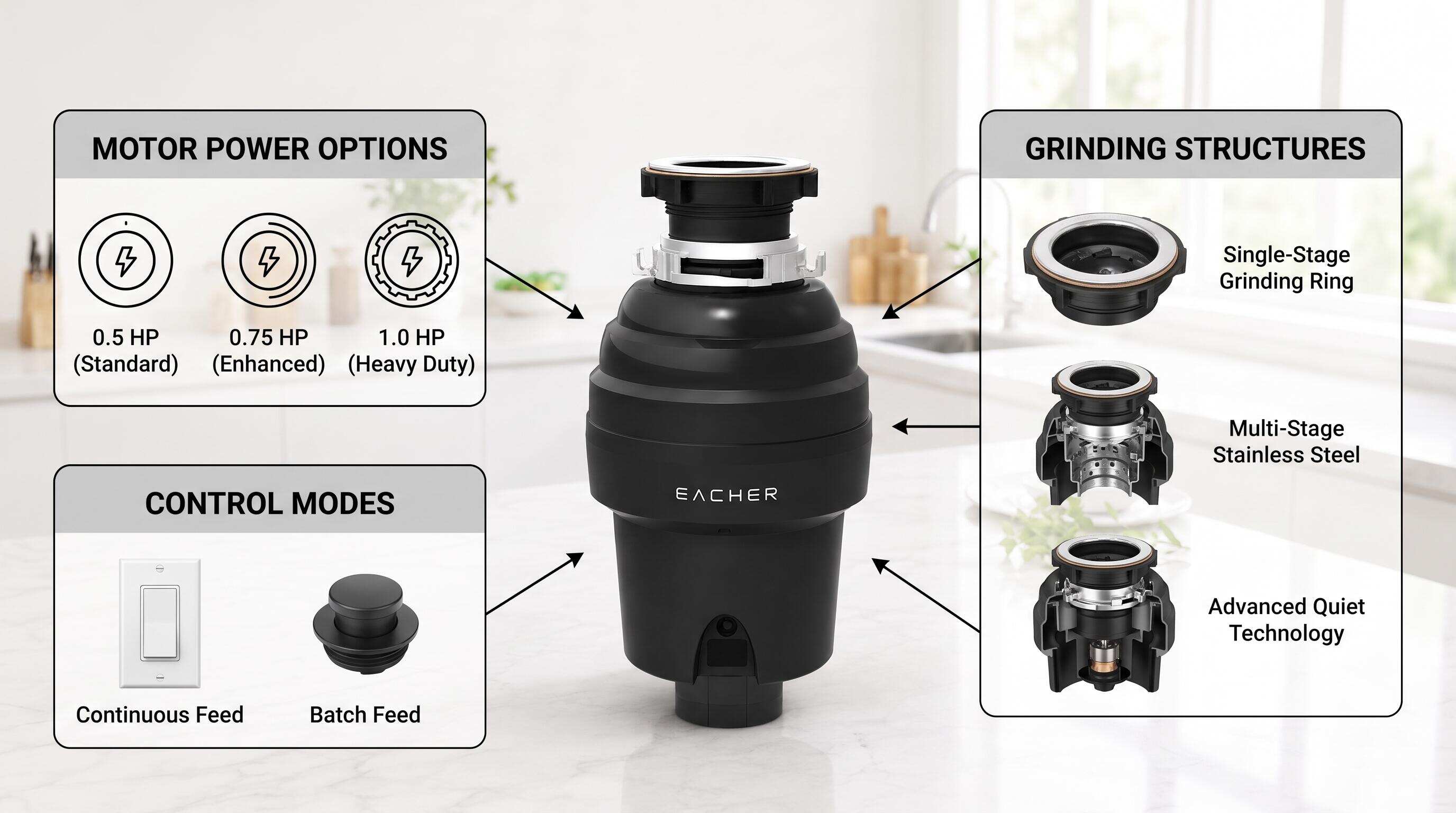
ALT: OEM food waste disposer customization showing motor power, control modes, and grinding structure options for private-label brands
What Does It Actually Take to Customize a Food Waste Disposer for Your Brand?
For kitchen appliance brands and procurement managers exploring private-label food waste disposers, the central question is rarely "can it be manufactured?" — it is "can it be manufactured to precisely match what our market expects?" The answer lies in understanding three foundational engineering layers: motor power configuration, control mode selection, and grinding structure design. These are the variables that determine product performance, target market fit, regulatory compliance, and ultimately, the return on your private-label investment.
This article draws on our experience as a specialized OEM/ODM manufacturer at EACHER — operating under Ningbo Yiju Environmental Technology Co., Ltd. with an annual production capacity of 300,000 units — to walk procurement decision-makers through the key customization dimensions available in food waste disposer development. Each item in this list was selected because it represents a genuine decision point that our B2B clients consistently encounter when designing or expanding their product lines. Whether you are launching a first SKU or broadening a regional portfolio, understanding these levers will help you allocate development resources efficiently and avoid costly late-stage redesigns.
The Core Customization Dimensions: Motor, Controls, and Grinding Architecture
Motor Type Selection: Brushed vs. Brushless vs. Smart Variable-Frequency
Motor type is the single most consequential decision in food waste disposer customization, because it determines cost structure, lifespan, noise output, and the level of intelligent control the product can support. At EACHER, we offer three distinct motor platforms: brushed motor models, brushless motor models, and smart variable-frequency models — each targeting a different segment of the global market.
Brushed motors deliver reliable, cost-effective performance and are well-understood by supply chains and service networks worldwide. Brushless motors eliminate mechanical contact within the drive system, resulting in quieter operation, reduced heat generation, and a longer service life — attributes that command a premium at retail but justify the margin in consumer-facing categories. Smart variable-frequency models represent the current leading edge: the motor adjusts its output dynamically based on load conditions, optimizing energy consumption and protecting the grinding system from overload events.
A pattern we consistently see in our OEM work is that brands entering a market for the first time tend to anchor on brushed models to control upfront tooling and unit cost, then migrate toward brushless or variable-frequency platforms as their volume grows and their product positioning matures. Understanding where your brand sits on this trajectory before the design phase starts is essential to avoiding a platform switch midcycle.
- Best for: Brushed models suit cost-sensitive or entry-level market positioning; brushless models fit mid-to-premium residential categories; variable-frequency models are optimal for smart home ecosystems and energy-efficiency-focused markets.
- Watch out: Variable-frequency drive systems require more sophisticated motor control electronics, which adds to BOM cost and increases the validation surface area for electrical safety certification.
Motor Power Rating and Load-Handling Capacity
Motor power — expressed in horsepower or watts depending on the regional convention — directly governs what volume and density of food waste a disposer can process reliably over its service life. Selecting the correct power tier for your target use case is a cost-efficiency decision as much as a technical one: over-specifying wastes margin, while under-specifying generates warranty claims and brand reputation risk.
In our engineering consultations with global clients, we frame motor power selection around three variables: the intended installation environment (residential versus light commercial), the waste composition typical of the target market (fibrous vegetables, hard shells, mixed food scraps), and the drainage infrastructure commonly found in that geography. A disposer destined for a market with older, lower-gradient plumbing systems may need higher torque at lower speeds rather than raw grinding speed.
Power customization at EACHER is not simply a matter of selecting from a fixed catalog tier. Our OEM/ODM process allows clients to specify performance envelopes — the sustained load the motor must handle without thermal shutdown — and we engineer the motor and control pairing accordingly.
- Best for: Brands with clear end-user application data (e.g., food service adjacency, large households, multi-unit residential buildings) who want to right-size performance to a specific price band.
- Watch out: Increasing motor power without a corresponding review of the grinding chamber geometry and impeller design can create a mechanical mismatch that reduces efficiency and increases vibration.
Control Mode Architecture: Manual Switch, Auto-Reverse, and Smart Integration
Control mode defines the user interaction model of the disposer and determines what the product can communicate to adjacent systems. Three primary control architectures are in active demand among our global clients: simple on/off switch activation, automatic reverse-cycle logic (which detects jamming and reverses rotation to clear blockages), and smart connectivity modes that integrate with home automation platforms or allow app-based monitoring.
The auto-reverse function deserves particular attention for brands targeting mass market residential segments. Jamming events are the primary driver of customer service calls in the disposer category. A control system that detects torque resistance and automatically executes a reverse-clear cycle resolves the majority of common blockage scenarios without user intervention — a feature that materially reduces warranty service cost and improves customer satisfaction scores. This is not a premium-only feature; incorporating it into mid-tier models is one of the highest-ROI customization decisions we see clients make.
Smart control integration, by contrast, requires a deliberate platform decision early in the product development cycle. Whether the disposer will communicate via a proprietary app, integrate with a voice assistant ecosystem, or report operational data to a broader home energy management system — each path has different firmware, certification, and ongoing software maintenance implications.
- Best for: Manual switch models suit the broadest installation base with minimum complexity; auto-reverse models are the value-maximizing choice for most residential OEM programs; smart integration is appropriate for brands with an established connected home product ecosystem or a premium positioning strategy.
- Watch out: Smart control features that depend on a companion app or cloud service create long-term software maintenance obligations. Build this into your lifecycle cost model before committing.
Grinding Chamber Geometry and Chamber Volume
The grinding chamber is where the disposer's mechanical work actually occurs, and its geometry — diameter, depth, and internal profile — determines both processing capacity and the size of food particles discharged. Chamber customization is often underestimated by first-time OEM clients who focus primarily on motor specifications, yet it is a critical determinant of performance differentiation between SKUs.
A larger chamber volume allows bulkier food waste inputs and reduces the frequency of partial-load cycles, which matters in high-usage households. Chamber geometry also influences how water and waste interact during processing: a well-designed internal profile promotes efficient slurry formation and reduces the risk of fibrous material wrapping around rotating components. In our product development work, we treat chamber geometry as an integral element of the grind system — not a secondary structural consideration.
For brands developing a multi-SKU line, chamber size is often the primary differentiating variable between a compact under-sink model and a full-capacity unit, with the motor and control systems remaining consistent across the range to control tooling cost.
- Best for: Brands building a product family with a clear entry/mid/premium tier structure, where chamber volume defines the tier rather than requiring entirely different motor platforms.
- Watch out: Chamber volume customization requires dedicated tooling for the housing component, which has upfront cost implications. Evaluate minimum order quantities in the context of tooling amortization before finalizing specifications.
Grinding Stage Configuration: Single vs. Multi-Stage Processing
Grinding stage configuration refers to how many sequential reduction steps food waste passes through before exiting the disposer. Single-stage systems use one set of rotating components to reduce waste to discharge particle size. Multi-stage systems — which are increasingly common in premium models — pass material through progressive reduction steps, producing finer output particles and handling harder waste types more reliably.
From a manufacturing standpoint, multi-stage systems introduce additional components and tighter tolerance requirements, which is reflected in unit cost. However, they also deliver a measurably better end-user experience with harder waste types such as small bones, fibrous stalks, and citrus peel — the very inputs that generate the most consumer complaints about single-stage units. For brands positioning into premium or prosumer categories, multi-stage grinding is frequently a specification that marketing teams cite as a differentiating product feature.
Per established mechanical engineering principles — consistent with IEC guidelines on rotating machinery performance classification — multi-stage grinding systems require more precise balancing of the impeller assemblies to avoid vibration at elevated loads.
- Best for: Premium residential and light commercial OEM programs where end-user experience and waste processing breadth are key brand differentiators.
- Watch out: Multi-stage configurations increase the number of wear components in the system. Factor this into warranty cost modeling and ensure your authorized service network has access to the appropriate replacement parts.
Grinding Component Materials and Surface Treatment
The material specification of grinding components — impellers, grinding rings, and cutting elements — determines durability, corrosion resistance, and the long-term maintenance profile of the product. Food waste environments are chemically aggressive: high moisture, organic acids, and variable pH levels all act on metal surfaces over time.
Stainless steel is the prevailing material standard for grinding components in quality-tier disposers, and it is what we specify as a baseline for EACHER's OEM programs. Surface treatment options — including specific hardening processes for high-wear contact surfaces — can extend component life further and reduce the risk of premature wear-related failures that generate warranty claims. The choice of material grade and treatment process should be governed by the expected duty cycle and the typical waste inputs of the target market.
For export programs, material selection also intersects with regulatory compliance. Certain markets require that food-contact components meet specific material safety standards, and the documentation requirements for demonstrating compliance can influence lead times. If you are building a product for the European or Australian market, our team recommends reviewing material certification requirements in parallel with the design specification process. Our guide on voltage and electrical compliance for these markets provides a useful parallel framework for understanding how regulatory considerations shape product development timelines.
- Best for: Any brand positioning above the entry tier, where warranty cost control and product longevity are material considerations in the business case.
- Watch out: Specifying higher-grade materials and additional surface treatments increases BOM cost. Run a sensitivity analysis on warranty claim rate reduction against the incremental materials cost to determine the optimal specification point.
Noise and Vibration Damping Architecture
Acoustic performance has become a genuine purchase driver in residential kitchen appliance categories, and food waste disposers are no exception. The noise signature of a disposer during operation is influenced by motor type, grinding chamber geometry, impeller balance, and the damping materials incorporated into the housing and mounting system.
Customizing the noise and vibration profile of a disposer for your brand typically involves a combination of specification choices: motor platform (brushless motors are inherently quieter), anti-vibration mounting collar design, and internal sound-insulating liners within the housing. Each layer of damping contributes incrementally to the final acoustic output — and each adds cost. The optimization challenge is determining the minimum damping package that meets the acoustic expectation of your target market segment.
In our experience, brands targeting Scandinavian, German, and Japanese markets consistently require tighter acoustic specifications than brands targeting markets where product noise is a lower purchase priority. Building an acoustic target into the product specification brief at the outset — rather than treating it as a tuning exercise during the sampling phase — saves significant iteration time and cost.
- Best for: Brands positioning into premium residential markets, open-plan kitchen environments, or any market where consumer reviews consistently cite noise as a category pain point.
- Watch out: Over-engineering acoustic damping into a unit that will be installed in a closed under-sink cabinet provides limited end-user benefit while adding cost. Match the damping investment to the actual installation context of your target consumer.
Electrical System Customization: Voltage, Frequency, and Safety Certification
Food waste disposers are destined for global markets with divergent electrical standards, and the electrical system specification — including input voltage range, operating frequency, motor winding configuration, and protection circuitry — must be engineered to the target market from the outset. Retrofitting a product designed for one electrical standard to another is technically possible but expensive and time-consuming; getting it right in the initial specification is a cost-efficiency imperative.
At EACHER, our OEM programs routinely configure products for 110V/60Hz markets (North America), 220–240V/50Hz markets (Europe, Australia, much of Asia), and other regional standards as required. Safety certification requirements — such as those governed by UL standards in North America or CE marking requirements in Europe — must be scoped into the product development timeline and budget at the planning stage. The step-by-step guide to starting an OEM food waste disposer project on the EACHER website provides a structured framework for mapping these decisions across the development timeline.
- Best for: Any brand exporting to markets with mandatory electrical safety certification requirements — which, in practice, means virtually all regulated consumer markets globally.
- Watch out: Certification timelines for electrical safety standards can extend the product development schedule by several months. Factor this into launch planning and negotiate sample submission schedules with your manufacturing partner early.
Quick Comparison at a Glance
| Customization Dimension | Best For | Key Strength | Limitation |
|---|---|---|---|
| Motor Type (Brushed/Brushless/Variable-Frequency) | Entry to premium tier segmentation | Defines product performance ceiling and cost structure | Higher-tech motors require more complex validation |
| Motor Power Rating | Market- and application-specific positioning | Right-sizes performance to price band | Mismatched power-to-chamber ratio reduces efficiency |
| Control Mode (Manual/Auto-Reverse/Smart) | UX differentiation and warranty cost reduction | Auto-reverse delivers high ROI at mid-tier | Smart modes create software maintenance obligations |
| Grinding Chamber Geometry | SKU family architecture | Enables tier differentiation with shared motor platform | Custom housing tooling adds upfront cost |
| Grinding Stage Configuration | Premium and prosumer positioning | Handles harder waste types; strong marketing claim | Increases wear component count and warranty complexity |
| Grinding Component Materials | Durability and warranty cost control | Extends service life; supports compliance documentation | Higher-grade materials increase BOM cost |
| Noise and Vibration Damping | Premium residential and acoustic-sensitive markets | Directly improves consumer review scores | Over-engineering damping adds cost without benefit in closed installations |
| Electrical System and Certification | All export programs | Ensures market access and regulatory compliance | Certification timelines extend development schedules |
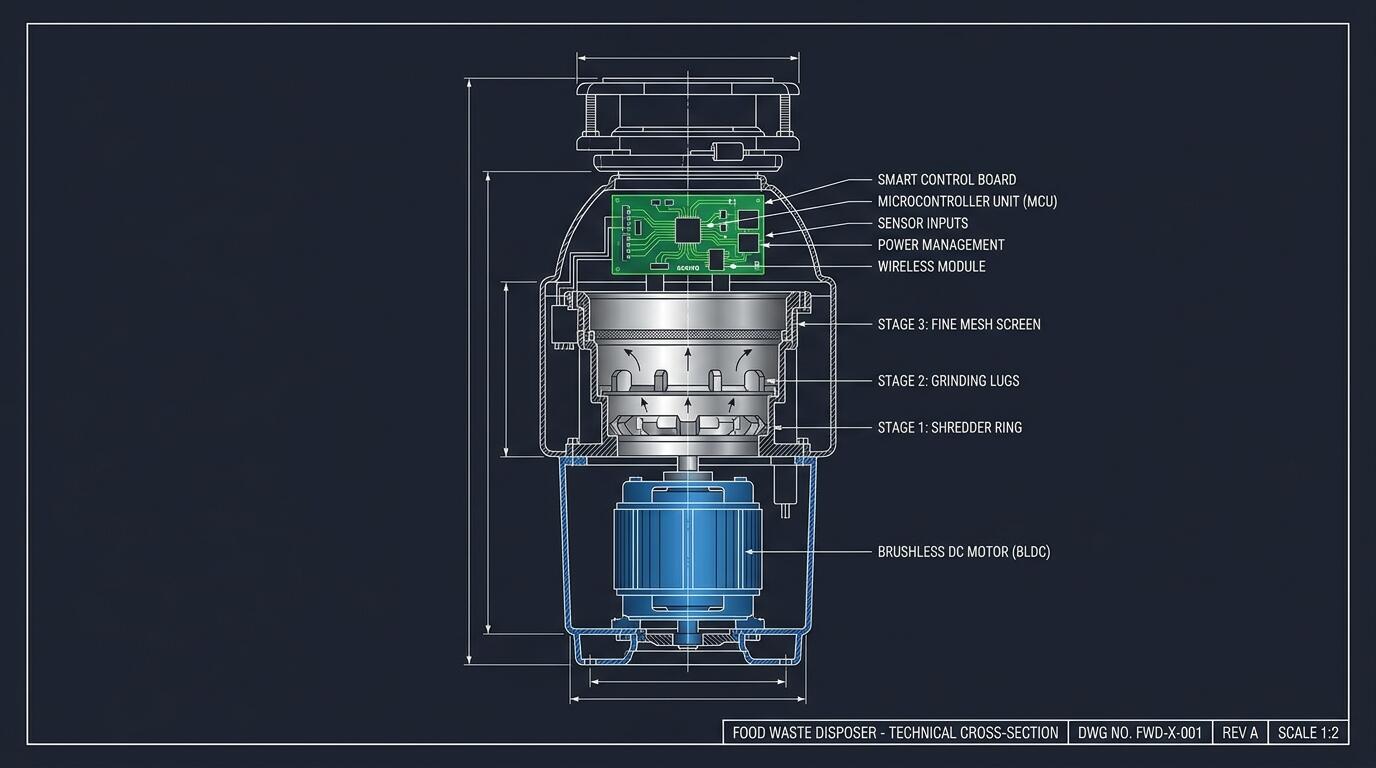
ALT: Cross-section diagram of a food waste disposer showing brushless motor, multi-stage grinding chamber, and smart control board for OEM customization
How to Choose the Right Customization Configuration for Your Program
Selecting the right combination of motor, control, and grinding specifications is not a matter of choosing the most technically advanced option across every dimension — it is a matter of matching the specification to your market positioning, your target retail price point, and your business case economics.
A practical decision framework starts with three questions. First, who is the end user, and what is their primary performance expectation — quiet operation, raw processing power, smart home integration, or low purchase price? Second, what is the target market's regulatory environment, and which certifications are mandatory for market entry? Third, what is the projected annual volume, and how does that volume interact with tooling amortization for any custom housing or chamber components?
A common misconception among brands entering the category for the first time is that customization is primarily about aesthetics — color, finish, and badge placement. In practice, the decisions with the greatest impact on product success are engineering decisions: motor platform, power specification, control architecture, and material selection. Aesthetic customization is straightforward and adds relatively little cost; engineering customization is where the real product differentiation is built, and where the experience of a manufacturing partner with deep category knowledge pays for itself.
For clients at the evaluation stage, we recommend beginning with our disposer performance testing and pre-production validation process as a reference point for understanding how engineering specifications translate into validated product performance before mass production begins.
Frequently Asked Questions FAQ
Q1: How do motor type and control mode choices affect the total cost of an OEM food waste disposer program?
Motor type and control mode are the two largest cost drivers in a food waste disposer OEM program after housing tooling. Brushless motors carry a higher component cost than brushed motors but typically reduce warranty costs over the product lifecycle through greater reliability. Smart control modes add electronics BOM cost and firmware development investment. The net cost impact depends on volume, target retail price, and the warranty cost assumptions built into your business case — a full lifecycle cost model is more useful than unit cost alone.
Q2: Are smart variable-frequency food waste disposers compatible with standard residential electrical installations?
Smart variable-frequency disposers are designed to operate within standard residential electrical supply parameters — the variable-frequency drive system manages motor speed internally and does not require a dedicated electrical circuit beyond what a conventional disposer installation uses. However, the specific voltage and frequency requirements must be matched to the target market, and the product must carry the appropriate electrical safety certifications for that market. Brands should confirm both the installation compatibility and the certification scope with their manufacturing partner before finalizing the specification.
Q3: How long does the customization and tooling process typically take for a new OEM food waste disposer program?
The customization and tooling timeline for a new OEM food waste disposer program varies depending on the degree of engineering change from an existing platform and the certification requirements of the target market. Programs that use an established motor and control platform with custom housing tooling typically move faster than programs requiring a fully new motor specification or a new certification submission. Electrical safety certification — particularly for markets such as North America or Europe — can add several months to the schedule. Engaging a manufacturing partner with existing certified platform families significantly compresses the overall timeline.
Summary
Customizing a food waste disposer for your brand involves three interlocking engineering decisions — motor power and type, control mode architecture, and grinding system design — each of which shapes product performance, market positioning, regulatory compliance, and business case economics. The brands that achieve the strongest returns from OEM food waste disposer programs are those that approach these decisions systematically at the outset of the development process, rather than treating them as detail-level choices to be resolved during sampling.
Three core principles consistently guide the most successful OEM programs we work with at EACHER: match the specification to the end-user context rather than maximizing technical complexity; build certification and tooling timelines into the project plan from day one; and treat motor platform selection as a long-term portfolio decision, not a single-SKU cost minimization exercise.
EACHER's position as a specialized OEM/ODM manufacturer — with brushed, brushless, and smart variable-frequency platforms in production and an annual capacity of 300,000 units — means that clients have access to a proven engineering base that can be configured to a wide range of market requirements without the cost and schedule risk of starting from scratch.
Ready to bring your custom food waste disposer to market with a trusted manufacturing partner? EACHER specializes in OEM/ODM solutions — from brushed and brushless to smart variable-frequency models — tailored precisely to your brand's specifications and market requirements. Visit the EACHER website to explore our capabilities, request a product catalog, or get in touch with our engineering team for a customized quote today.
Sources & Citations
- International Electrotechnical Commission (IEC). "Standards for Rotating Electrical Machines and Household Appliance Safety."
https://www.iec.ch - International Organization for Standardization (ISO). "ISO Standards for Quality Management and Manufacturing Process Control."
https://www.iso.org - Underwriters Laboratories (UL). "UL Standards for Household Food Waste Disposers and Electrical Appliance Safety."
https://www.ul.com - SciEPublish. "Robot Grinding: From Frontier Hotspots to Key Research Directions."
https://www.sciepublish.com/article/pii/703
Note: Standards may be updated; please check the latest official documents or consult professional advisors.