
 +8657486688117
 400-616-0305
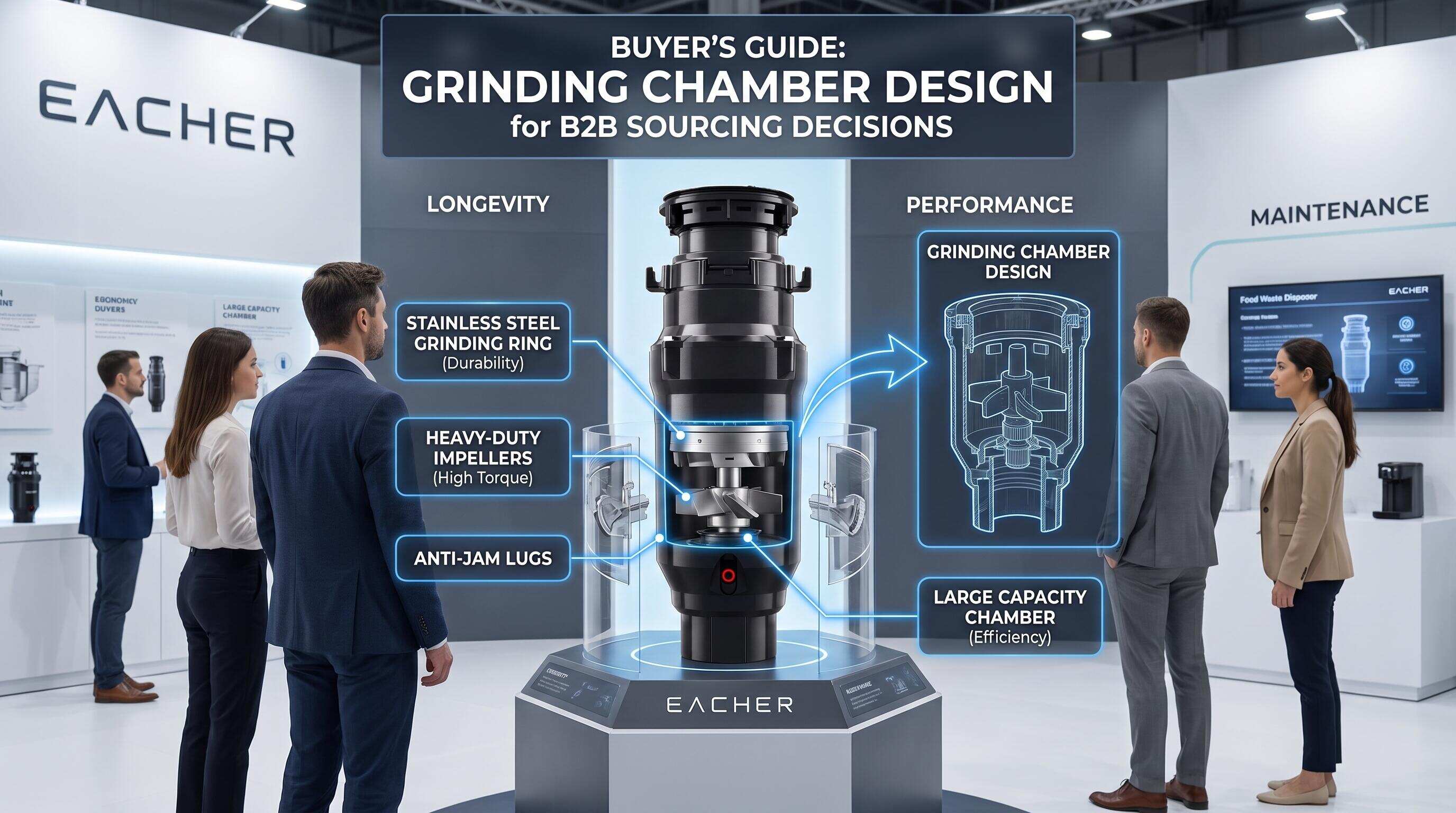
ALT: Buyer's guide to food waste disposer grinding chamber design for B2B sourcing decisions
What This Guide Helps You Achieve: Smarter Grinding Chamber Sourcing
Key Conclusion: The grinding chamber is the functional core of any food waste disposer — its design directly determines processing capacity, noise output, motor load, and long-term durability. Buyers who evaluate chamber geometry, material grade, and grind mechanism configuration before placing orders consistently avoid costly post-launch redesigns. This guide walks procurement decision-makers through a structured evaluation framework so that grinding chamber specifications translate directly into competitive, market-ready products.
When a sourcing decision goes wrong on a food waste disposer, the root cause is rarely the motor spec sheet or the finish color. In our work with clients across multiple markets, a pattern we consistently see is that grinding chamber design is the most frequently underspecified subsystem at the time of initial inquiry — and the one that generates the most costly revisions once prototypes arrive. This guide is written for procurement managers, product developers, and brand buyers who are actively evaluating or shortlisting food waste disposer manufacturers this quarter and need a structured, technically grounded approach to assessing grinding chamber design before committing to production tooling.
Before You Start: Prerequisites and Preparation for Chamber Design Evaluation
Effective evaluation of grinding chamber design requires preparation on two fronts: understanding your end-market requirements and having sufficient internal alignment on product positioning before engaging suppliers. Rushing into specification discussions without this groundwork typically results in over-specified chambers that inflate cost, or under-specified ones that fail performance expectations in the field.
What you need before starting this evaluation:
- A clear definition of your target market segment — residential entry-level, residential premium, or light commercial — since chamber volume, grind stage count, and material grade all shift significantly between these tiers
- Knowledge of the food waste profile your end users will process most frequently (fibrous vegetables, hard bones, mixed organic waste), as this directly influences chamber geometry and cutting disc specifications
- An understanding of the drainage plumbing standards in your target market, since chamber outlet diameter and positioning must align with regional sink installation norms
- Preliminary motor type preference or flexibility — brushed, brushless, or smart variable-frequency — because chamber design is optimized differently depending on torque delivery characteristics
- Your target price band and minimum order volume, as these constrain the viable range of chamber materials and manufacturing tolerances your supplier can realistically commit to
- Any certification or compliance requirements (UL, CE, RoHS, or others applicable to your export market) that may impose constraints on material selection within the chamber assembly
The time investment for a thorough grinding chamber evaluation — from initial specification review through prototype assessment — is meaningful and should be planned accordingly. Treating it as a single-meeting agenda item is a common mistake that leads to specification drift later in the project.
Checklist before starting:
- End-market segment defined and documented
- Target food waste profile identified
- Regional plumbing and drainage standards confirmed
- Motor technology preference or range established
- Target price band and MOQ communicated to sourcing team
- Applicable certifications and compliance requirements listed
How to Evaluate Disposer Grinding Chamber Design: Step-by-Step Instructions
Step 1: Define the Chamber Volume and Capacity Requirements for Your Market
The grinding chamber volume — the internal space where food waste is processed — is the foundational specification that downstream decisions flow from. A chamber that is too small for the expected household size creates frequent jamming and user frustration; one that is oversized for entry-level positioning adds unnecessary cost and weight.
Begin by mapping your target household profile to the required effective processing capacity. Residential single-family applications in markets with high organic waste generation typically demand meaningfully larger chamber volumes than apartment or compact kitchen applications. Light commercial settings — small cafes, residential hotel kitchens — require chambers designed for higher throughput and more rigorous duty cycles than any residential product.
Tip: Ask potential suppliers to provide cross-sectional drawings of the chamber, not just external dimensions. The internal taper, the distance between the upper grinding ring and the lower turntable, and the clearance geometry around the impeller arms all determine effective capacity far more than a nominal volume figure.
Step 2: Assess the Grinding Mechanism Configuration — Single-Stage vs. Multi-Stage
The grinding mechanism refers to the combination of rotating elements (typically a turntable and impeller arms) and the stationary grind ring that together reduce food waste to fine particles. Single-stage chambers process waste in one continuous pass; multi-stage configurations route partially ground material through secondary reduction zones before discharge.
Single-stage designs are cost-effective, easier to manufacture to consistent tolerances, and entirely appropriate for standard residential use with typical food waste streams. Multi-stage designs are justified when the target user profile includes hard materials — small bones, dense rinds, fibrous stalks — that single-stage chambers struggle to reduce to the particle size required by local drainage regulations. According to guidelines published by the Water Environment Federation, disposal particle size and water usage are both factors that wastewater infrastructure planners consider when evaluating food waste disposer adoption, making fine grind performance a legitimate product differentiator in regulated markets.
Tip: When reviewing a supplier's grind mechanism, request performance data on specific waste types rather than generic throughput claims. The difference between a chamber that processes leafy greens efficiently and one that handles corn husks without jamming comes down to impeller arm geometry and grind ring tooth profile — details that should be visible in engineering drawings.
Step 3: Evaluate Chamber Material Grade and Surface Treatment
The grinding chamber in a food waste disposer is a corrosive environment. Organic acids, moisture, and abrasive particles are present in every operating cycle. The material grade and surface treatment used in the chamber assembly determine corrosion resistance, structural longevity, and noise characteristics simultaneously.
Stainless steel is the dominant material for premium and mid-tier chamber bodies, with meaningful variation in grade determining actual performance. Lower-tier products sometimes employ reinforced polymer bodies for the upper chamber section, which reduces cost but introduces limitations on high-temperature resistance and long-term dimensional stability. The grind ring — the stationary toothed collar against which food waste is sheared — is almost always a ferrous or stainless alloy regardless of body material choice, since it bears direct abrasive load.
Surface treatments applied to chamber interiors affect both corrosion resistance and acoustic behavior. Electropolished or precision-machined interior surfaces reduce food particle adhesion and make cleaning cycles more effective. Per ISO standards governing stainless steel corrosion resistance classifications, the specific alloy grade and surface finish together determine the effective service life of the chamber assembly — a distinction that matters significantly for warranty positioning in your product line.
Tip: Request material certificates and surface treatment specifications in writing during supplier qualification, not as an afterthought before first production. Substitutions in chamber material grade are one of the most common cost-cutting moves that emerge under production cost pressure if specifications are not contractually anchored.
Step 4: Examine the Grind Ring Tooth Profile and Turntable Design
The grind ring is the stationary toothed element lining the inner circumference of the lower chamber. The turntable is the rotating disc driven by the motor shaft, carrying impeller arms that fling food waste outward against the grind ring teeth. The relationship between tooth geometry, impeller arm count, and rotational dynamics defines the actual grind performance of the product.
Grind ring tooth profiles vary in pitch, height, and angular orientation. Coarser tooth profiles with larger pitch handle volume efficiently but produce larger average particle sizes. Finer tooth profiles with closer pitch produce smaller particle sizes — often required in markets with stricter discharge regulations — but are more sensitive to jamming under overload conditions and impose higher motor torque demands. The turntable design — including impeller arm count, arm geometry, and the clearance between arm tips and the grind ring — must be matched to the ring profile to deliver coherent overall performance.
In our experience working with OEM clients across multiple product tiers, the mismatch between a high-throughput turntable design and a fine-pitch grind ring is a recurring root cause of noise and vibration issues that only become apparent during final validation, not during component-level inspection.
Tip: Ask suppliers whether their grind ring and turntable specifications are validated as a matched system or whether components are specified independently. A matched, co-validated assembly reduces integration risk for your product program significantly. You can also explore how disposers are validated before mass production to understand what pre-production testing should cover.
Step 5: Assess Chamber Acoustic Design and Vibration Isolation Features
Noise performance is a primary purchase criterion for residential food waste disposers across most developed markets, and the grinding chamber is the acoustic source. Vibration isolation between the chamber assembly and the mounting collar, damping material placement, and chamber wall thickness all contribute to the final installed sound level.
Chamber wall thickness and stiffness affect resonance frequency. Thinner walls reduce cost and weight but increase the likelihood of audible resonance during grind cycles. Strategic use of constrained-layer damping — typically polymer or elastomeric inserts bonded to the chamber exterior — attenuates transmitted vibration before it reaches the sink mounting and the surrounding cabinet structure.
Evaluate suppliers on whether their chamber acoustic design is a deliberate engineering feature or simply a byproduct of wall thickness choices. Products positioned in the premium residential segment increasingly require acoustic performance that meets or exceeds the ambient thresholds recognized by consumer product rating organizations in North American and European markets.
Tip: Request a noise measurement protocol and test results at the chamber-plus-motor assembly level under loaded operating conditions, not just unloaded no-waste spinning tests. The loaded condition is the relevant acoustic scenario for end-user experience.
Step 6: Confirm Chamber Compatibility with Your Target Motor Architecture
The grinding chamber must be engineered in alignment with the motor type driving it — brushed, brushless, or smart variable-frequency. Each motor architecture delivers torque differently, and the chamber must be optimized for its specific torque and speed profile. If you are starting an OEM food waste disposer project and have not yet finalized motor selection, chamber design and motor selection should proceed in parallel rather than sequentially.
Brushed motor disposers typically operate at fixed speed, meaning the chamber must be designed to handle peak torque demands at that single operating point. Brushless motor systems offer more consistent torque delivery and longer service life, allowing chamber tolerances to be optimized with greater confidence in the motor's performance envelope. Smart variable-frequency disposers — which modulate motor speed in response to detected load — place different demands on chamber geometry, since the same chamber must perform acceptably across a range of rotational speeds. EACHER's range spans all three motor architectures, and in our work with OEM clients, matching chamber design to motor architecture from the start of a project consistently prevents late-stage performance issues that require costly tooling modifications.
Tip: If your product roadmap includes an upgrade path from a brushed to a brushless platform, discuss chamber interface compatibility with your manufacturer at the design stage. A chamber that physically accepts both motor types without structural modification reduces future product line development costs significantly.
Step 7: Validate Supplier Capability Through Documentation and Prototype Review
The final step before committing to a manufacturing partner for your grinding chamber specification is a structured capability validation. This goes beyond reviewing a factory audit checklist; it requires evidence that the supplier has produced chambers matching your specification at volume, validated them against your target performance criteria, and maintained consistent quality across production batches.
Request documented evidence of chamber dimensional tolerances from recent production runs, material certificates for the specific alloy grades used, and test reports from grind performance and corrosion resistance validation. If your target markets require specific electrical or safety certifications, confirm that the chamber assembly contributes no compliance gaps — per the guidance published by standards bodies such as UL and IEC, the chamber material and construction must meet the relevant product safety standards applicable to food-contact or incidental food-contact components in the assembled appliance.
Tip: A supplier who can produce a dimensionally accurate prototype rapidly and provide annotated test data alongside it is demonstrating manufacturing process maturity, not just design capability. Prototype quality is a reliable proxy for production quality when the supplier has genuine process control.
Common Mistakes and Troubleshooting in Grinding Chamber Specification
| Symptom | Likely Cause | How to Fix |
|---|---|---|
| Frequent jamming reported during product testing | Grind ring tooth pitch too fine for the waste types targeted, or impeller arm clearance too generous | Review tooth profile specification against target waste stream; co-validate grind ring and turntable as a matched system |
| Higher-than-expected noise in final product | Chamber wall thickness insufficient; absence of constrained-layer damping; resonance frequency falls within grind cycle operating range | Specify minimum wall thickness in procurement contract; require acoustic test data under loaded conditions before production approval |
| Corrosion visible in chamber after accelerated life testing | Material grade substituted below specification during production; surface treatment not applied per spec | Require material certificates per production batch; include surface treatment protocol in quality plan; conduct salt spray testing per ASTM B117 or equivalent |
| Chamber leaks at mounting collar joint | Dimensional tolerance on chamber flange outside specification; seal design inadequate for operating pressure | Require dimensional inspection report for collar interface from production samples; validate seal material and compression spec in assembly drawings |
| Grind particle size does not meet local discharge requirements | Tooth profile geometry produces insufficient reduction; multi-stage configuration needed for target waste profile | Re-evaluate grind ring tooth pitch; assess whether single-stage chamber is appropriate for target market or whether multi-stage design is required |
| Motor overload under normal operating conditions | Chamber geometry not optimized for motor torque envelope; impeller arm design creating excessive hydraulic resistance | Conduct co-validation of chamber and motor as an integrated assembly; adjust impeller arm geometry in coordination with motor supplier |
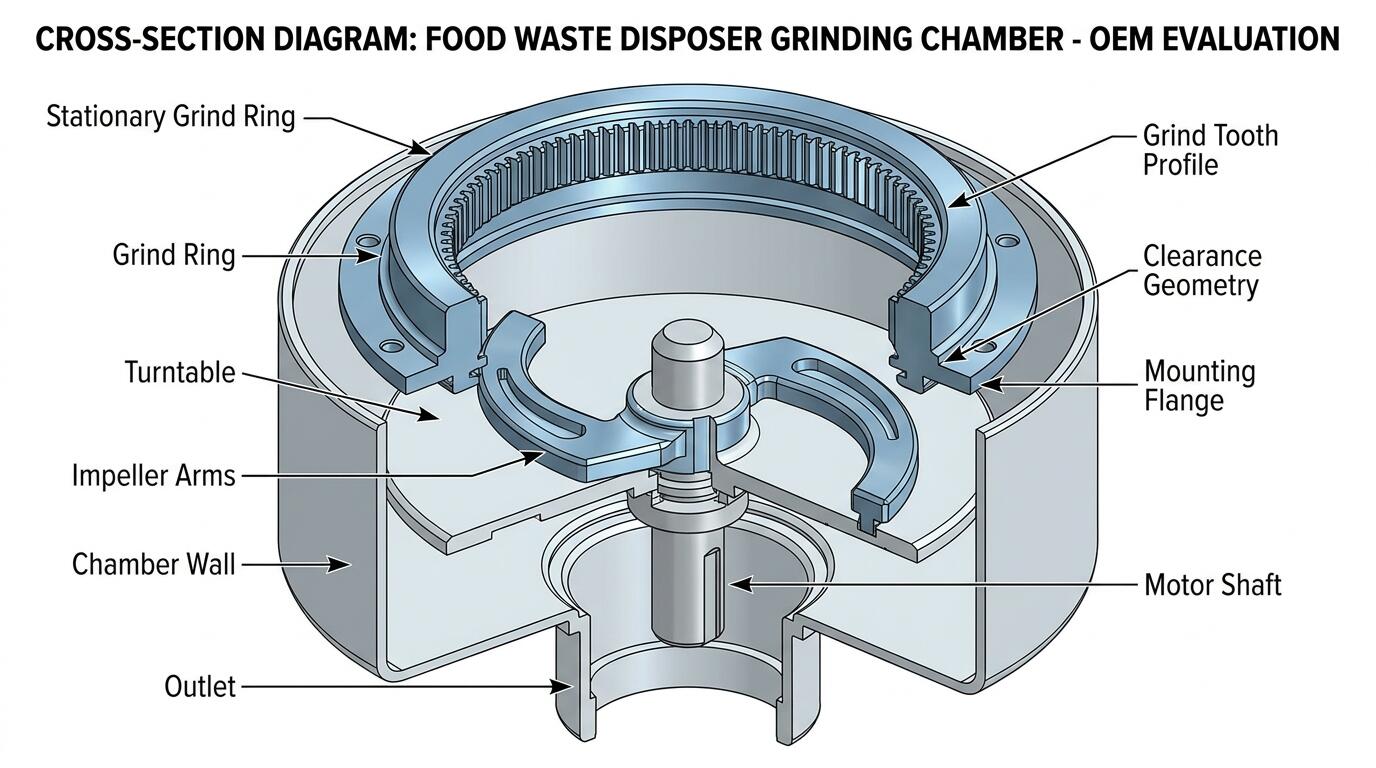
ALT: Cross-section of food waste disposer grinding chamber showing grind ring, turntable, and impeller arm design for OEM sourcing evaluation
Pro Tips for Better Grinding Chamber Sourcing Decisions
Specify the grind ring as a controlled component, not a commodity item. A pattern we consistently observe is that buyers lock down motor and electronics specifications carefully but treat the grind ring as a standard purchase item. In practice, grind ring tooth geometry is a core intellectual property differentiator in food waste disposer design, and the difference between a ring that performs and one that merely exists is not visible to the naked eye. Require engineering drawings with dimensional tolerances and hardness specifications in your product documentation, not just a vendor-supplied part number.
Treat chamber acoustic validation as a release gate, not a checkbox. Advanced procurement teams build acoustic performance criteria into the formal product release criteria for prototype approval, not into the post-launch quality audit process. A grinding chamber that fails acoustic targets late in development is expensive to fix — wall thickness, damping, and mounting geometry changes all have tooling cost implications. Set the acoustic acceptance criteria at the specification stage and validate against them at first prototype.
Consider the full operational temperature range of your target market. Chamber materials and seals that perform well in temperate conditions may behave differently at the temperature extremes encountered in markets with significant seasonal variation. Polymer components within the chamber assembly are particularly susceptible to dimensional change under thermal cycling. Specify operating temperature range requirements explicitly and request validation data across that range.
Understand the implications of grind ring hardness for long-term performance. A common misconception in the market is that a harder grind ring is always better. In practice, grind ring hardness must be balanced against the toughness of the surrounding chamber structure. An excessively hard ring bonded to a chamber body that flexes under load can generate micro-cracks in the ring mounting interface over time, leading to premature failure. Ask suppliers to specify both hardness and the mechanical basis for their ring-to-chamber bonding approach.
Align chamber design decisions with your target market's plumbing codes early. Regulations governing food waste disposer discharge particle size and water usage vary meaningfully across markets. In some jurisdictions, municipal wastewater authorities publish specific guidance on acceptable grind performance, making compliance a non-negotiable design input rather than a desirable feature. Reviewing the applicable regulatory environment before finalizing chamber specifications prevents costly redesigns later in the program.
People Also Ask
Q1: How does grinding chamber volume affect the performance of a food waste disposer?
Grinding chamber volume determines how much food waste can be processed in a single operating cycle before the chamber becomes overloaded. A chamber with insufficient internal volume for the household waste load creates back-pressure that stresses the motor and increases jamming frequency. Chamber volume should be matched to the target household size, the typical food waste composition, and the motor torque capacity — these three variables together define the effective processing capacity of the assembled product.
Q2: Are stainless steel grinding chambers always better than polymer alternatives?
Stainless steel chambers offer superior corrosion resistance, longer structural service life, and better acoustic stiffness in most operating environments, making them the preferred choice for mid-tier and premium product positioning. Reinforced polymer chambers can be appropriate for entry-level products where cost constraints are the primary design driver, provided the polymer grade is rated for continuous exposure to organic acids and elevated moisture. The choice should be driven by target market positioning, duty cycle expectations, and the warranty period the brand intends to support.
Q3: How long does it typically take to validate a custom grinding chamber design before production?
The timeline for grinding chamber design validation depends on the complexity of the specification changes, the supplier's tooling lead times, and the number of prototype iterations required. A design that closely follows an established platform with incremental modifications reaches validated prototype status more quickly than a ground-up custom geometry. Buyers should plan for meaningful design and validation time as part of their overall product development schedule, and should build prototype review milestones into their sourcing agreements from the start rather than assuming a linear, single-iteration process.
Final Thoughts
The grinding chamber is not a passive enclosure — it is an active performance system whose geometry, materials, and mechanism configuration determine whether a food waste disposer delivers on its market positioning or falls short in the hands of end users. Buyers who treat chamber design as a secondary specification behind motor selection and cosmetic design consistently encounter performance and quality issues that are expensive to resolve after tooling is committed.
Three points that should anchor your sourcing approach this quarter: first, specify the grinding chamber — including grind ring tooth profile, material grade, surface treatment, and acoustic design — as precisely as you specify the motor; second, validate chamber performance as an integrated system with the motor, not as an isolated component; third, require documented evidence of production-level dimensional control and material certification before approving a supplier for volume production.
If your product program is at the stage where manufacturing partner selection is the immediate next step, engaging with a supplier who brings demonstrated OEM and ODM capability across multiple motor architectures — with the production volume and technical depth to support custom chamber design — is the most direct path to a market-ready product on a competitive timeline. For teams navigating export compliance requirements alongside design specification work, understanding the voltage and electrical compliance requirements for your target markets in parallel with chamber design decisions will prevent late-stage surprises that delay market entry.
Ready to bring your custom food waste disposer to market with a trusted manufacturing partner? EACHER specializes in OEM/ODM solutions — from brushed and brushless to smart variable-frequency disposers — engineered to your exact specifications and backed by an annual production capacity of 300,000 units. Visit the EACHER website today to explore partnership opportunities, request a product catalog, or get in touch with our team for a tailored quote.
References & Further Reading
- Water Environment Federation. "Food Waste Disposers and Their Impact on Wastewater Infrastructure".
https://www.wef.org - International Organization for Standardization (ISO). "Stainless Steels — Corrosion Resistance and Surface Finish Standards".
https://www.iso.org - ASTM International. "ASTM B117 — Standard Practice for Operating Salt Spray (Fog) Apparatus".
https://www.astm.org - International Electrotechnical Commission (IEC). "IEC Standards for Household and Similar Electrical Appliances — Safety and Performance".
https://www.iec.ch - UL Standards & Engagement. "Safety Standards for Food Waste Disposers and Household Appliances".
https://www.ul.com
Note: Standards may be updated; please check the latest official documents or consult professional advisors.