
 +8657486688117
 400-616-0305
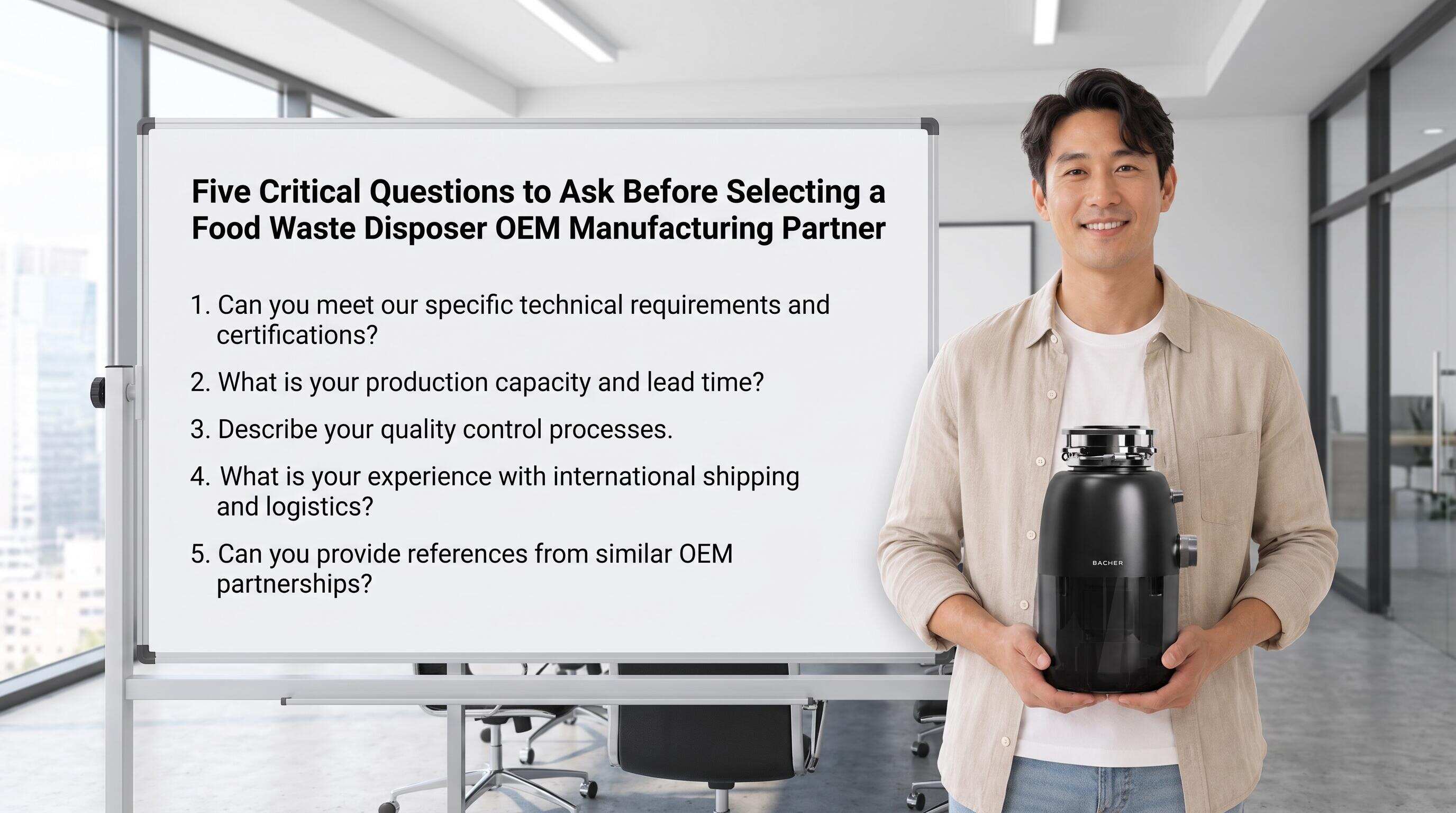
ALT: Five critical questions to ask before selecting a food waste disposer OEM manufacturing partner
What Every B2B Buyer Should Know Before Choosing a Food Waste Disposer OEM Partner
The single question most procurement teams face at this stage is deceptively simple: how do I know whether a manufacturer can actually deliver what they promise? Choosing the wrong OEM partner for food waste disposers — products that involve rotating machinery, water exposure, motor performance, and global safety compliance — can delay a product launch, inflate unit costs, or leave a brand exposed to warranty claims it cannot resolve. This article addresses that challenge directly by laying out five essential questions every buyer, brand owner, or product development team should ask before signing an OEM agreement.
These five questions were drawn from patterns we consistently observe in our work with global clients across North America, Europe, and the Asia-Pacific region. They are not theoretical checkboxes; they reflect the real decision points where OEM relationships succeed or break down. Read this list as a structured evaluation framework — use it during factory visits, RFQ negotiations, and due-diligence conversations to separate credible manufacturing partners from those that simply look good on paper.
Five Questions That Separate Strong OEM Partners from Weak Ones
Does the Manufacturer Specialize in Food Waste Disposers — or Just Assemble Them?
Specialization is the foundation of reliable OEM manufacturing. A manufacturer that focuses exclusively on food waste disposers — rather than treating them as one line among dozens of unrelated appliances — develops deeper process knowledge, more refined tooling, and a more disciplined supply chain for the specific components these products require: grinding chambers, grinding rings, anti-jamming mechanisms, motor assemblies, and waterproof housings.
In our work with clients evaluating new manufacturing partners, a pattern we consistently see is that generalist assembly operations struggle with tolerances specific to disposer motor alignment and vibration dampening. A specialized manufacturer, by contrast, can speak with authority about the trade-offs between brushed and brushless motor configurations, explain why variable-frequency drive technology reduces peak current draw, and recommend grinding chamber geometry suited to different regional waste profiles.
EACHER, operating under Ningbo Yiju Environmental Technology Co., Ltd., is an example of a purpose-built food waste disposer manufacturer with an annual production capacity of 300,000 units. That level of output, concentrated in a single product category, signals the kind of operational maturity that translates to consistent quality at scale.
Best for: Buyers launching a new branded disposer line who need a partner capable of guiding product development decisions, not just executing a bill of materials.
Watch out: Manufacturers that claim specialization but cannot demonstrate category-specific engineering depth in conversations about motor type selection, noise management, or grinding performance — these are usually generalists in disguise.
What Motor Technologies Does the Manufacturer Offer, and Can They Guide the Right Choice?
Motor technology is the defining variable in food waste disposer performance, durability, and total cost of ownership. There are three principal motor architectures currently used in the market, and a capable OEM partner should be able to explain the practical implications of each.
A brushed motor is a traditional, carbon-brush-driven induction motor — reliable, cost-effective, and well-suited for entry-level and mid-range products where price sensitivity is high. A brushless motor eliminates physical brush contact, resulting in lower friction, longer service life, reduced heat generation, and quieter operation — characteristics that justify a higher retail price point in premium markets. A smart variable-frequency motor, which uses electronic drive control to modulate rotational speed based on load, represents the current performance ceiling for residential disposers: it adapts in real time to waste volume and hardness, delivering efficient processing while protecting the grinding mechanism from overload.
According to the International Electrotechnical Commission (IEC), motor efficiency classifications and operational safety requirements for household appliances are governed by IEC standards for motor-operated appliances, which define the baseline expectations that a compliant manufacturer must meet. An OEM partner who can navigate these requirements across all three motor types demonstrates both technical competence and regulatory awareness.
Best for: Product development teams designing a tiered product portfolio — entry, mid, and premium — who need a single manufacturing partner capable of producing across the full motor-technology spectrum without fragmenting the supply chain.
Watch out: Partners that offer only one motor type and reframe it as the "best" solution regardless of your market segment. This signals limited manufacturing capability, not genuine product expertise.
How Does the Manufacturer Approach OEM and ODM Customization — and Where Are the Real Limits?
OEM customization means the manufacturer produces a product to your design and specifications. ODM customization means the manufacturer provides an existing design that you brand and adapt for your market. Both models are legitimate, but the depth of customization available — and where the manufacturer draws the line — varies enormously between suppliers.
In genuine OEM relationships, a qualified manufacturer should be able to accommodate custom grinding chamber configurations, motor selection, noise insulation materials, housing colors and finishes, control panel logic, and packaging. In ODM arrangements, the baseline design is already validated, which compresses development timelines, but meaningful product differentiation requires a partner willing to allow modifications beyond cosmetic branding.
A pattern we consistently see with buyers new to this category is underestimating how much the answer to "what can you customize?" reveals about a manufacturer's actual engineering capability. A partner with in-house R&D and tooling facilities can say yes to more requests and execute them with confidence. A partner relying on third-party toolmakers for every non-standard component will quote longer lead times and add cost at every customization step.
At EACHER, the OEM/ODM offering spans brushed, brushless, and smart variable-frequency models, providing clients with the flexibility to enter the market quickly via an existing validated platform or to develop a fully proprietary product design — you can explore the full scope of these capabilities on the EACHER website.
Best for: Brand owners who want to differentiate in a competitive retail environment and need a manufacturing partner that treats customization as a core competency, not an exception.
Watch out: Manufacturers that define "customization" as logo placement and box printing only. If a supplier cannot modify functional components or provide design documentation, they are a private-label reseller, not a true OEM/ODM partner.
What Certifications Does the Manufacturer Hold, and Which Markets Do They Cover?
Certifications are not bureaucratic formalities — they are the documented proof that a product has been tested against established safety and performance standards by an accredited third party. For food waste disposers entering regulated markets, the absence of the right certification is a hard barrier to retail entry, and a manufacturer that cannot support your target market's requirements is not a viable partner regardless of other strengths.
For the North American market, the primary relevant standard is UL 430, which covers the safety requirements for household waste disposers in the United States. Products sold in Canada are typically evaluated against CSA standards. For the European market, the CE marking framework applies, encompassing the Low Voltage Directive and the Electromagnetic Compatibility Directive as the primary instruments. For the Australian and New Zealand markets, RCM certification is required. A capable OEM manufacturer will have existing certifications for major markets and, critically, will have documented experience guiding clients through the certification process for markets they have not yet formally certified.
Per the requirements set by standards bodies including the International Organization for Standardization (ISO), manufacturing quality management systems themselves should meet ISO 9001 requirements — a certification that signals process discipline across production, inspection, and continuous improvement. Buyers should request certification documentation and verify it against the issuing body's records, not simply accept a supplier's assurance.
Best for: Distributors and retailers entering regulated markets — particularly the US, EU, and Australia — who need a manufacturer that can deliver products ready for retail without triggering customs holds or retailer compliance reviews.
Watch out: Manufacturers that present outdated certificates, certificates limited to a single model not applicable to your configuration, or certifications issued by bodies that cannot be independently verified. Always request the certificate number and verify it directly.
Can the Manufacturer Scale Production Without Compromising Quality — and What Does Their Capacity Actually Look Like?
Production capacity is not just a number — it is an operational statement about whether a manufacturer can grow with your business, absorb volume spikes during peak retail seasons, and maintain quality consistency as output increases. A manufacturer with a small, hand-assembled operation may produce excellent samples but fail catastrophically at scale. Conversely, a high-volume facility with poor process controls will ship consistent defects at high speed.
The meaningful questions to ask here go beyond the headline units-per-year figure. Ask how production is structured across shifts. Ask what the facility's current utilization rate is — a factory running at full capacity has no headroom for your ramp-up. Ask what quality control checkpoints exist at each production stage, from component incoming inspection through final functional testing. Ask how the manufacturer has managed sudden order volume increases from existing clients.
EACHER's annual production capacity of 300,000 units reflects a manufacturing infrastructure built for commercial-scale demand. That scale matters practically: it means the production systems, component sourcing relationships, and quality management processes are designed for volume, not just for prototype and sample runs. At the same time, scale without process discipline is meaningless, which is why buyers should always ask to review quality management documentation alongside raw capacity figures.
According to ISO 9001 — the internationally recognized quality management system standard published by the International Organization for Standardization — a structured approach to production planning, process monitoring, and corrective action is the baseline for any manufacturer claiming consistent output quality.
Best for: Established brands and high-volume distributors planning SKU rollouts across multiple retail channels who need a manufacturer capable of delivering tens of thousands of units per quarter without quality degradation.
Watch out: Manufacturers that quote large capacity figures but cannot explain how quality is maintained as volume increases, or that rely entirely on end-of-line inspection rather than in-process quality controls. End-of-line-only inspection catches defects after they are already produced — it does not prevent them.
Quick Comparison at a Glance
The five questions above each probe a distinct dimension of OEM partner capability. The table below maps each question to its core evaluation purpose, what a strong answer looks like, and the most common failure mode buyers encounter.
| Evaluation Question | Best For | Key Strength to Probe | Common Limitation |
|---|---|---|---|
| Specialization in food waste disposers | New product launches, first-time OEM buyers | Category-specific engineering depth | Generalist assemblers misrepresenting specialization |
| Motor technology range and guidance | Multi-tier product portfolio development | Ability to advise across brushed, brushless, and variable-frequency | Single-technology suppliers reframing limitation as recommendation |
| OEM/ODM customization depth | Brand differentiation, proprietary product development | In-house R&D, tooling, and functional customization capability | Suppliers defining customization as cosmetic branding only |
| Certifications and market coverage | Entering regulated retail markets (US, EU, AU, others) | Current, verifiable certifications for target market standards | Outdated, model-specific, or unverifiable certification claims |
| Scalable production capacity and quality | High-volume distributors and established retail brands | Volume infrastructure with documented in-process quality controls | High-capacity claims without supporting quality management systems |
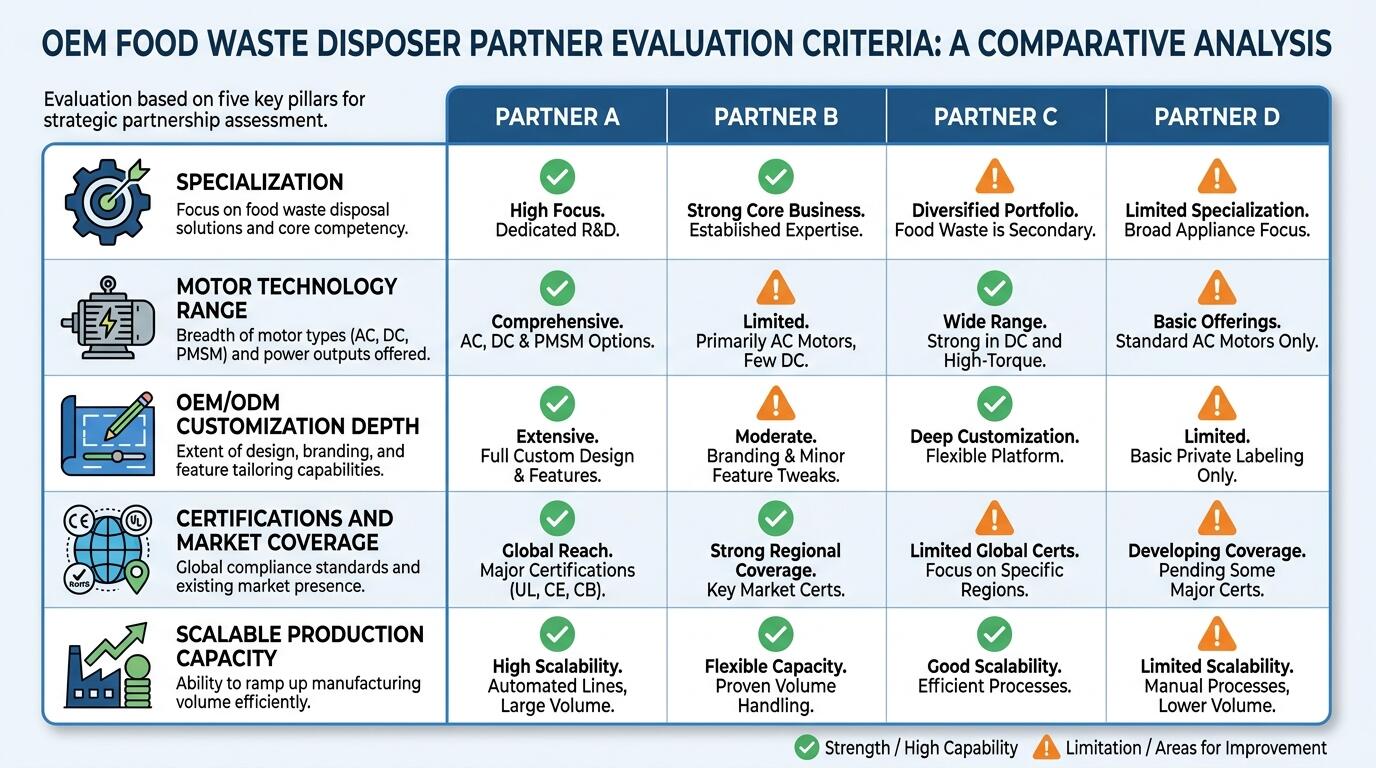
ALT: Comparison table summarizing five OEM food waste disposer partner evaluation criteria including specialization, motor technology, customization, certifications, and production capacity
How to Choose the Right OEM Partner for Your Situation
The right OEM partner depends on where your product is in its lifecycle and what your primary business constraint is right now. Different situations call for weighting these five questions differently.
If you are entering the market for the first time with a new brand, prioritize the specialization question and the customization depth question. You need a partner that will guide you through product decisions you have not yet made, not just execute a spec sheet you do not yet have. A manufacturer with genuine category expertise and ODM capability will accelerate your time to market while reducing early-stage technical risk.
If you are an established distributor adding a private-label disposer line to an existing appliance portfolio, the certification and scalability questions should dominate your evaluation. Your target markets are already defined, your volume projections are based on real sales data, and your primary risk is a compliance failure or a supply disruption — not a product development misstep.
If you are a brand owner developing a premium product line for a specific regional market, the motor technology question becomes central. A partner that can offer smart variable-frequency models with genuine engineering support — not just catalog access — enables meaningful product differentiation in a segment where performance claims must be substantiated.
A common misconception worth addressing directly: many buyers assume that a manufacturer with the lowest sample price is the optimal cost partner at volume. In practice, the total cost of an OEM relationship includes tooling amortization, quality failure rates, logistics, certification support, and the cost of delays. A manufacturer that prices samples aggressively but lacks process controls, certification depth, or customization capability will often cost more over the product lifecycle than a specialist that charges a fair price from the start.
Questions & Answers
Q1: How do brushed and brushless food waste disposer motors differ in terms of OEM product positioning?
Brushed motors use carbon brushes that make physical contact with the motor's commutator, making them cost-effective and reliable for entry-level products. Brushless motors eliminate that contact, resulting in lower noise, reduced heat, and longer operational life — attributes that support premium retail positioning. For OEM buyers designing a tiered product line, the motor type selection should align with target retail price points and the performance claims the brand intends to make in its target market.
Q2: Are food waste disposer OEM manufacturers required to hold market-specific safety certifications before shipping products to retailers?
Yes, in most major regulated markets, products must meet specific safety standards before retail sale. In the United States, UL 430 governs household waste disposer safety requirements. In the European Union, CE marking under the Low Voltage Directive and the Electromagnetic Compatibility Directive is required. A competent OEM partner will hold current certifications relevant to your target market and can provide documentation for verification. Buyers should always confirm certification validity directly with the issuing body rather than relying solely on manufacturer-provided copies.
Q3: How long does a typical OEM customization project take from initial inquiry to production-ready samples?
Project timelines vary based on customization scope. An ODM engagement — adapting an existing validated platform with cosmetic or minor functional changes — typically moves faster than a full OEM project built from a new design. The primary time variables are tooling fabrication (for custom housings or components), engineering review cycles, and certification testing for new configurations. A manufacturer with established in-house tooling and R&D infrastructure will compress these timelines relative to one that outsources tooling to third parties. Buyers should request a milestone-based project schedule at the RFQ stage to set realistic expectations.
The Bottom Line
Choosing the right food waste disposer OEM partner is a decision that shapes your product's performance, your brand's credibility in the market, and your operational resilience over the long term. The five questions in this article are designed to surface the real capability gaps that standard supplier presentations rarely reveal.
Key Takeaways:
- Specialization in food waste disposers — not general appliance assembly — is the foundation of reliable OEM partnership.
- Motor technology range (brushed, brushless, and smart variable-frequency) reflects the depth of a manufacturer's product engineering competence.
- True OEM/ODM customization capability requires in-house R&D and tooling, not just branding and packaging changes.
- Market-specific certifications (such as UL 430 for North America and CE for Europe) are non-negotiable for regulated retail entry, and they must be verified, not assumed.
- Production capacity is meaningful only when paired with documented quality management processes that maintain consistency at scale.
The next step is straightforward: take these five questions into your next supplier conversation and evaluate the quality of the answers — not just the confidence with which they are delivered.
Ready to bring your food waste disposer product to life with a trusted manufacturing partner? EACHER specializes in fully customized OEM/ODM solutions — from brushed and brushless to smart variable-frequency models — backed by an annual capacity of 300,000 units. Visit EACHER to explore our capabilities and request a tailored quote today.
Sources & Citations
- International Electrotechnical Commission (IEC). "IEC Standards for Motor-Operated Household Appliances — Safety and Performance Requirements".
https://www.iec.ch - International Organization for Standardization (ISO). "ISO 9001 — Quality Management Systems Requirements".
https://www.iso.org - Underwriters Laboratories (UL). "UL 430 — Standard for Household Food Waste Disposers".
https://www.ul.com
Note: Standards may be updated; please check the latest official documents or consult professional advisors.