
 +8657486688117
 400-616-0305

ALT: European kitchen with food waste disposer illustrating rising demand trends in food waste disposer market
Why Is Europe's Food Waste Disposer Market Shifting This Quarter?
Kitchen renovation cycles, tightening food waste regulations, and growing consumer awareness around sustainable waste management are converging to reshape purchasing patterns across Europe. Europe's food waste disposer market is entering a phase where demand is increasingly shaped by regulatory pressure rather than pure consumer preference alone, and the central finding of this analysis is that OEM/ODM manufacturing partners who can adapt quickly to compliance-driven specifications and regional installation norms will capture the bulk of near-term growth opportunities. This shift matters because buyers, importers, and brand owners who misread the underlying drivers risk building inventory or product lines around outdated assumptions about what European retailers and installers actually want.
This topic deserves close attention right now because the interplay between EU-level food waste policy, national plumbing codes, and shifting kitchen appliance retail channels is creating a more fragmented but also more opportunity-rich landscape than in prior years. Procurement teams that treat the European market as a single homogeneous zone tend to underestimate the compliance and customization work required to succeed in individual countries, a mistake that becomes costly only after production runs and shipments have already been committed.
Background and the Current Landscape of Food Waste Disposer Demand
A food waste disposer (also called a garbage disposal unit) is a kitchen appliance, typically installed beneath a sink, that shreds food scraps into fine particles so they can pass through plumbing for wastewater treatment rather than being discarded as solid waste. Historically, adoption of these units across Europe has lagged behind markets such as North America, largely due to differences in sewage infrastructure, national plumbing regulations, and long-standing consumer habits around food waste separation and composting.
That landscape is changing. Municipal food waste diversion targets, extended producer responsibility frameworks, and broader circular economy initiatives across EU member states are pushing both consumers and commercial kitchen operators to reconsider how they handle organic waste at the point of generation. According to the National Institutes of Health, shifts in household behavior around food handling and waste were already accelerating before recent global disruptions, and that behavioral momentum has continued to influence how European households think about kitchen waste management. This is not a one-off trend; it reflects a structural change in how food waste is perceived as a resource-recovery issue rather than simply a disposal inconvenience.
At the same time, the retail and specification landscape for kitchen appliances in Europe has become more channel-diverse. Buyers now source disposers through traditional plumbing wholesalers, big-box home improvement retailers, e-commerce marketplaces, and increasingly through kitchen renovation contractors who bundle disposers into full sink-and-cabinetry packages. Each channel carries different expectations around noise levels, installation footprint, energy efficiency labeling, and after-sales support, which means a single product configuration rarely satisfies the entire continent.
Import and distribution dynamics add another layer of complexity. Many European brand owners and distributors do not manufacture in-house; instead, they rely on OEM/ODM partners, often based in China, to produce units under their own brand identity. This arrangement has become more attractive as European buyers seek to control cost structures while still meeting local certification and quality expectations, a pattern we consistently see among clients who enter the market through private-label strategies rather than building factories domestically. The result is a market where manufacturing flexibility, not just unit price, increasingly determines which suppliers win long-term contracts.
Sustainability reporting requirements are also reshaping how distributors talk about disposers to end customers. Packaging, energy consumption claims, and end-of-life recyclability are becoming part of the sales narrative, a dynamic mirrored in adjacent categories tracked by the Food and Beverage Packaging Market Report, which documents how packaging and product stewardship expectations are rising across consumer goods categories in parallel with appliance demand. Buyers who ignore this broader sustainability narrative risk positioning their disposer lines as purely functional products in a market that increasingly rewards environmental credibility.
Root Causes Behind Shifting Demand Patterns
Regulatory pressure on food waste diversion
National and EU-level policies aimed at reducing landfill-bound organic waste are a primary driver of renewed interest in food waste disposers. When municipalities tighten rules around separate food waste collection or introduce volume-based waste fees, households and commercial kitchens look for at-source solutions that reduce the burden of manual sorting and storage. This regulatory pressure does not apply uniformly across Europe, which is precisely why disposer specifications that work well in one country may need adjustment for another.
Urban housing density and kitchen renovation cycles
Smaller urban kitchens across many European cities favor compact, quiet appliances that do not compromise limited under-sink storage space. Renovation-driven demand tends to spike alongside broader kitchen remodeling cycles, meaning disposer sales often move in tandem with cabinetry, sink, and faucet replacement projects rather than as a standalone purchase decision. A common mistake among new market entrants is designing a single disposer footprint optimized for spacious North American under-sink cavities, then attempting to sell that same configuration into markets where compact installation is the norm.
Consumer sustainability awareness and behavioral shifts
Rising awareness of food waste as an environmental and economic issue has changed how consumers frame the value proposition of a disposer purchase. Where the appliance was once marketed mainly on convenience, many European buyers now respond more strongly to messaging around reduced landfill contribution and support for wastewater-based resource recovery. This shift in framing changes what marketing collateral and certification claims OEM/ODM partners need to support, and manufacturers who cannot substantiate sustainability claims with credible documentation risk losing credibility with increasingly informed buyers.
Plumbing infrastructure compatibility and installation variance
Unlike some other regions, many European buildings feature narrower waste pipes, different trap configurations, and varying local codes governing what can be discharged into municipal sewage systems. This infrastructure variance is one of the most underestimated root causes of demand fragmentation, because it directly constrains which disposer configurations are even installable in a given country or building type. Distributors who fail to verify local plumbing compatibility before committing to a product line frequently encounter costly return or retrofit issues after installation.
Distribution channel diversification and private-label growth
The growth of e-commerce and contractor-bundled kitchen packages has fragmented how disposers reach end customers, and each channel imposes different packaging, warranty, and documentation expectations. Brand owners entering through private-label or white-label strategies increasingly expect OEM/ODM manufacturing partners to support flexible branding, customized packaging, and configurable technical specifications rather than offering a single fixed catalog product. In our work with clients pursuing private-label entry into European retail, the ability to adjust motor type, control interface, and noise profile without a full product redesign is consistently one of the most requested capabilities.
Evidence and Multi-Angle Comparison of Market Approaches
Evidence from adjacent sustainability and waste-reduction research supports the broader thesis that European demand for at-source food waste solutions is strengthening. The strategy document on economic and environmental gains from food waste reduction, prepared in connection with the New Climate Economy initiative, outlines how reducing the volume of food waste sent to landfill carries measurable economic and environmental benefits at a systemic level, reinforcing why municipalities and national governments continue to prioritize food waste diversion policy. While that research does not focus specifically on disposer appliances, it establishes the policy logic that indirectly fuels appliance-level demand.
Distributors and brand owners approaching the European market tend to fall into a few recognizable strategic postures, each with distinct strengths and trade-offs. Some prioritize rapid market entry with a narrow product range, others invest early in country-specific certification and customization, and still others attempt a one-size-fits-all pan-European approach that minimizes upfront complexity but risks weaker fit in individual national markets.
| Perspective / Approach | Strengths | Trade-offs | Best Fit |
|---|---|---|---|
| Rapid entry with a single standardized SKU | Lower upfront tooling and certification cost; faster time to market | Limited fit across countries with differing plumbing codes and noise expectations; higher risk of returns or installation complaints | Distributors testing initial demand in a single, well-understood market before scaling |
| Country-specific customization from the outset | Stronger compliance alignment; better installer and end-user satisfaction; supports premium positioning | Higher initial investment in configuration variants and documentation; longer lead time to launch | Established brand owners planning multi-country rollout with dedicated local support teams |
| Pan-European "average" configuration | Simplifies logistics and inventory management; easier to communicate a single marketing message | Risks being suboptimal everywhere rather than optimal anywhere; may struggle in markets with stricter installation constraints | Mid-size distributors seeking a balanced compromise while building market intelligence for future customization |
Reviewing this comparison, a pattern we consistently see is that buyers who start with a standardized SKU but maintain a direct line to a manufacturing partner capable of introducing configuration variants tend to transition most smoothly toward country-specific customization once initial market feedback comes in. This staged approach reduces upfront risk while preserving the option to adapt quickly once real installation and consumer feedback data becomes available, rather than committing fully to either extreme from day one.
Working directly with OEM/ODM manufacturers such as EACHER, which produces both intelligent brushless variable-frequency series and brushed DC series food waste disposers, illustrates how manufacturing flexibility can support this staged market entry strategy. Brands entering Europe can begin with a core configuration, then request adjustments to control interface, motor type, or accessory packaging as country-specific feedback accumulates, without needing to switch manufacturing partners mid-strategy.
Outlook: What This Means for Buyers and Brand Owners This Quarter
The direction of travel for Europe's food waste disposer market points toward continued fragmentation by country-level regulation paired with rising overall demand volume, meaning suppliers who can offer configurable manufacturing rather than fixed catalog products are best positioned to capture growth. Buyers evaluating opportunities this quarter should treat regulatory and plumbing compatibility research as a prerequisite step, not an afterthought layered on after production commitments are made.
Procurement managers and brand owners should prioritize a few concrete actions in the near term. First, validate installation compatibility with target-country plumbing norms before finalizing unit specifications, since retrofitting after shipment is far costlier than adjusting configuration during production planning. Second, build sustainability documentation into product launch materials early, since European consumers and retailers increasingly expect substantiated environmental claims rather than generic marketing language.
Third, favor manufacturing partners who demonstrate genuine OEM/ODM flexibility across both intelligent brushless variable-frequency and brushed DC product lines, since demand signals this quarter suggest that different price and performance tiers are moving simultaneously across different European sub-markets rather than converging on a single dominant configuration. A manufacturer capable of supporting both tiers under one relationship reduces the operational complexity of managing multiple supplier relationships as a brand's European footprint expands.
Finally, distributors should resist the temptation to lock in large initial production runs before validating installation and consumer feedback in at least one representative market. The staged entry approach discussed above, moving from a standardized core configuration toward country-specific variants as evidence accumulates, remains the most defensible way to manage risk while European demand patterns continue to mature and diversify.
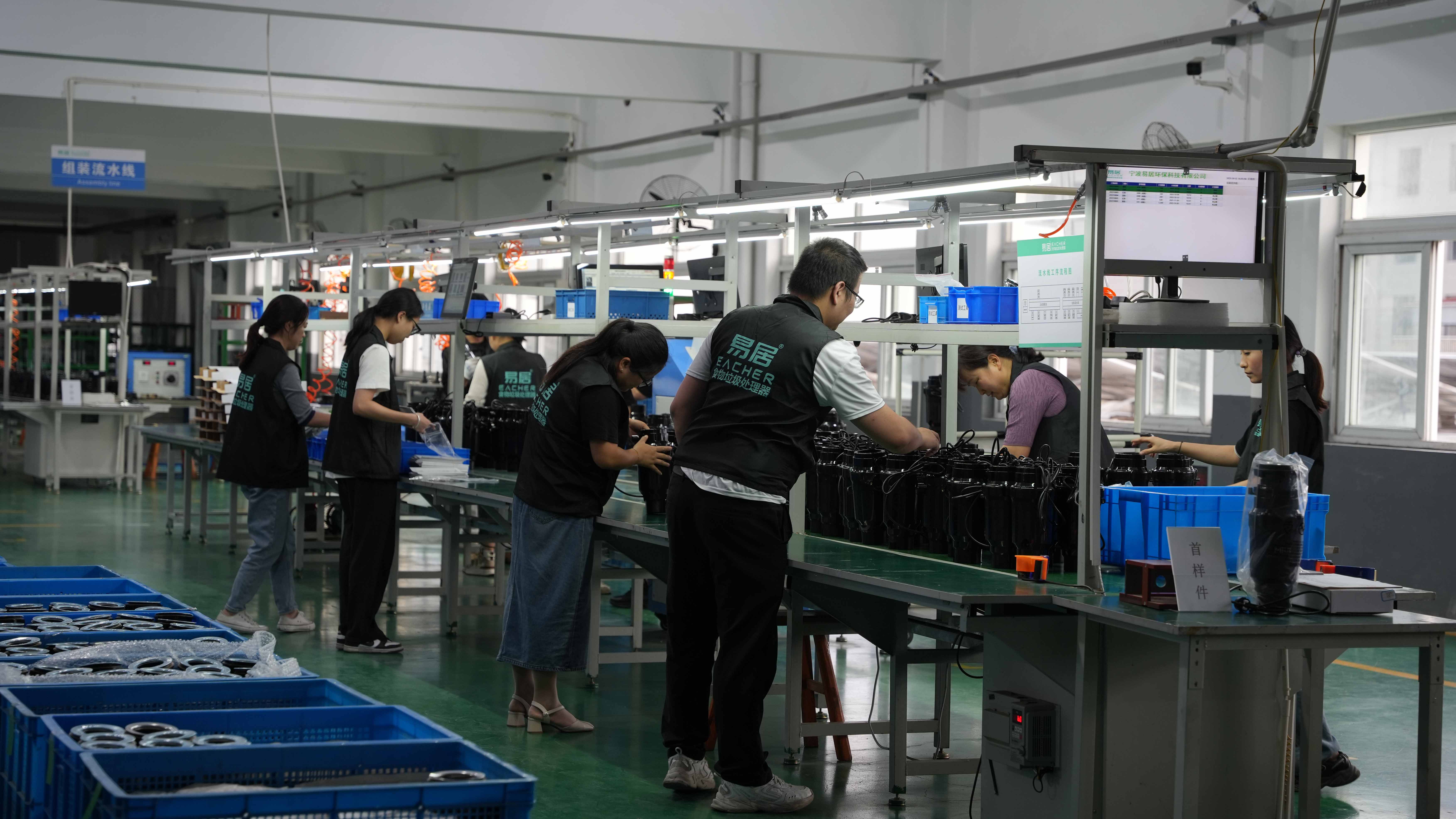 ALT: OEM ODM food waste disposer production line supporting customized European market entry strategies
Common Questions
Q1: How do European plumbing codes affect food waste disposer installation?
European plumbing codes vary by country and often specify narrower waste pipe diameters, different trap configurations, and restrictions on what municipal sewage systems can accept compared to other regions. Buyers should confirm local code compatibility before finalizing a disposer configuration, since mismatches between unit design and building plumbing are among the most common causes of installation delays and customer complaints in this market.
Q2: Is OEM/ODM manufacturing a viable route for launching a private-label disposer brand in Europe?
Yes, OEM/ODM manufacturing is a widely used route for brand owners entering the European kitchen appliance market without operating their own factories. Working with an established manufacturer, such as EACHER, allows brand owners to specify branding, packaging, and technical configuration while relying on the manufacturer's existing production expertise, which reduces the capital and technical risk of building manufacturing capability from scratch.
Q3: How long does it typically take to adapt a disposer product line for a new European market?
Timelines vary depending on how much customization is required, but adapting an existing configuration for a new market generally takes longer when full country-specific certification and installation testing are involved, compared to markets where an existing configuration already meets local requirements. Buyers should build this variability into launch planning rather than assuming a uniform rollout timeline across all target countries.
Summary
Europe's food waste disposer market this quarter is defined less by a single growth number and more by increasing fragmentation across regulatory, plumbing, and distribution-channel lines, all layered on top of genuinely rising underlying demand for at-source food waste solutions.
Regulatory pressure on food waste diversion is a primary driver of renewed disposer demand across EU member states, though it applies unevenly by country.
Plumbing infrastructure variance across Europe is one of the most underestimated risks in product specification and installation planning.
Consumer expectations around sustainability documentation are rising, making substantiated environmental claims a competitive differentiator rather than an optional marketing add-on.
Staged market entry, starting with a standardized configuration and evolving toward country-specific variants, consistently reduces risk compared to committing fully to either a single pan-European SKU or full customization from day one.
Manufacturing partners offering flexibility across both intelligent brushless variable-frequency and brushed DC product lines are best positioned to support brand owners navigating this fragmented demand landscape.
Buyers and brand owners who want to act on these trends without absorbing unnecessary risk should begin by aligning product specifications with a chosen entry market's plumbing and regulatory requirements, then work with a manufacturing partner capable of supporting configuration changes as the strategy matures.
Looking for a trusted manufacturing partner for food waste disposers? EACHER specializes in OEM/ODM production of intelligent brushless variable-frequency and brushed DC food waste disposers tailored to your brand's specifications. Visit the EACHER website today to discuss your custom manufacturing needs and discover how our expertise can help bring your product vision to life.
References
National Institutes of Health. "Has the COVID-19 pandemic changed food waste perception and behavior?".
https://pmc.ncbi.nlm.nih.gov/articles/PMC9751389/New Climate Economy / WRAP. "Strategies to achieve economic and environmental gains from reducing food waste".
https://newclimateeconomy.net/sites/default/files/2023-08/WRAP-NCE_Economic-environmental-gains-food-waste.pdfDataintelo. "Food and Beverage Packaging Market Report".
https://dataintelo.com/report/food-and-beverage-packaging-market
Note: Standards may be updated; please check the latest official documents or consult professional advisors.